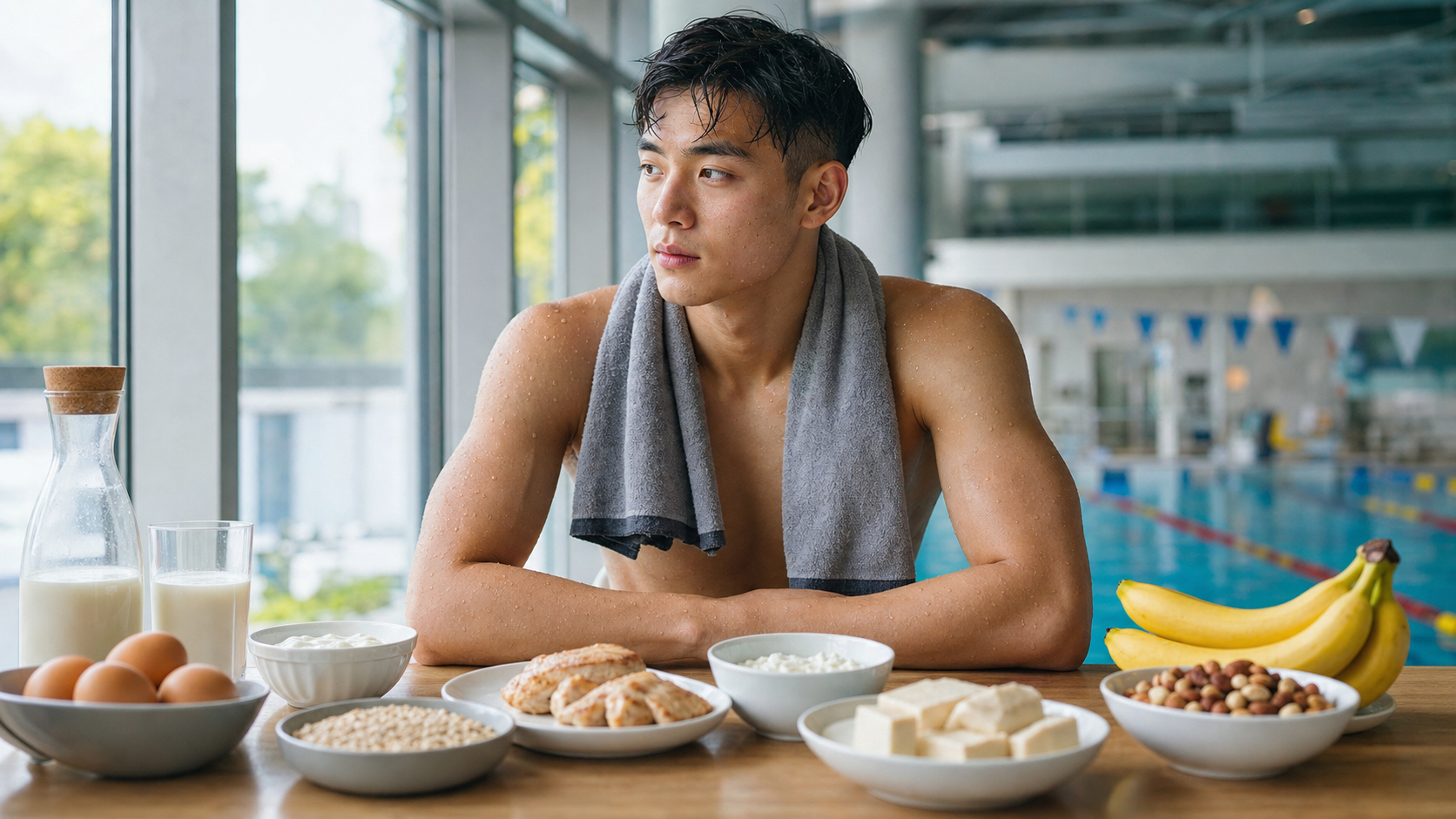
Introduction
Maximizing muscle protein synthesis (MPS) doesn’t depend solely on total daily protein intake—how protein is distributed across meals is equally critical. Research shows that consuming 20–40 grams of protein per meal maximally stimulates MPS, while concentrating the same amount of protein into a single meal is far less effective than spreading it evenly across three to five meals. For swimmers training daily, this distribution strategy directly impacts post-training recovery efficiency and the rate of muscular adaptation.
How Much Protein Do Swimmers Need?
Total Daily Requirements
Based on sports science research and recommendations from the International Society of Sports Nutrition (ISSN):
| Training Type | Daily Protein Requirement (per kg body weight) |
|---|---|
| General fitness swimming | 1.2–1.4 g/kg |
| Competitive swim training | 1.6–1.8 g/kg |
| High-intensity double-session periods | 1.8–2.0 g/kg |
| Muscle maintenance during weight loss | 2.0–2.4 g/kg |
Example calculation: A 70 kg competitive swimmer should consume 112–126 g of protein daily.
Why “20–40 g Per Meal”?
The leucine threshold required to stimulate MPS each time is approximately 2–3 g. Most protein sources providing 20 g of protein deliver sufficient leucine to trigger MPS. Beyond 40 g, the excess protein is primarily oxidized for energy rather than used for muscle synthesis, so it’s more efficient to allocate that amount to the next meal instead.
Daily Protein Distribution Strategies
Basic Distribution: Three Main Meals + Two Snacks
Using a 70 kg athlete with a daily target of 120 g protein as an example:
| Time | Meal | Protein Target | Food Examples |
|---|---|---|---|
| 7:00 AM | Breakfast | 25–30 g | 2 eggs + 300 mL low-fat milk + oatmeal |
| 10:00 AM | Immediate post-training | 25–30 g | 1.5 scoops whey protein + banana |
| 12:30 PM | Lunch | 30–35 g | Chicken breast rice + tofu soup |
| 3:30 PM | Afternoon snack | 15–20 g | 400 mL unsweetened soy milk + a handful of nuts |
| 7:00 PM | Dinner | 25–30 g | Salmon + brown rice + vegetables |
Daily total: Approximately 120–145 g of protein, evenly distributed across five meals.
Pre-Sleep Protein: The Key to Overnight Muscle Synthesis
Research (Van Loon Lab, 2012) shows that consuming 40 g of casein (a slow-release protein) before bed provides a sustained supply of amino acids during sleep, significantly enhancing overnight MPS. This is particularly beneficial on double-training days or before competitions following heavy training sessions.
Practical options available in Taiwan:
- 2–3 slices of low-fat cheese (approximately 15–20 g protein)
- 100 g cottage cheese (approximately 12 g protein; available at some larger supermarkets in Taiwan)
- 30–40 g casein protein powder (available online or at fitness specialty stores)
- 200 g unsweetened Greek yogurt (approximately 18–20 g protein)
Strategic Use of Different Protein Sources
Post-Training: Prioritize Whey Protein
Whey protein is digested and absorbed most rapidly and contains approximately 11–13 g of leucine per 100 g, making it the optimal choice for stimulating MPS after training. If whey protein isn’t available, low-fat milk plus chicken breast can serve as a substitute.
Throughout the Day: Diversify Your Sources
Relying on a single protein source (such as chicken breast only) is not just monotonous—it may also lead to deficiencies in certain essential amino acids or micronutrients:
- Animal proteins: Complete essential amino acid profiles with high bioavailability (eggs, fish, beef, dairy)
- Legume proteins: Rich in fiber and phytochemicals, but lower in certain essential amino acids (tofu, soy milk, edamame)
- Combination strategy: Tofu + eggs, soy milk + oatmeal can achieve complementary effects
Challenges for Vegetarian Swimmers
Vegan athletes face the challenge of lower leucine density. Recommendations:
- Increase protein intake to 30–40 g per meal to achieve equivalent MPS stimulation
- Choose plant proteins with higher leucine content, such as pea protein and soy protein
- Supplement with essential amino acid (EAA) supplements as an adjunct
Common Mistakes and Corrections
Mistake 1: Concentrating protein at dinner
Taiwanese dietary habits often feature the largest meal of the day in the evening, but if breakfast and lunch are protein-deficient, the day’s MPS opportunities are wasted. Correction: Ensure at least 25 g of protein at breakfast.
Mistake 2: No protein supplementation after training
Swimmers often feel too fatigued to eat after swimming, or consider “just drinking a sports drink” as sufficient replenishment. Sports drinks contain virtually no protein and cannot initiate MPS. Correction: Keep protein foods in your training bag and prepare them before getting in the water.
Mistake 3: Protein intake drops significantly on rest days
Athletes diligently supplement on training days but neglect protein on rest days because “there’s no training.” In fact, muscle repair and adaptation primarily occur during the recovery period, making protein equally important on rest days.
Practical Recommendations
- Keep portable protein foods on hand: Hard-boiled eggs, low-fat cheese sticks, tea eggs, unsweetened soy milk, etc., for immediate consumption after training.
- Take advantage of convenience stores: Taiwan’s convenience stores offer a wide range of protein-rich foods, such as tea eggs, sliced chicken breast, and soy milk—great options for post-swim replenishment.
- Plan a weekly protein schedule: You don’t need to calculate precisely every day, but maintain a general awareness of balanced distribution throughout the week.
- Prioritize supplementation when training intensity is high, and shorten the interval between supplementation and other large meals.
Conclusion
The importance of protein for swimmers is beyond question, but “how to eat” and “when to eat” are just as important as “how much to eat.” By evenly distributing daily protein intake, seizing the golden post-training window, and leveraging the characteristics of different protein sources, swimmers can maximize muscle synthesis efficiency and turn every effort in the water into genuine performance gains.
Related Reading
- Protein Requirements for Swimmers: Recommended Intake per Kilogram of Body Weight
- Daily Protein Needs for Swimmers: Calculating Based on Body Weight and Training Volume
- Post-Swim Recovery Meals: Optimal Protein and Carbohydrate Combinations
- Protein Timing and Dosage: The 0.4 g/kg Per-Meal Muscle Synthesis Window
CT暗黑廚房) 車友必備 宇宙無敵鮮蚵湯 幫助訓練恢復 天然食補 好市多 超肥鮮蚵 破PR
7 年前
西進武嶺 免費訓練分析服務 Intervals | 練不夠還是練過頭?你哪一種類型選手?AI模型告訴你! | 備戰神器 | 公路車 訓練 | CT Yeh
4 年前
一日北高/長距離團騎 常見問題補充篇 / 組團或跟團的眉角 / 壯車友容易被瘦車友慢性拉爆 / 原來屁股痛可能是這個原因...? / 風場配速法 / 公路車 / CT Yeh
2 年前
一日北高常見問題大集合 | 攻略 | 路線 | 訓練 | 補給 | 自行車 單車 | 一日雙城 | 雙塔 | TWB北高360 | 屁股痛
6 年前
靠單車減肥35公斤 心得分享與整理
7 年前
16/02/16 - 夜訪中社路 緩慢進步中
10 年前
FTL 與 SYB 車隊專訪 西進武嶺 實用攻略分享! 2小時 如何練?!你不知道的眉角!新手準備武嶺必看 EP1 | 實力派女車友 | 精華版 | 公路車 | CTYeh
4 年前
滑雪新手們慘摔學習全紀錄(請開字幕),滑雪好好玩 | Snowboard + Ski | 岩原 スキー場 | 滑雪APP使用 | GoPro Max
6 年前