Introduction
In the analysis of swimming propulsion, one factor is widely underestimated: ankle flexibility. Research shows that for every 10-degree increase in ankle dorsiflexion range, freestyle flutter kick propulsion can improve by approximately 8–12%. Many swimmers train for years yet see their performance plateau; one reason is overly tight ankles, which limit the effective propulsive surface area of the kick.
This article analyzes the relationship between the ankle joint and kick propulsion from a biomechanical perspective, and provides a concrete, actionable training plan for flexibility and elastic tendon strength.
The Role of the Ankle Joint in the Flutter Kick
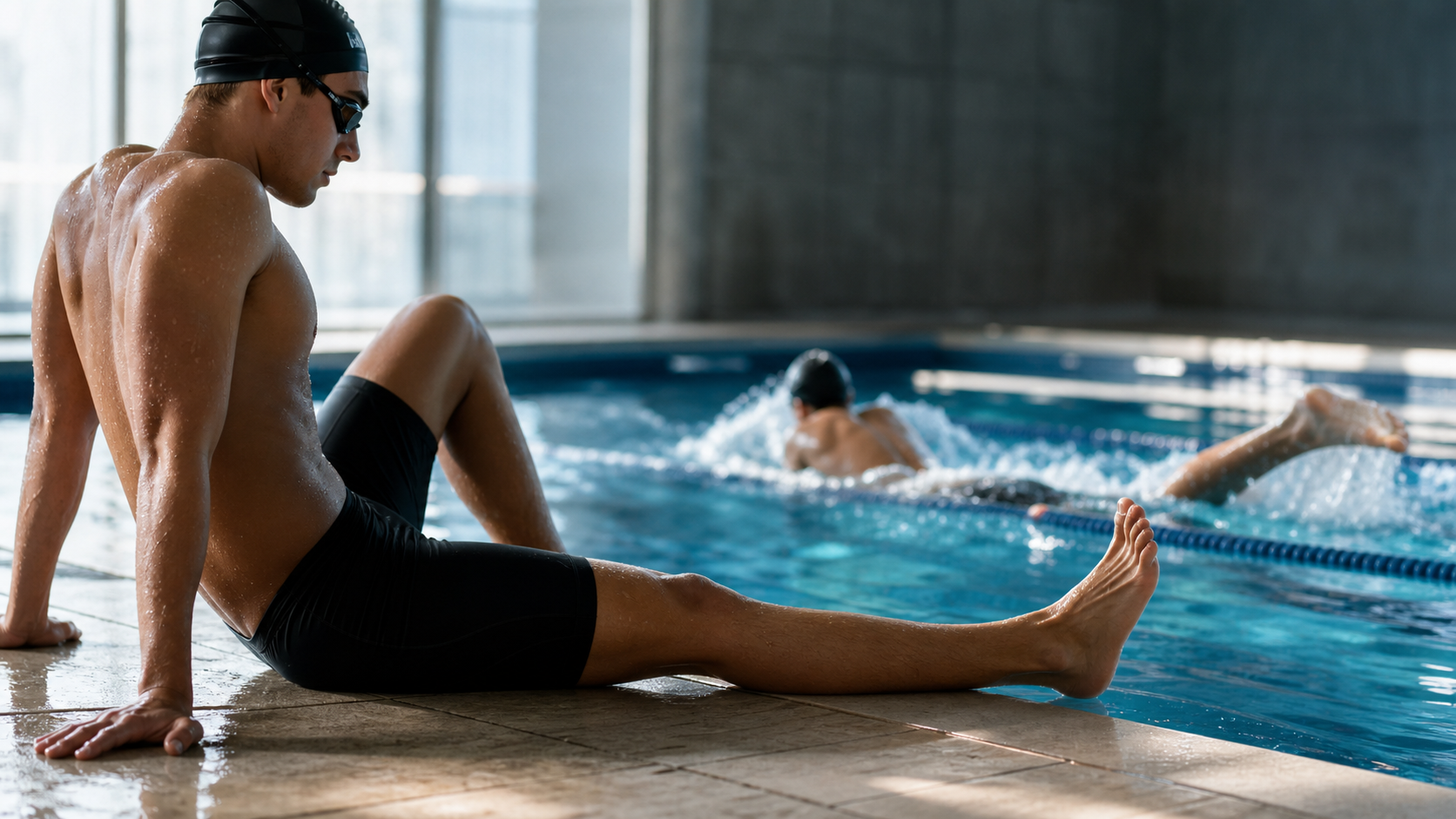
The freestyle flutter kick is a whip-like undulating movement powered by the hips. In this motion, the ankle joint acts as the “terminal amplifier”:
- Ideal state: The ankle can fully plantarflex (pointing the toes downward), maximizing the foot’s surface area for applying force to the water, resulting in high propulsive efficiency
- Overly tight state: The ankle remains in excessive dorsiflexion (toes pointing forward or even upward), reducing the foot’s surface area; the kick becomes “slapping” the water rather than “pushing” it, and propulsion drops significantly
Ankle Range of Motion Standards
| Range of Motion | Assessment | Impact on Swimming Kick |
|---|---|---|
| Plantarflexion > 50 degrees | Excellent | Ample propulsion, effective foot usage |
| Plantarflexion 40–50 degrees | Good | Kick efficiency 80–90% |
| Plantarflexion 30–40 degrees | Fair | Kick efficiency 60–75%, room for improvement |
| Plantarflexion < 30 degrees | Needs improvement | Kick efficiency < 60%, significantly limits speed |
Self-Assessment Test
Sit on the floor with your legs extended. Have someone measure the angle between the sole of your foot and the floor (vertical line) when you press your toes downward as far as possible—this is your plantarflexion angle. Most non-swimmer athletes have a plantarflexion angle between 30–40 degrees.
Ankle Flexibility Training Methods
Static Stretching (Daily Essential)
Kneeling Ankle Stretch:
- Kneel on a yoga mat with the tops of your feet flat on the floor
- Slowly shift your body weight backward toward your heels (increasing pressure on the tops of your feet)
- Hold for 30 seconds, repeat 3 times
- Feel the stretch along the front of the foot (anterior ankle)
Standing Ankle Circles:
- Stand on one leg, lifting the other foot
- Make large circular motions with the ankle (10 times clockwise, 10 times counterclockwise)
- Switch legs and repeat
Dynamic Mobility (Pre-Training Warm-Up)
Heel Raises:
- Stand with both feet, slowly rise onto your toes to the highest point, then slowly lower
- 3 sets × 15 reps, emphasizing the “lowering” phase where the heels fully touch the ground and go slightly past the normal position
Resistance Band Plantarflexion:
- Seated, loop a resistance band around the ball of your foot
- Perform plantarflexion (pressing the toes downward) against the band’s resistance
- 3 sets × 20 reps, strengthening the muscles around the ankle joint
Elastic Tendon Strength Training
Ankle propulsion comes not only from muscle strength but also from “elastic tendon strength”—the Achilles tendon stores elastic energy during the upward phase of the kick and rapidly releases it during the downward phase, generating additional propulsion.
Plyometric Training
Jump Rope: The simplest and most effective ankle elasticity training
- 3 times per week, 10–15 minutes per session
- Focus on the springiness of the ankles, not on jumping with the knees
Frog Jump:
- Feet together, perform 10 consecutive forward frog jumps
- Emphasize ankle elasticity during both takeoff and landing
- 3 sets, 60 seconds rest between sets
Calf Jump:
- Hands on hips, perform small hops using only ankle elasticity (feet not fully leaving the ground)
- 10 seconds of fast jumping, 3 sets
In-Water Training Integration
After improving ankle flexibility, the brain needs to “relearn” how to kick with a more flexible ankle:
- Kickboard Drills: Use a kickboard to focus on kicking, feeling how greater plantarflexion affects propulsion
- Vertical Kicking: In deep water, cross your arms over your chest and use only your legs to keep your head above water; this drill directly demonstrates how ankle flexibility affects buoyancy (propulsion)
- Contrast Swimming: Immediately after doing ankle stretches on land, swim 50 meters and compare the feeling to your usual experience
Practical Recommendations
- Improving ankle flexibility requires 4–8 weeks of consistent stretching; don’t rush the process
- If you have old injuries (ankle sprains, Achilles tendon issues), consult a physical therapist before stretching
- Wearing shoes that restrict ankle movement, such as slippers or flip-flops, will gradually reduce ankle flexibility over time
- Self-test your plantarflexion angle once a month to track progress
Conclusion
Ankle flexibility is the most overlooked factor in swimming propulsion, yet it is also one of the most directly impactful to improve. Through daily static stretching, dynamic mobility work, and elastic tendon strength training, combined with in-water sensory integration drills, most swimmers can feel a noticeable improvement in kick efficiency within 6–8 weeks. This is a training investment that requires almost no additional pool time yet delivers tangible speed gains.
Related Reading
- Flexibility Training for Swimming: The Impact of Ankle and Shoulder Range of Motion on Kicking and Pulling
- Swimming Kick Power: A Guide to Calf Flexibility Training
- Flexibility Programs for Swimmers: Systematic Training for Ankles, Shoulders, and Thoracic Spine
- Flexibility Training for Swimmers: Ankle, Shoulder, and Thoracic Spine Range of Motion
西進武嶺 免費訓練分析服務 Intervals | 練不夠還是練過頭?你哪一種類型選手?AI模型告訴你! | 備戰神器 | 公路車 訓練 | CT Yeh
4 年前
CT 喇低賽) 武嶺牽車 才是王道 西進牽車四小時內秘訣 攝手位置 如何判斷 防抽筋小秘訣
7 年前
[教學] Premiere 影片 手震 修正 教學 防抖 單眼 影像 GoPro 穩定 Video Stabilization
8 年前
一起升級!海鷗盃LSD團練...JJSC Zone2招待 騎到手抖 / 公路車 / CT Yeh
2 天前
白沙屯媽祖進香在家走!UREVO 坡度自調走步機 / 可連接訓練遊戲APP MyWhoosh / 邊看直播邊走起來 / CT Yeh
11 個月前
洗單車神器 吹水機! 實際洗車用用看 暴力洗鍊條大法 | 公路車 | CT Yeh
4 年前
#公路車 #西進武嶺 配速配瓦實驗 坡度分析 四小時內攻略 建大盃 NeverStop #西進武嶺攻略
6 年前
西進武嶺 8000名單車友數據分析 PART1 | 從新手到高手數量/瓦數/推力比/FTP推力比/功率計使用率 大解析 | 公路車 | CTYeh
5 年前