Introduction
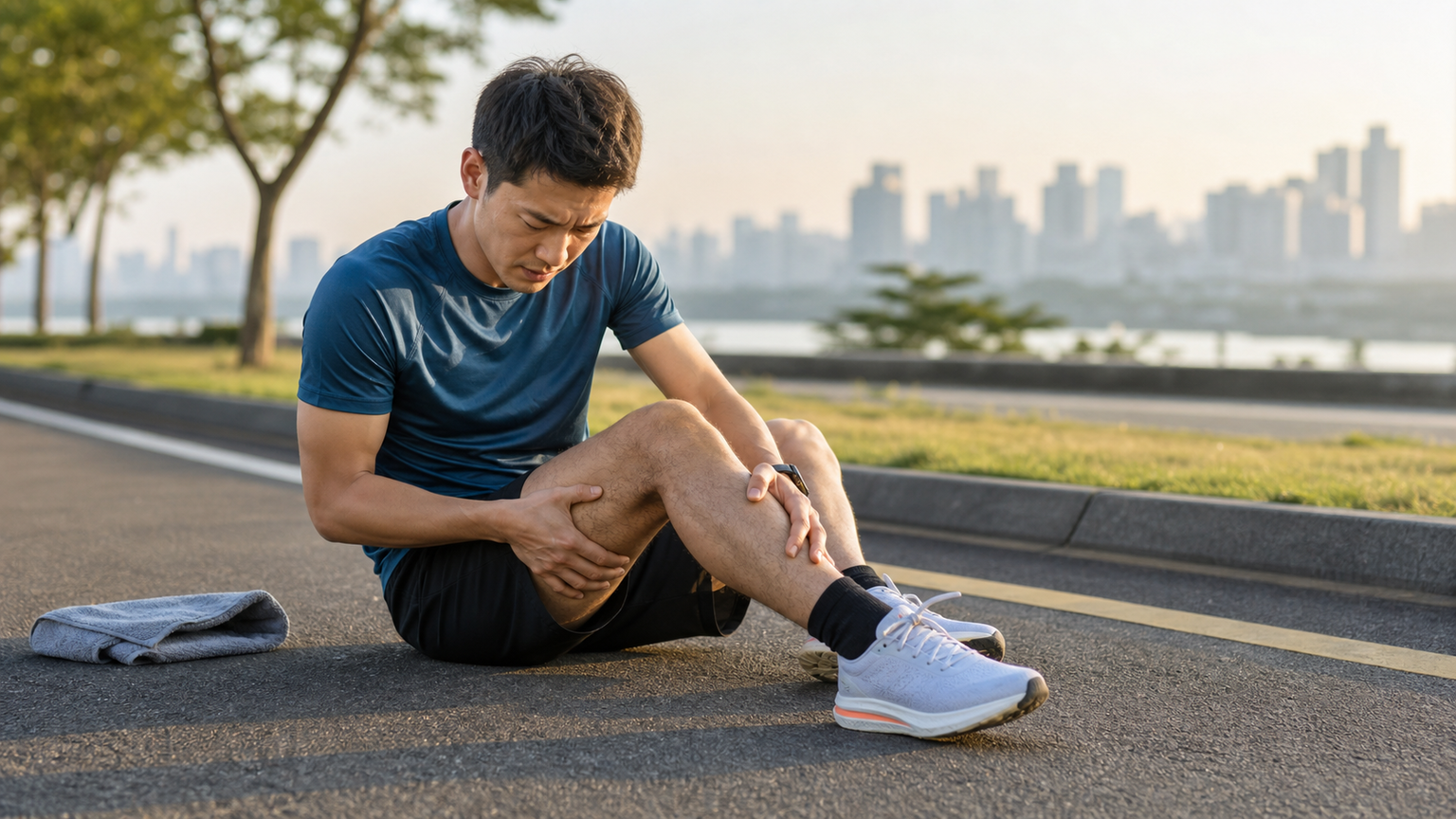
You went for your first run yesterday, and the moment your feet hit the ground this morning—your thighs are intensely sore, front and back. This “price of running” has a formal name: Delayed Onset Muscle Soreness (DOMS).
The good news: DOMS is not an injury; it’s a normal process of muscle adaptation. The bad news: there’s no method that can completely eliminate it, but several approaches can significantly speed up recovery.
What is DOMS and Why Does It Happen
The Scientific Explanation (Simplified)
DOMS occurs primarily because the muscles undergo eccentric contraction—that is, the muscle lengthens while under load. Running downhill and absorbing impact during landing both involve extensive eccentric contractions, which is why DOMS is especially pronounced after trail running or your first run.
Eccentric contractions cause micro-tears in muscle fibers, and the subsequent inflammatory response causes the soreness you feel. This process prompts the muscle fibers to rebuild thicker and stronger—it’s the fundamental mechanism behind muscle growth.
Important to know: Lactic acid is not the cause of DOMS. Lactic acid is metabolized and cleared within hours after exercise, while DOMS typically peaks 24 hours later.
The Typical DOMS Timeline
| Time | Status |
|---|---|
| 0-6 hours after exercise | Usually feels normal |
| 12-24 hours after exercise | Soreness begins to appear |
| 24-48 hours after exercise | Soreness peaks |
| 48-72 hours after exercise | Starts to subside |
| 3-5 days after exercise | Usually fully recovered |
Effective DOMS Management Methods (Evidence-Based)
Method 1: Active Recovery
Effectiveness: Moderate to good
Performing low-intensity activities (such as easy walking, slow swimming, or easy cycling) during the 2-3 days of soreness promotes blood circulation and accelerates the clearance of metabolic waste, leading to faster recovery than complete rest.
How to do it:
- Day 2 of soreness: Easy 30-40 minute walk
- Don’t run; keep the intensity genuinely low
- Swimming is an excellent active recovery option (community pools are widespread in Taiwan)
Method 2: Gentle Massage or Foam Rolling
Effectiveness: Moderate
Research shows that massage performed within 30 minutes after running can moderately reduce DOMS severity. Using a foam roller on your own has similar effects.
Foam rolling recommendations:
- Front of thighs (quadriceps): 30-60 seconds per side
- Back of thighs (hamstrings): 30 seconds per side
- Calves: 30 seconds per side
- Direction of pressure: roll back and forth along the long axis of the muscle
- Stop if you feel sharp pain
Method 3: Contrast Water Therapy or Cold Water Immersion
Effectiveness: Moderate (particularly helpful for reducing swelling)
Cold water immersion (water temperature around 10-15°C, soaking for 10-15 minutes), widely used by professional athletes, has been shown in studies to shorten recovery time. Home version: contrast showers (1 minute cold, 1 minute hot, repeated 5-6 times).
Method 4: Adequate Protein Intake
Effectiveness: Good
Muscle repair requires protein. Consuming 20-30 grams of protein within 30-60 minutes after running can accelerate muscle fiber repair. Reference to common foods in Taiwan:
| Food | Protein Content | Notes |
|---|---|---|
| Chicken breast, 100g | ~23g | Most efficient protein source |
| Soy milk, 500ml | ~15g | Readily available in Taiwan |
| 2 eggs | ~12g | Quick and convenient |
| 2 tea eggs | ~12g | Available at convenience stores |
| 1 can of tuna | ~20g | Convenient and inexpensive |
Method 5: Adequate Sleep
Effectiveness: Very important
Growth hormone is secreted most abundantly during deep sleep (NREM stage 3) and is key to muscle repair. Ensuring 7-9 hours of sleep after running is the most natural and effective recovery tool.
Methods with Uncertain Effectiveness (Common but with Limited Scientific Support)
- Static stretching: Post-run static stretching is not as effective for recovery as most people believe, though it can temporarily relieve tightness
- Ice packs (cold packs): Helpful for acute injuries, but evidence for their effect on DOMS is weak
- Pain relievers (e.g., acetaminophen): Can temporarily relieve symptoms, but may suppress the inflammatory response that promotes muscle adaptation; not recommended long-term
How to Reduce Future DOMS Severity
The “Repeated Bout Effect” is an interesting physiological phenomenon: if the same movement is performed a second time, the severity of DOMS is significantly reduced. This means:
- Regular training is the best prevention: The first run is painful, but after 3-4 consecutive runs, DOMS from the same training load decreases significantly
- Don’t run once and then take a long break before running again: An “all-or-nothing” training pattern makes every run feel like your first, keeping DOMS consistently severe
- Progressively increase training load: Follow the 10% rule to avoid sudden large increases in mileage that cause severe DOMS
Practical Tips
- Get a foam roller: Available from Taiwanese sports brands or online retailers for NT$500-1,000, it’s a worthwhile investment.
- Consume protein immediately after running: Make a glass of soy milk or tea eggs a regular part of your post-run routine.
- Light training is okay during DOMS: Moderate DOMS (pain level 2-4) doesn’t require complete cessation of exercise; light activity actually aids recovery.
- Stay hydrated during severe DOMS: Muscle cells need plenty of water during the repair process; ensure you drink at least 2,000ml of water daily.
Conclusion
DOMS is an inevitable companion on the road to running progress—behind every bout of soreness, stronger muscles are waiting. Learning proper recovery methods helps you bounce back faster from each training session and build a positive training rhythm.
Related Reading
- The Complete Guide to Preventing and Managing Running-Related Delayed Onset Muscle Soreness (DOMS)
- Muscle Damage and Repair After Road Running: A Scientific Analysis of DOMS
- Managing Post-Run Muscle Soreness: Causes of DOMS and Methods to Accelerate Recovery
- The Science of Post-Run Muscle Recovery: The Mechanisms of DOMS (Delayed Onset Muscle Soreness)
摔車後補裝備: 好市多新款單車安全帽& Specialized Romin 北高整路屁股都不痛的坐墊 | 一千元居然有MIPS | CT Yeh | 公路車
4 年前
一日北高/長距離團騎 常見問題補充篇 / 組團或跟團的眉角 / 壯車友容易被瘦車友慢性拉爆 / 原來屁股痛可能是這個原因...? / 風場配速法 / 公路車 / CT Yeh
2 年前
一日北高常見問題大集合 | 攻略 | 路線 | 訓練 | 補給 | 自行車 單車 | 一日雙城 | 雙塔 | TWB北高360 | 屁股痛
6 年前
西進武嶺 免費訓練分析服務 Intervals | 練不夠還是練過頭?你哪一種類型選手?AI模型告訴你! | 備戰神器 | 公路車 訓練 | CT Yeh
4 年前
Never Stop 西進武嶺 前後雙機 完整全程錄影 訓練台 實境
8 年前
單車 一日北高 ( 雙城 ) 肥宅雙人瘋狂行 紀錄片 REACTO
10 年前
車錶新黑馬? / 超狂續航 / 超好用錶冠 / 無敵準定位 / Dash圖表合成!?/ COROS DURA 評測!/ 公路車 / CT Yeh
2 年前
FTL 與 SYB 車隊專訪 西進武嶺 實用攻略分享! 2小時 如何練?!你不知道的眉角!新手準備武嶺必看 EP1 | 實力派女車友 | 精華版 | 公路車 | CTYeh
4 年前