Introduction
The explosive growth of Zwift during the pandemic, combined with Taiwan’s high-density urban environment, has made smart trainers and online virtual riding platforms the primary training option for many Taiwanese cyclists. However, the data quality of indoor training and its comparability to outdoor riding has always been an important topic of discussion in the sports science community. The power numbers look the same, but the riding feel differs noticeably from outdoor riding—what’s the reason behind this? Can the data be directly compared?
Power Accuracy of Indoor Trainers
Direct Drive vs. Wheel-on Smart Trainers
| Type | Representative Products | Power Accuracy | Advantages | Disadvantages |
|---|---|---|---|---|
| Direct Drive | Tacx Neo, Wahoo KICKR, Elite Direto | ±1–2% | High accuracy, no friction error | Higher price |
| Wheel-on | Tacx Vortex, Kinetic Road Machine | ±3–5% | Affordable | Tire pressure has significant impact, requires calibration |
| Virtual Power (Zwift Estimate) | Setups without a power meter | ±10–20% | Completely free | Worst accuracy, not recommended for training analysis |
Modern direct-drive smart trainers achieve a power accuracy of ±1–2%, outperforming some commercially available pedal-based power meters (approximately ±2–3%), making them a reliable source of power data.
Key Differences Between Indoor and Outdoor Training
1. Fundamental Differences in Cooling Environment
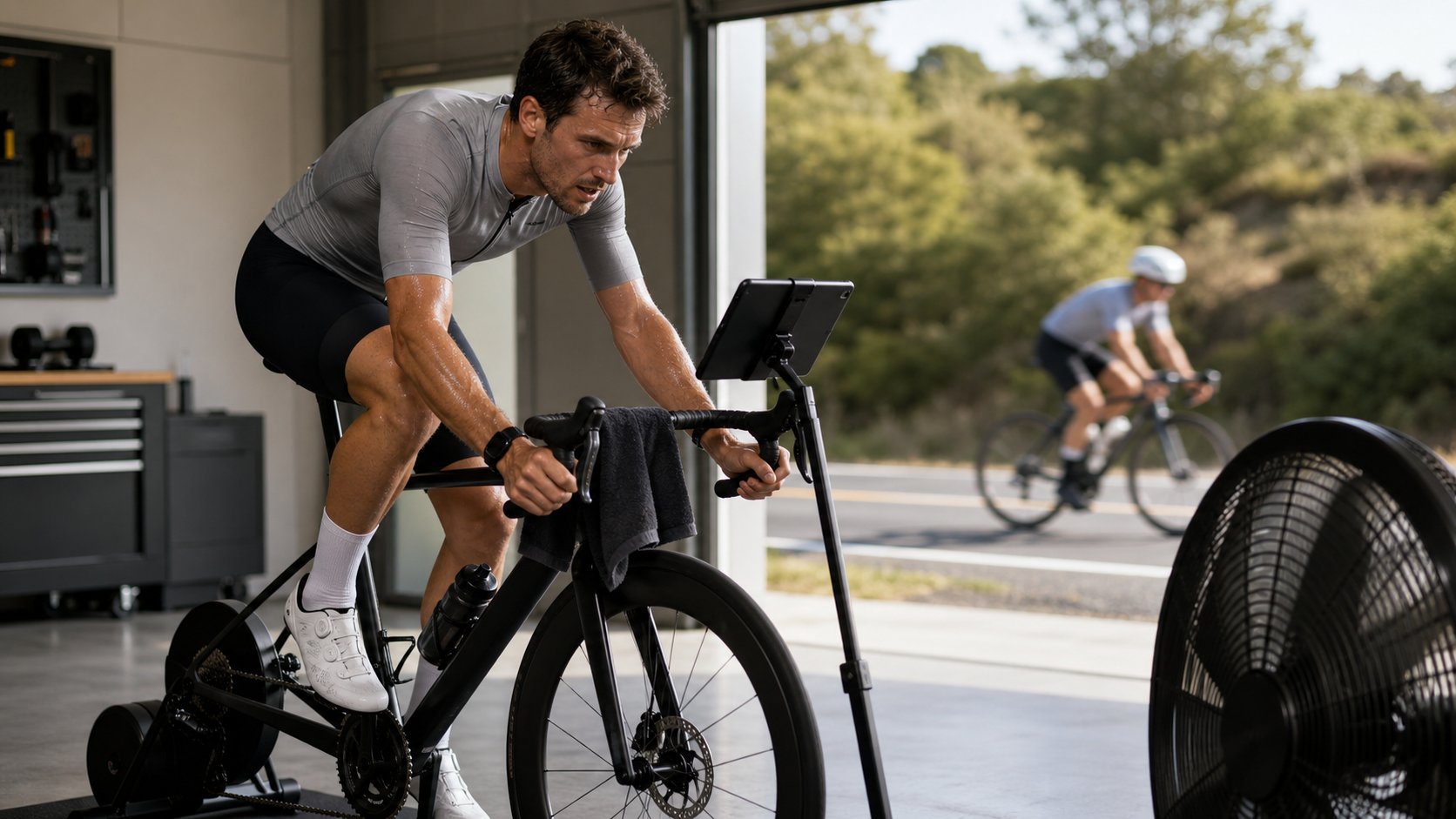
This is the most important difference between indoor and outdoor training. When riding outdoors, the forced convection from forward speed effectively dissipates body heat; during indoor stationary riding, this cooling mechanism is almost non-existent. Even with a fan, the effect is far inferior to outdoor conditions.
Impact: At the same power output, indoor heart rate is typically 5–15 bpm higher than outdoors, core temperature rises faster, fatigue is more pronounced, and sustainable duration is shorter.
Countermeasures: For indoor training, use a powerful industrial fan (high CFM rating) directed at the neck and chest; use air conditioning in summer to lower room temperature; consider using cooling towels.
2. Differences in Pedaling Dynamics
When riding outdoors, the bike sways slightly forward and backward due to gradient changes and road surface variations, allowing the rider’s center of gravity to shift more naturally with each pedal stroke. Indoor trainers completely fix the bike, eliminating this natural dynamic, resulting in:
- Different saddle pressure distribution (saddle soreness may occur in different areas)
- Pedal Smoothness scores are typically slightly lower on fixed trainers
- Slightly different engagement patterns of the core muscles
Countermeasures: Using trainers with lateral sway functionality (such as the Tacx Neo 2T or Wahoo KICKR MOVE), or pairing with a rocker plate, can partially alleviate this issue.
3. Inertia Differences in Gradient Simulation
When climbing in real life, wheel speed is slow and the inertia provided by the flywheel weight is small; when descending, speed is high and inertia is large, allowing for low power output while maintaining smooth pedaling. The flywheel inertia simulation on smart trainers may be overly responsive or insufficiently realistic in certain settings, resulting in a pedaling feel that differs from outdoor riding, especially during high-gradient simulations.
4. Zwift’s Gamified Power Adjustments (ERG Mode vs. SIM Mode)
ERG Mode: The trainer automatically adjusts resistance to maintain a set power output, unaffected by gear ratios. Suitable for structured training workouts, but the pedaling feel is “controlled,” differing from free pedaling outdoors.
SIM Mode (Simulation Mode): The trainer adjusts resistance based on the gradient of the Zwift map, closer to the outdoor riding feel, but power output is entirely controlled by the rider.
Differences in Indoor vs. Outdoor FTP
Many cyclists find that FTP measured on Zwift is 3–8% lower than outdoors. The main reasons:
- Insufficient cooling: Higher heart rate, feeling more fatigued, tendency to back off early
- Lack of psychological stimulation: Outdoors offers scenery, road conditions, and competitors; indoors can feel monotonous, resulting in lower psychological drive
- Trainer calibration issues: Some trainers show increased error at high power outputs (especially wheel-on models)
Recommendation: Do not directly use Zwift FTP as the FTP baseline for outdoor training. Instead, conduct a separate test outdoors (or with a precisely calibrated power meter).
Data Advantages of Indoor Training
Although there are differences between indoor and outdoor training, indoor training also offers unique data advantages:
- High structured execution rate: ERG mode ensures every interval is executed at precise power targets, with data consistency far superior to outdoor riding
- No traffic interruptions: Data is continuous, with no power interruptions from stopping at red lights
- Accurate TSS calculation: Workouts are executed exactly as designed, making TSS more accurate
- Cleaner power data: No power spikes and noise from road undulations
Special Considerations for Indoor Training in Taiwan
Indoor temperatures in Taiwan are generally high in summer. From July to September, training environments without air conditioning can reach room temperatures above 35°C, making the indoor-outdoor differences even more extreme. Recommendations:
- Always use air conditioning for summer indoor training (set to 20–22°C)
- Prepare at least 750ml of water and replenish every 15 minutes
- Target power for summer indoor training can be reduced by 5–8% compared to normal
Practical Recommendations
- Use the same trainer for FTP tests consistently: Different devices have different power baselines; ensure before-and-after comparisons use the same equipment.
- Use trainer values for indoor workouts and power meter values for outdoor rides: Avoid mixing two data systems; track trends separately.
- ERG mode for training, SIM mode for race simulation: Use SIM mode for Zwift races or group rides for a more realistic feel; use ERG mode for Z2–Z4 interval training for higher execution quality.
- Add a “room temperature” note to indoor data: This helps with post-hoc interpretation of elevated heart rate or lower power output.
- Rainy season or heavy air pollution periods are prime time for indoor training: Taiwan’s plum rain season (May–June) and winter air pollution (December–February) are the best times for systematic indoor training—no need to force outdoor rides.
Conclusion
Zwift and smart trainers have become indispensable training tools for urban cyclists in Taiwan, but their data is not directly equivalent to outdoor data. Understanding the systematic differences between indoor and outdoor training—especially cooling and pedaling dynamics—allows you to integrate both types of training data more accurately. Indoor training data quality has clear advantages in structured workout execution. As long as you prepare properly in terms of equipment calibration and environmental control, it can fully serve as the core tool for scientific training to improve cycling performance.
Related Reading
- Indoor Trainer Power Workouts: A Comparison of Structured Training on Zwift and TrainerRoad
- The Impact of Taiwan’s Zwift League on Training Quality: A Study on the Relationship Between Indoor Training and Outdoor Performance
- The Complete Guide to Stationary Trainers: Zwift vs TrainerRoad Comparison
- Indoor Training Platform Showdown: An In-Depth Comparison of Zwift vs Wahoo SYSTM vs TrainerRoad
訓練台體驗) 2019台北自行車展 三大家 訓練台體驗 Tacx Neo Flux 2 Xepdo Apx Wahoo Kickr
7 年前
RAMP FTP Test 直播 究竟能撐到幾瓦 訓練台 Gravat Zwift
6 年前
元宇宙單車運動!智騎 X7 Pro 智能訓練台 ThinkRider 居家線上練功
5 年前
安裝) 超酷! RGT Cycling 最新 訓練台 騎乘軟體 模擬一級賽經典路線 選手 Road Grand Tours 安裝教學 Zwift 替代方案
7 年前
2021 Apple TV 4K 讓你在家騎單車 | Zwift 和 Rouvy 測試 | 影音畫質屌打其他設備 | 公路車 | 訓練台必備
5 年前
2022台北國際自行車展 訓練台 試騎心得大全 差點腿軟走出! 元宇宙武嶺!| Garmin Tacx Oreka Xpedo Wahoo | 公路車 | CT Yeh
4 年前
Zwift 元宇宙單車世界 如何與全世界同步騎車運動
6 年前
ThinkRider 智騎 XXPRO 訓練台,高階機種功能 只要 1/3價格!? 實測功率對比、噪音實測 / 公路車 / CT Yeh
1 年前