Introduction
Heart rate and power are the two most commonly used physiological metrics in cycling training, but both have their limitations: heart rate lags and is influenced by emotions; power only reflects mechanical output and does not directly tell you the physiological state of your muscles. Muscle Oxygen Saturation (SmO2) monitoring provides a third dimension—it directly measures the real-time oxygenation status in the working muscle groups, reflecting muscular metabolic stress earlier and more precisely. The Moxy Monitor is currently the most widely used commercial SmO2 sensor. This article will introduce its principles and practical applications in cycling training.
The Physiological Significance of SmO2
What is SmO2
SmO2 is a sports application of Near-Infrared Spectroscopy (NIRS) technology. The sensor emits near-infrared light at specific wavelengths that penetrates the skin and muscle tissue, and calculates the proportion of oxygenated hemoglobin in the muscle based on how hemoglobin absorbs light.
Physiological states represented by SmO2:
- High SmO2 (70–95%): Adequate muscle oxygen supply, smooth aerobic metabolism
- Moderate SmO2 (40–70%): Increased oxygen consumption, gradually rising metabolic stress
- Low SmO2 (< 40%): Oxygen supply cannot keep up with consumption, increased anaerobic metabolism involvement
- Resting SmO2: Varies by individual, typically 65–85%
SmO2 vs. Heart Rate vs. Power
| Metric | Response Speed | What It Measures | Limitations |
|---|---|---|---|
| Power (W) | Instant | Mechanical output | Does not reflect physiological state |
| Heart Rate (bpm) | 30–60 second delay | Cardiopulmonary demand | Heavily influenced by emotion/temperature |
| SmO2 (%) | Instant (2–3 seconds) | Real-time muscle oxygenation | Localized measurement, requires correct placement |
How to Use the Moxy Monitor
Placement
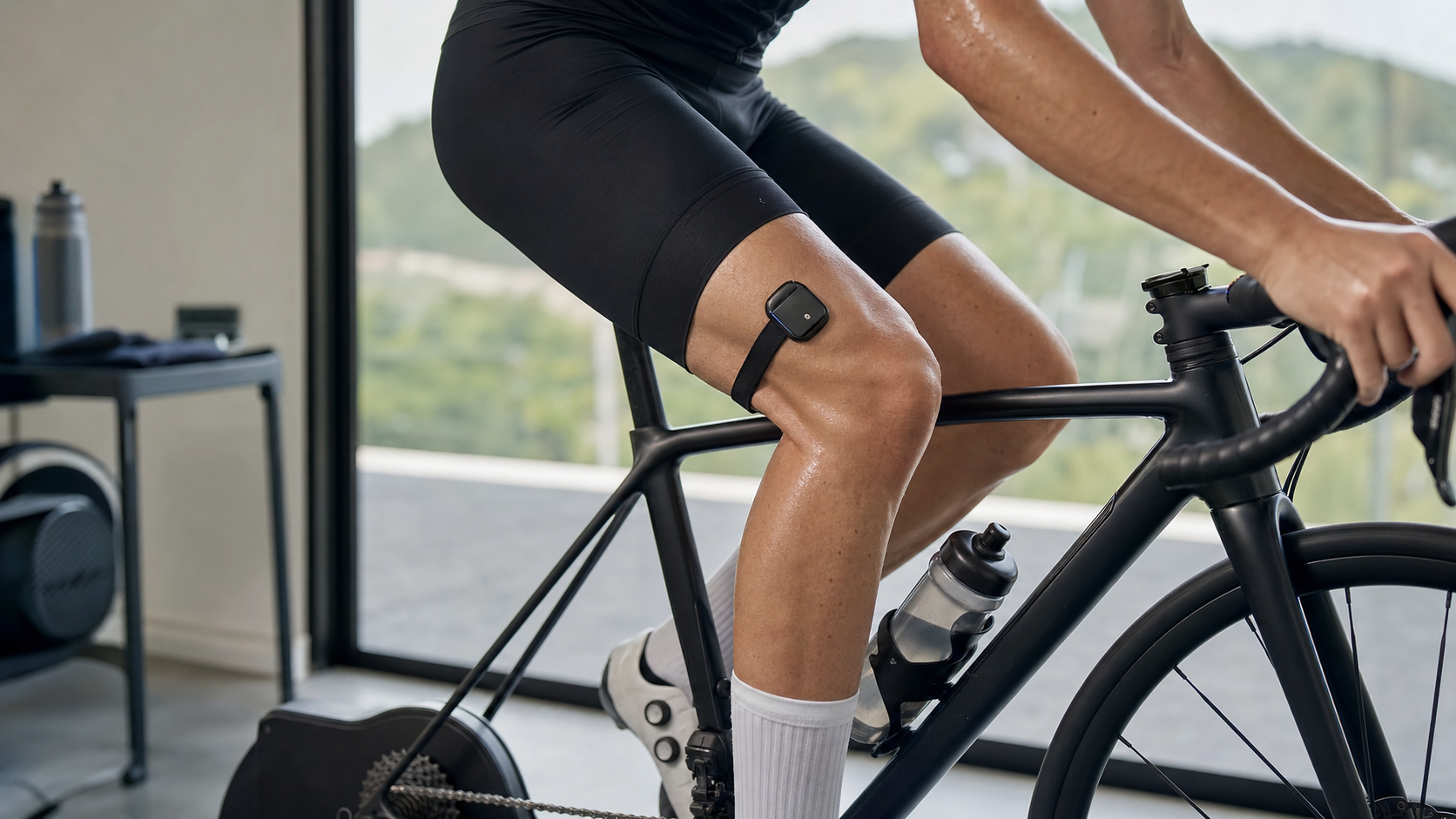
In cycling training, the Moxy sensor is most commonly placed on the quadriceps (outer thigh) or gastrocnemius (calf). The quadriceps are the primary working muscles during pedaling and represent the most indicative monitoring site. Use sports tape (such as Tegaderm or Hypafix) to secure the sensor to the skin, ensuring proper adhesion.
Data Synchronization
The Moxy Monitor syncs with bike computers (Garmin Edge, Wahoo ELEMNT) via ANT+ or Bluetooth, allowing real-time SmO2 values to be displayed on the head unit while also being recorded in the activity file for post-ride analysis.
Applications of SmO2 in Training Zone Determination
Minimum Blood Oxygen Saturation Test (MOXY 5-1-5 Test)
The 5-1-5 test is the most commonly used method in Moxy training methodology for determining individualized thresholds:
Protocol:
- Ride at a fixed power for 5 minutes (starting at a lower intensity)
- Rest for 1 minute (observe SmO2 rebound speed)
- Increase power and ride for 5 minutes
- Repeat until SmO2 drops and fails to rebound (i.e., muscle oxygen supply is fully saturated by consumption)
Interpretation:
- Identify the power point where SmO2 drops and fails to fully recover after 1 minute of rest → corresponds to LT2 (threshold)
- Identify the power point where SmO2 barely drops during exercise → corresponds to LT1 (aerobic threshold)
Real-Time Training Zone Monitoring
During Zone 2 aerobic riding, SmO2 should remain relatively stable (decline of < 10–15%). If SmO2 continues to trend downward, it means the intensity has exceeded the aerobic threshold and power should be reduced.
| Training Zone | Expected SmO2 Behavior |
|---|---|
| Zone 1 (Recovery) | SmO2 slightly decreases or holds steady, rebounds quickly after rest |
| Zone 2 (Aerobic Base) | SmO2 declines slowly and steadily, rebounds quickly after exercise |
| Zones 3–4 (Tempo/Threshold) | SmO2 drops noticeably, takes several minutes to rebound after rest |
| Zone 5 (VO2max) | SmO2 rapidly drops to a low point, extremely high metabolic stress |
| Sprint | SmO2 plummets rapidly, may briefly rebound afterward (surge in blood flow) |
Advanced SmO2 Application: Diagnosing Muscular Asymmetry
By placing one Moxy sensor on each thigh simultaneously, you can diagnose left-right pedaling force asymmetry (Pedal Asymmetry). If SmO2 on one side drops noticeably faster than the other, it indicates that side’s muscles are under higher metabolic stress, which may be related to asymmetrical pedaling technique or past injuries. This application is particularly valuable for riders with old knee injuries or hip issues.
Cost and Practical Considerations of the Moxy Monitor
- Equipment cost: A single Moxy Monitor costs approximately US$800–1,000 (around NT$25,000–30,000 through Taiwan distributors), making it relatively expensive
- Learning curve: SmO2 data interpretation is more complex than heart rate and requires a learning period
- Skin thickness effects: NIRS signals may be attenuated in areas with more subcutaneous fat, affecting data quality
- Moxy is not needed in every scenario: For most amateur riders, a power meter + heart rate strap is sufficient; Moxy is primarily for serious riders and coaches seeking more refined training monitoring
Alternative: Proxy Metrics Using Garmin HRV and Firstbeat
Riders who cannot afford a Moxy can partially replicate SmO2 functionality through the following proxy metrics:
- Power:Heart Rate Decoupling (Pw:HR Decoupling): Indirectly reflects whether aerobic metabolism is stable
- Training Effect: Garmin’s aerobic/anaerobic training effect scores
- Ventilatory Threshold Testing: Estimate LT1 via the talk test (Ventilatory Threshold Talk Test)
Practical Recommendations
- Use SmO2 as a complement to “power + heart rate,” not a replacement: Combining all three yields the greatest benefit; SmO2 fills the gap that heart rate cannot reflect in real time.
- Learn your personal SmO2 baseline in a fixed trainer environment first: Outdoor riding is affected by movement and leg position changes; indoor fixed trainers make it easier to establish stable SmO2 baseline values.
- Focus on “trend direction” rather than “absolute values”: SmO2 varies greatly between individuals (some rest at 75%, others at 90%); tracking your own trends is more meaningful than comparing with others.
- Avoid applying lotion before testing: Oils or lotions on the skin surface can affect the optical sensor’s signal quality.
- Work with a coach or sports scientist for interpretation: SmO2 data interpretation is relatively complex; beginners are advised to seek a coach with MOXY training experience to help design training plans.
Conclusion
Muscle oxygenation monitoring represents the cutting edge of cycling training data analysis, evolving training from “how many watts did I produce” to “what is the oxygen status of my muscles right now.” For Taiwanese riders pursuing precision training, SmO2 technology is worth paying attention to. Even though the current price of Moxy makes it an unaffordable tool for everyone, understanding the physiological logic behind it can deepen your interpretation of power and heart rate data, enabling you to design more effective training plans.
Related Reading
- The Future of Wearable Lactate Sensors: How Real-Time Metabolic Monitoring Can Change Training
- Muscle Oxygen Monitoring SmO2 Technology: New Applications of Near-Infrared Spectroscopy in Training
- VO2max: The Most Important Aerobic Metric for Cyclists
- Cycling VO2max Testing: A Comparison of the Laboratory Gold Standard and Field Testing
#公路車 #Vo2Max #最大攝氧量 測驗 體驗 | 心肺測試
6 年前
多機位拍片神器 DJI Action 2 拍出速度張力感 | 類空拍機視角 4陣列麥克風超強降風噪 實測! | 公路車 | CT Yeh
3 年前
2026 車錶排行榜!誰是最多車友正在使用?練家子最愛哪款?🏆 (2萬名車友數據) / 公路車 / CT Yeh
5 個月前
西進武嶺 免費訓練分析服務 Intervals | 練不夠還是練過頭?你哪一種類型選手?AI模型告訴你! | 備戰神器 | 公路車 訓練 | CT Yeh
4 年前
DJI Osmo Action 4 / 單車運動攝影最佳選擇!比賽 2.5 H 續航測試 / 超強夜拍 / 墾丁&日本實地拍攝測試! GoPero / 公路車 / CT Yeh
3 年前
再快都跟的上!? 單車跟隨攝影機之王 HOVERAir X1 PROMAX 全面實測 / 唯一!8K畫質&自行車專用模式和跟蹤信標&前後避障 / DJI Neo 可參考/ 公路車 / CT Yeh
1 年前
#公路車 #Fitting 靠人工智慧APP 幫你調整單車
6 年前
DJI Osmo Action 6 / 單車運動拍攝實用技巧 公路車 CT Yeh
7 個月前