Introduction
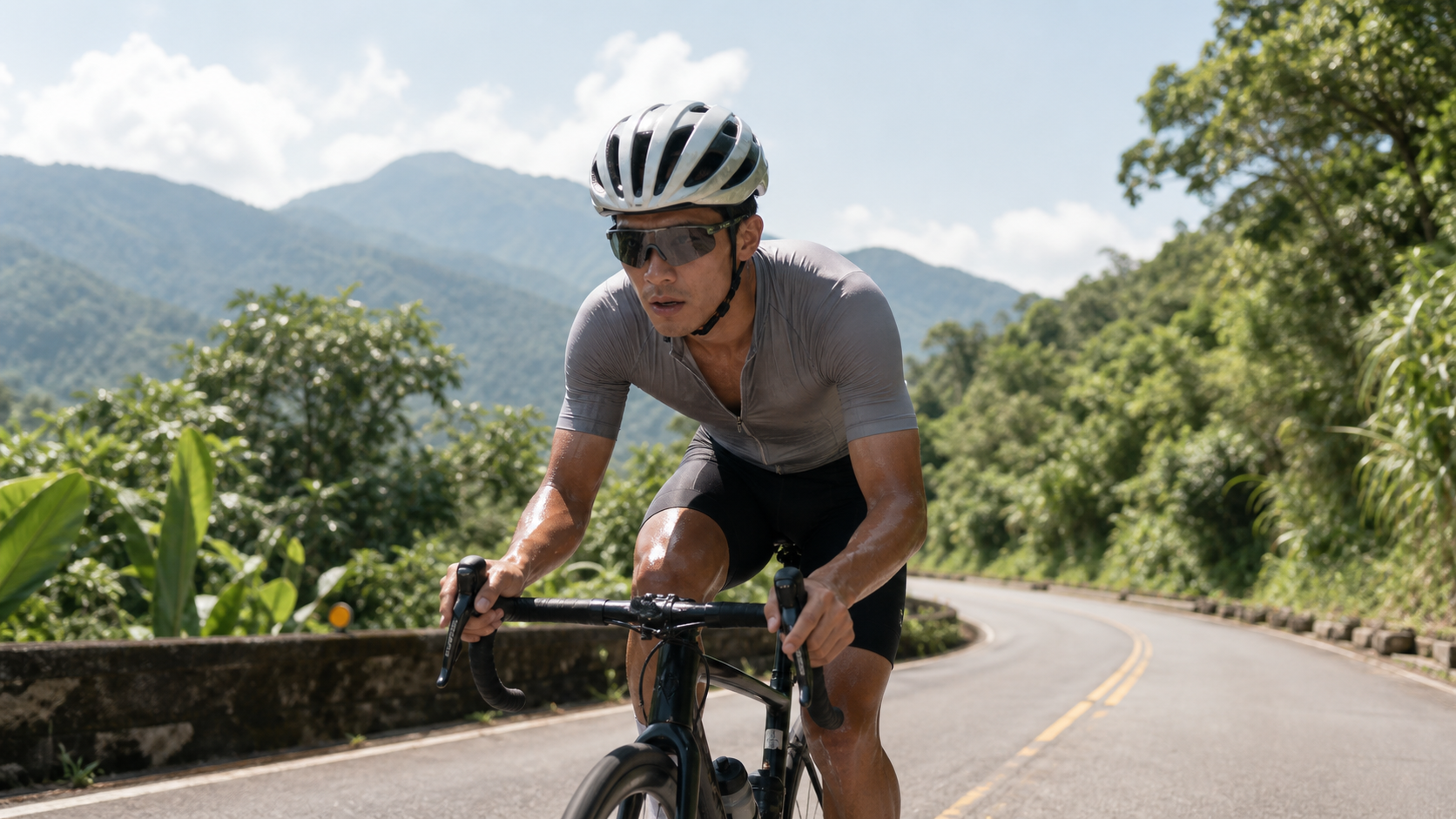
Summer in Taiwan poses a major challenge for cyclists. From July to September, lowland temperatures frequently exceed 35°C. Even at the same power output, a rider’s heart rate, perceived exertion, and actual performance differ drastically from cooler weather. Without understanding how temperature affects training data, seeing “unusually high heart rate and lower power than usual” in summer might be misread as a training regression or overtraining. This article breaks down the physiological mechanisms of riding in heat and provides practical power-correction strategies.
Physiological Effects of Heat on Cycling Performance
Cardiovascular Drift
In hot environments, the body must simultaneously:
- Deliver blood to muscles (providing oxygen and energy)
- Deliver blood to the skin (for heat dissipation)
These two demands compete for limited cardiac output, leading to “cardiovascular drift”: at a fixed power output, heart rate steadily rises over time, unlike in cooler weather where it remains stable. Research shows that at the same power output, heart rate differences between 25°C and 35°C environments can reach 10–20 bpm.
Mechanisms Behind Power Decline
The decline in power output in heat stems from several factors:
- Rising core temperature: Muscle efficiency decreases as body temperature rises; power output is noticeably impaired above 39.5°C
- Dehydration effects: Blood viscosity increases, cardiac output drops; losing 2% of body weight in water reduces aerobic capacity by roughly 4–8%
- Central nervous system inhibition: The brain actively limits exercise intensity to protect core temperature (central fatigue mechanism)
Quantifying Temperature’s Impact on Power
| Temperature (°C) | Power capacity relative to 20°C | Heart rate deviation |
|---|---|---|
| 20 | 100% (baseline) | Baseline |
| 25 | 98–99% | +3–5 bpm |
| 30 | 94–97% | +5–10 bpm |
| 35 | 88–93% | +10–15 bpm |
| 38+ | 80–88% | +15–20 bpm |
Note: These figures are general estimates; individual variation is significant. Riders who are well heat-acclimatized (after 8–14 days of training in hot conditions) show a markedly reduced impact.
Special Considerations for Summer Training in Taiwan
The Protective Effect of Altitude
Taiwan’s mountain roads offer a natural solution for summer training. Even when the lowlands hit 37°C, climbing to 1500m (such as above Pinglin on the Beiyi Highway, or the summit of Yangmingshan) drops the temperature by roughly 8–10°C, restoring power capacity to near-normal levels. Temperatures in Taiwan’s mountain areas are even lower between 5–8 AM, making this the golden window for high-quality summer training.
Taipei Basin’s “Urban Heat Island” Effect
Due to its enclosed terrain and dense buildings, Taipei Basin’s summer Heat Index (the effective temperature accounting for humidity) often runs 3–5°C higher than the actual air temperature, with perceived temperatures possibly reaching 40–42°C. Expecting yourself to hold your usual FTP in these conditions is unreasonable and carries health risks.
Power-Correction Strategies for Hot Weather
Lowering Target Power
For outdoor summer training, it’s recommended to adjust target power based on temperature:
Correction formula (simplified):
- Temperature ≤ 25°C: Target power = 100% of normal setting
- Temperature 26–30°C: Target power = 95% of normal setting
- Temperature 31–35°C: Target power = 88–92% of normal setting
- Temperature > 35°C: Switch to a “heart rate ceiling” to control intensity; do not force power targets
Example: A rider with an FTP of 280 W doing Sweet Spot training (normal target 85–95% FTP = 238–266 W) in 33°C conditions should lower the target to 210–240 W, using whether heart rate exceeds the threshold heart rate as the final deciding factor.
Using Heart Rate Instead of Power to Control Intensity
In hot conditions, “holding a fixed power” often drives heart rate steadily upward to dangerous levels. A better strategy is to set a heart rate ceiling and let power naturally drop to match cardiovascular load:
- Zone 2 heat-corrected heart rate ceiling = normal Zone 2 upper heart rate limit (unchanged, but allow power to drop)
- Observe the power–heart rate relationship and record “today’s power at 150 bpm”
- As heat acclimatization progresses, the power at the same heart rate gradually climbs back up—that’s the signal that adaptation is complete
The Importance of a Hydration Plan
During outdoor summer rides in Taiwan, sweat loss can reach 800–1500 ml per hour (depending on temperature, intensity, and individual differences). Recommendations:
| Ride duration | Hydration recommendations |
|---|---|
| < 60 minutes | Drink 200 ml every 15–20 minutes, with electrolytes |
| 60–120 minutes | Drink 250–350 ml every 20 minutes, with sodium, potassium, and magnesium electrolytes |
| > 120 minutes | In addition to fluids, replenish carbohydrates (30–60g per hour) and higher doses of electrolytes |
Drinking plain water without electrolytes after heavy sweating can lead to hyponatremia, a potential risk during long summer rides. Consider electrolyte tablets or sports drinks.
Heat Acclimatization Training
Planned heat acclimatization can help the body adapt to high temperatures within 8–14 days. Key physiological adaptations include: increased plasma volume (higher effective blood volume), earlier onset of sweating (cooling starts sooner), and lower electrolyte concentration in sweat (reduced electrolyte loss).
Suggested heat acclimatization protocol (for riders preparing for summer races):
- 10–14 consecutive days of 45–90 minutes of aerobic-intensity (Zone 2–3) outdoor training
- Choose a time of day with temperatures similar to race conditions
- After each session, core temperature should reach 38.5–39.5°C (feeling “hot but able to continue”)
- Replenish fluids and electrolytes immediately after training
How to Compare Summer and Winter Training Data Correctly
Do not directly compare times on the same route between summer (35°C) and winter (18°C); these data points cannot be compared due to environmental factors. The correct approach for long-term tracking:
- Prioritize “year-over-year comparisons within the same season” (this July vs. last July)
- Record the temperature for every ride as background context for interpreting data
- Use power data rather than speed/time, which partially corrects for environmental effects
Practical Tips
- Check the day’s high temperature before heading out in summer, and adjust your target power in advance to avoid unknowingly burning yourself out.
- Cold towels / neck cooling: Apply a cold, wet towel to your neck before departure or at aid stations mid-ride to reduce perceived heat and delay heart rate drift.
- 5:00–7:00 AM is the golden window for outdoor summer training in Taiwan: Temperatures are typically 5–8°C lower than in the afternoon, and traffic is lighter, making it the best time for power quality.
- The cool period after typhoons in August–September is especially precious in Taiwan: Typhoons often bring 2–3 days of cooler weather (temperatures dropping below 28°C), a rare opportunity for high-quality outdoor training in late summer.
- In the heat, “finishing the ride” matters more than “hitting the power target”: Don’t force yourself just because you can’t reach your power goals. Once heat exhaustion sets in, recovery can take weeks.
Conclusion
Taiwan’s summer heat is an unavoidable environmental factor in cycling training. Understanding how temperature systematically affects power and heart rate, and shifting summer training goals from “producing your usual power” to “maintaining aerobic fitness while heat-acclimatizing,” is a smart training strategy. By temperature-correcting target power, refining hydration plans, and taking advantage of mountain mornings, Taiwanese riders can absolutely sustain high-quality training through the hot summer and prepare for the peak racing season in autumn and winter.
Related Reading
- Cardiopulmonary Stress of Riding in Hot Environments: Physiological Adaptation for Summer Training in Taiwan
- Cycling Heat Acclimatization Training: Coping Strategies for Taiwan’s Summer Heat
- Heat Acclimatization Training: Physiological Strategies to Improve Summer Cycling Performance in Taiwan
- The Impact of High Temperatures on Cycling Power Output: Power Decay Rate per 1°C Rise in Core Temperature
#公路車 #Fitting 靠人工智慧APP 幫你調整單車
6 年前
ThinkRider 智騎 XXPRO 訓練台,高階機種功能 只要 1/3價格!? 實測功率對比、噪音實測 / 公路車 / CT Yeh
1 年前
#公路車 #Vo2Max #最大攝氧量 測驗 體驗 | 心肺測試
6 年前
CT暗黑廚房) 車友必備 宇宙無敵鮮蚵湯 幫助訓練恢復 天然食補 好市多 超肥鮮蚵 破PR
7 年前
2025 自行車錶排行榜 兩萬車友大數據 / Garmin Bryton 排名會大洗牌嗎? / 全新的碼表前身分析 /公路車 / CT Yeh
1 年前
單車 一日北高 ( 雙城 ) 肥宅雙人瘋狂行 紀錄片 REACTO
10 年前
單車AI教練!全新 ChatGPT4o 幫你分析訓練成果!排武嶺課表,分析騎車姿勢! 太神了! / 公路車 / CT Yeh / feat. 緯緯
2 年前
靠單車減肥35公斤 心得分享與整理
7 年前