Introduction
Swimming is a full-body exercise, and after each training session, the shoulder girdle (deltoids, trapezius, pectoralis major, rotator cuff), back (latissimus dorsi, erector spinae), and legs (quadriceps, glutes, soleus) all bear considerable load. Muscle micro-damage, accumulation of lactate metabolic byproducts, and connective tissue tightness all need to be addressed through adequate recovery methods. Massage, as a recovery method with thousands of years of history, still holds a place in modern sports science, but to maximize its benefits, it is essential to understand the mechanisms behind it and the correct timing for its use.
Physiological Mechanisms of Sports Massage
The benefits of massage for muscle recovery come from the following physiological pathways:
Promoting Blood and Lymphatic Circulation
The mechanical pressure of massage can promote venous blood return, increase local microcirculation, accelerate the clearance of lactate and metabolic waste, while bringing in fresh oxygen and nutrients. The promotion of lymphatic circulation helps reduce post-training tissue edema and swelling.
Reducing Muscle Tightness and Tension
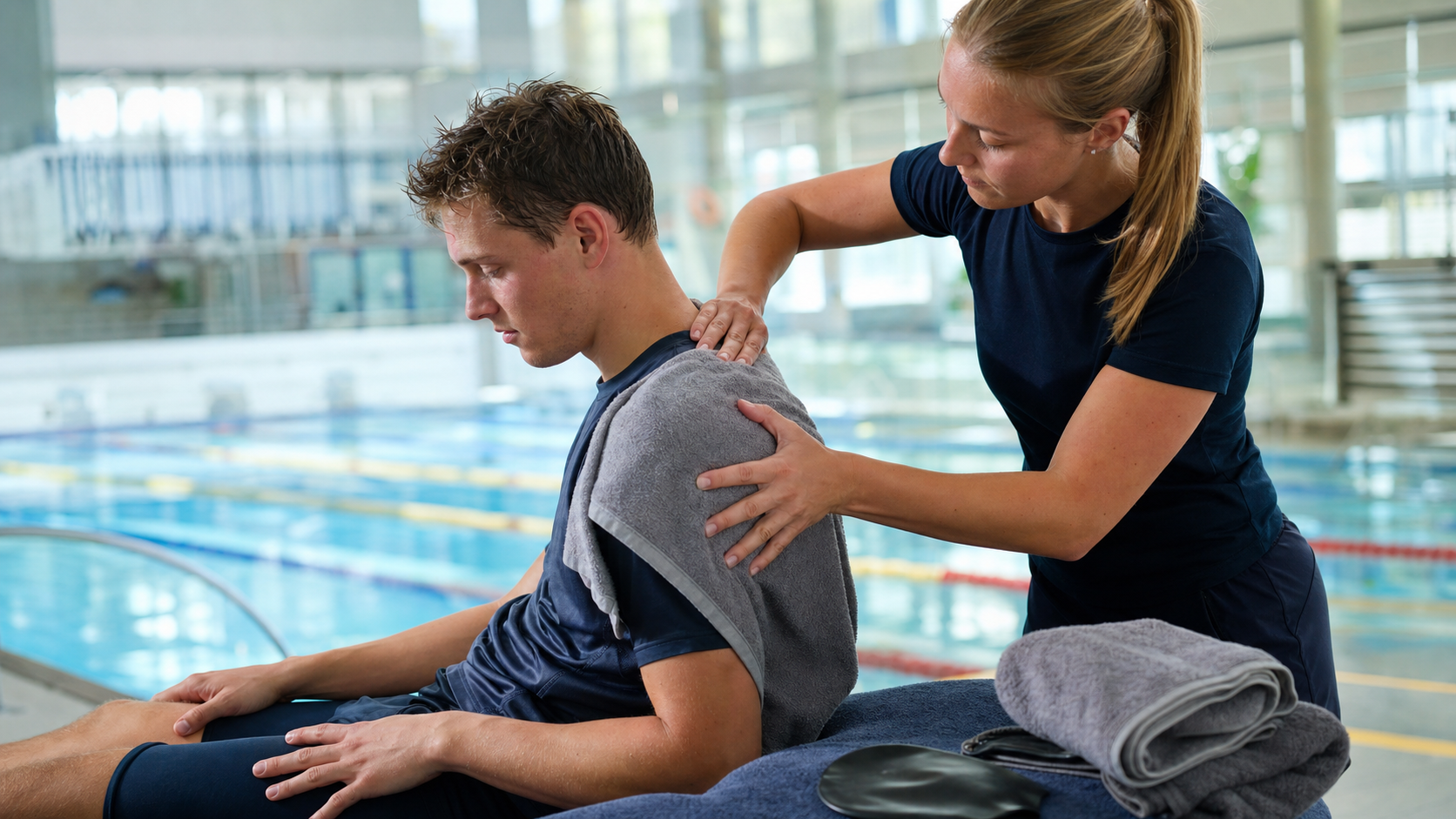
Deep tissue massage can break up “trigger points” in muscle fibers and connective tissue, relieving the state of sustained local muscle contraction and improving joint range of motion. This is particularly effective for the shoulder stiffness commonly seen in swimmers.
Neuromodulatory Effects
Massage stimulates cutaneous sensory receptors, reducing pain sensitivity through the nervous system (gate control theory), and activates the parasympathetic nervous system, lowering cortisol levels and promoting physical and mental relaxation.
Psychological Benefits
There is substantial evidence that massage can significantly reduce “perceived fatigue.” Even when the objective recovery level of the muscles differs little, athletes’ sense of being “ready” is markedly enhanced.
Comparison of Different Massage Techniques
| Technique Type | Primary Effects | Optimal Timing | Precautions |
|---|---|---|---|
| Swedish Massage | Full-body relaxation, promotes circulation | 24–48 hours post-training | Gentle pressure, suitable for fatigue recovery phase |
| Deep Tissue Massage | Relieves deep muscle tension | 48–72 hours post-training or on rest days | Immediate use after high-intensity sessions may worsen damage |
| Sports Massage | All phases: preparation, recovery, rehabilitation | Pre-race activation or post-race recovery | Pre-race massage should be lighter and quicker; post-race can be deeper |
| Myofascial Release | Releases fascial adhesions | Between training sessions | Apply slow, sustained pressure; do not use forceful kneading |
| Foam Rolling | Self-myofascial release | Before or after training | Avoid rolling directly over bones or joints |
Optimal Timing for Massage
Immediate Post-Training Massage: Use with Caution
During the 0–6 hours after high-intensity training, muscles are still in an acute inflammatory state, and tissue micro-damage has just begun to repair. Performing deep tissue massage with excessive intensity during this period may worsen tissue damage and delay recovery. If massage is performed during this window, choose gentle lymphatic drainage massage or light foam rolling.
24–48 Hours Post-Training: Optimal Timing
At 24–48 hours after training, the acute inflammatory phase gradually stabilizes and muscle repair enters an active phase. Moderate-intensity sports massage at this time can:
- Accelerate the clearance of metabolic waste
- Improve the severity of delayed onset muscle soreness (DOMS)
- Enhance readiness for the next training session
24–72 Hours Pre-Race: Activation-Style Light Massage
Pre-race massage should focus on light, superficial techniques, with the goal of activating neuromuscular responses and improving blood circulation, rather than deep relaxation. Keep the session to 15–20 minutes to avoid excessive muscle relaxation before competition (which may reduce explosive power).
Deep Maintenance During the Off-Season
The off-season after the competitive season ends is the optimal time for deep tissue massage and fascial system restructuring, allowing you to address chronic tightness and muscle imbalances accumulated throughout the season and prevent injuries in the upcoming season.
Key Massage Areas for Swimmers
Shoulder Girdle Region (Most Critical for Swimmers)
- Rotator cuff muscles (supraspinatus, infraspinatus, teres minor, subscapularis): The primary working muscles for freestyle pulling and a common source of swimmer’s shoulder issues. A massage therapist can apply deep point pressure to treat trigger points.
- Pectoralis minor and serratus anterior: Prone to tightness after prolonged training, restricting normal scapular movement. Can be released by rolling against a wall with a foam roller.
- Upper trapezius: An accessory muscle during pulling and a common site of tension accumulation.
Lower Back and Glutes
- The core rotational force generated by freestyle flip turns accumulates in the erector spinae of the lower back and the gluteus medius.
- The external rotation movement of breaststroke over long-term training may cause tightness in the piriformis, which can be released by side-sitting on a foam roller or tennis ball.
Calves and Plantar Region
- The impact of wall pushes, flip turns, and the plantarflexion motion of kicking can easily cause tightness in the posterior calf (gastrocnemius, soleus) and the plantar fascia.
- Pressing the soles of the feet with a tennis ball for 2–3 minutes daily is a low-cost self-maintenance practice.
Recommended Self-Myofascial Release Tools
| Tool | Target Area | Difficulty | Price |
|---|---|---|---|
| Foam Roller | Large muscle groups (back, legs) | Low | NT$300–1500 |
| Massage Ball (firm) | Around the scapulae, plantar region | Medium | NT$100–500 |
| Percussion Massage Gun | Full body, especially large muscle groups | Low | NT$1000–5000 |
| Massage Stick | Calves, front of thighs | Low | NT$200–800 |
Practical Recommendations
- Schedule one professional massage per week: If your budget allows, one moderate-intensity sports massage per week is the best maintenance for continuous training.
- Perform daily self-myofascial release: Spend 10–15 minutes on a foam roller after each training session to effectively prevent the accumulation of chronic tightness.
- Consume protein after massage: Massage promotes blood circulation; combining massage with protein intake after training can theoretically enhance amino acid delivery efficiency.
- Inform your massage therapist of your training status: Let the therapist know if you are on the second day post-training (DOMS peak) or after heavy lifting sessions so they can adjust the pressure accordingly.
Conclusion
Sports massage is an effective recovery tool in a swimmer’s arsenal, but its benefits depend on correct timing and proper technique application. Understanding the physiological mechanisms of each massage technique, the muscle tightness patterns specific to swimming, and when to use professional massage versus self-release tools will maximize the return on your recovery investment. Muscles grow during recovery, and massage is a powerful aid in accelerating that recovery.
Related Reading
- The Benefits of Massage for Running Recovery: Frequency and Effectiveness of Deep Tissue Massage
- The Effects of Massage on Road Running Recovery: Self-Massage vs. Professional Sports Massage Therapists
- Recovery Training for Swimmers: Easy Swimming, Deep Water Running, and Relaxation Techniques
- Swimming as Recovery Training: How to Use Aquatic Exercise to Promote Tissue Repair and Regeneration
[教學] Premiere 影片 手震 修正 教學 防抖 單眼 影像 GoPro 穩定 Video Stabilization
8 年前
如何把 GoPro 影片 翻轉 批次 轉正?
6 年前
CT暗黑廚房) 車友必備 宇宙無敵鮮蚵湯 幫助訓練恢復 天然食補 好市多 超肥鮮蚵 破PR
7 年前
一日北高/長距離團騎 常見問題補充篇 / 組團或跟團的眉角 / 壯車友容易被瘦車友慢性拉爆 / 原來屁股痛可能是這個原因...? / 風場配速法 / 公路車 / CT Yeh
2 年前
西進武嶺 免費訓練分析服務 Intervals | 練不夠還是練過頭?你哪一種類型選手?AI模型告訴你! | 備戰神器 | 公路車 訓練 | CT Yeh
4 年前
教學) 如何做出專業 慢動作 影片 Slow Motion 120fps GoPro 7 ActionCam AX700 A99II
7 年前
多機位拍片神器 DJI Action 2 拍出速度張力感 | 類空拍機視角 4陣列麥克風超強降風噪 實測! | 公路車 | CT Yeh
3 年前
DJI OSMO Action 3 新韌體超強! 2.5H續航!運動攝影新神器!超強快充!今年不換GoPro了🤣| 公路車 | CT Yeh
3 年前