Introduction
The Individual Time Trial (ITT) is a battle against time and the laws of physics. In this discipline, there are no teammates to draft behind and no group to shield you from the wind. Riders must maintain the optimal aerodynamic position while sustaining the highest power output for the longest duration. In Taiwan, time trials range from national road races to KOM time trial challenges across the island, each with different demands on riding position, but the core principles of aerodynamics are universal.
Fundamentals of Aerodynamics
CdA Value: Your Most Important “Performance Metric”
In time trials, the key physical parameter affecting speed is CdA (Coefficient of Drag × Frontal Area). The lower the CdA, the faster the speed at the same power output.
| CdA Range | Riding Type | Speed Impact |
|---|---|---|
| 0.18–0.22 | Professional time trial position | Optimized |
| 0.22–0.28 | Amateur time trial (adjusted) | Good |
| 0.28–0.35 | Road bike on drops | Average |
| 0.35–0.45 | On the hoods | Not for time trialing |
Practical significance: Reducing CdA from 0.30 to 0.25 can increase speed by approximately 1.5–2 km/h at 250W.
Setting the Forward Lean Angle
Three Levels of Torso Angle
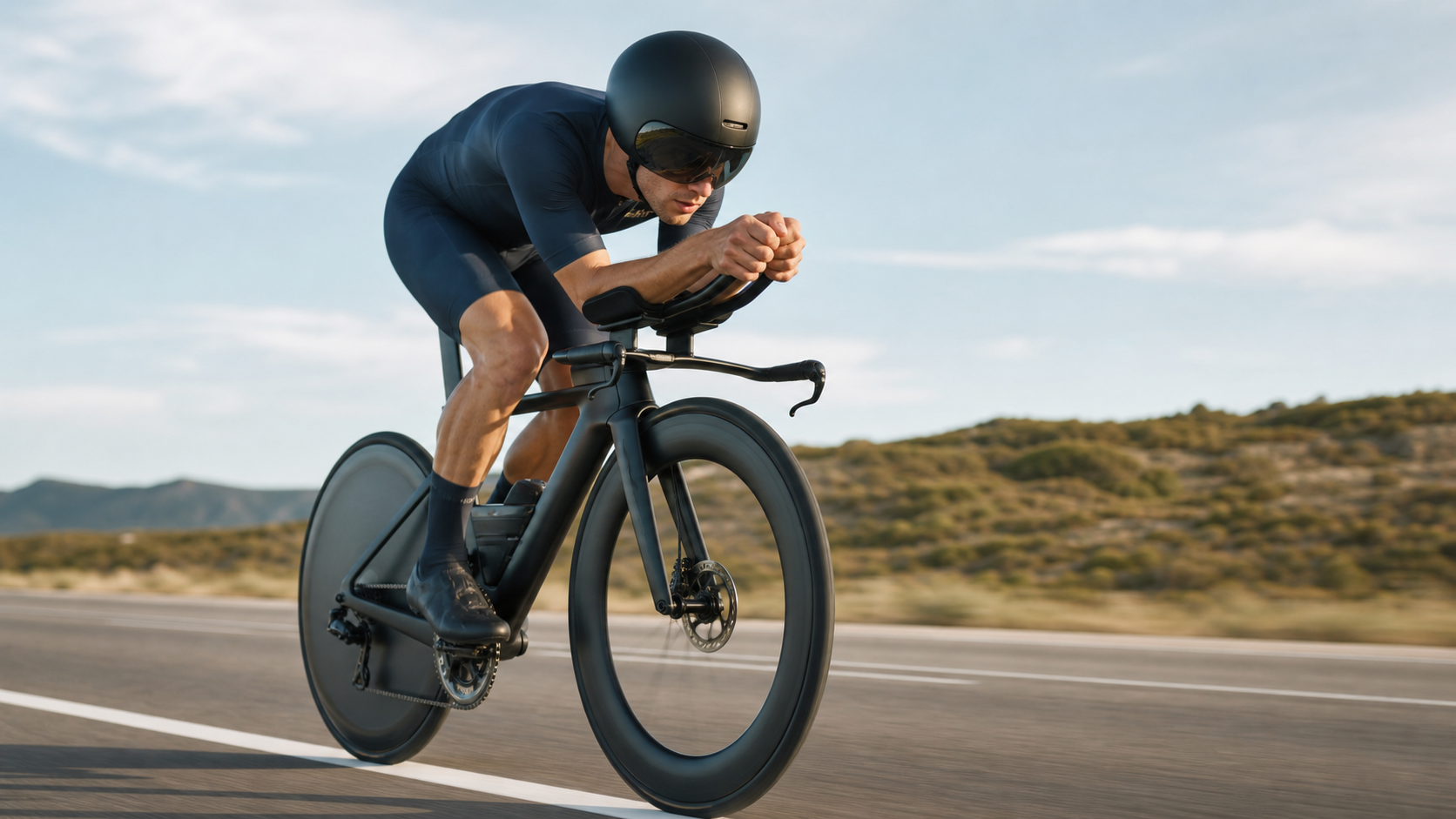
The torso forward lean angle (relative to the horizontal ground line) in time trials is the core of aerodynamics.
Level 1: 15–20 degrees (very aggressive)
- Suitable for riders with exceptional flexibility and strong back muscles
- Lowest CdA in wind tunnel testing
- Most riders cannot sustain this for long, and pedaling efficiency decreases
Level 2: 20–30 degrees (standard time trial position)
- Adopted by most professional time trialists
- Strikes a balance between aerodynamics and pedaling efficiency
- Requires good hip flexor flexibility
Level 3: 30–40 degrees (compromise position)
- Suitable for amateur riders with less flexibility
- Sacrifices some aerodynamic performance but maintains higher pedaling power
- For longer time trials (40km+), may yield better overall results
How to Find Your Optimal Angle
The ideal approach is to conduct a “self wind tunnel test”—try different angles on a trainer while recording:
- Subjective comfort at the same power output
- Pedaling stability after 5 minutes
- Whether you can maintain a consistent cadence (80–90rpm)
Key Settings for Elbow Support
Elbow Pad Width
The elbow pad width on a TT handlebar directly affects frontal area:
- Narrower than shoulder width (ideal): Elbows tucked in, reducing frontal area, but requires good scapular control
- Equal to shoulder width (standard): The most common setup, offering good stability
- Wider than shoulder width (not recommended): Increased frontal area, sacrificing aerodynamics
Recommendation: Start with a shoulder-width setup, then gradually try narrowing by 1cm to see if it affects pedaling smoothness.
Elbow Pad Height and Forearm Angle
The height of the elbow pads determines the pitch angle of the upper body and also affects the strain on the neck and back:
| Elbow Pad Height | Effect | Considerations |
|---|---|---|
| Below saddle height | More aggressive forward lean, lower CdA | May cause neck and hip flexor tension |
| Level with saddle height | Standard time trial setup | Starting point for most riders |
| Above saddle height | Higher upper body, slightly more relaxed | For long-distance time trials or those with limited flexibility |
Aerobar Extension Length
The length of the extensions determines hand position, which in turn affects grip posture and head position. Extensions that are too short force the upper body to rise; too long causes the body to lose stable support.
Basic measurement method: After assuming the time trial position, place your hands at the end of the extensions. Your upper arms should be naturally vertical or slightly angled forward, without any feeling of overreaching.
Aerodynamics of Head Position
The height and angle of the head significantly affect CdA, especially regarding helmet choice. In the time trial position:
- Keep the head as much as possible in line with the torso’s extension, reducing the “gooseneck” effect
- Use a TT helmet, which integrates the head and back into a streamlined shape
- Glasses should not protrude beyond the helmet; integrated glasses or visor designs are better
Practical Recommendations
- Regularly conduct self-assessments on a velodrome or trainer: Use your smartphone’s slow-motion feature to film your side profile, examining torso angle and elbow support.
- Flexibility training is essential: Perform hip flexor stretches and back extension exercises 2–3 times per week; this is the foundation for maintaining a time trial position.
- Position adaptation takes time: Do not make major position adjustments the week before a race; new positions require at least 2–4 weeks of adaptation.
- Prioritize sustainability: The most aggressive position does not equal the fastest result; the best position is one you can maintain for the entire event.
Conclusion
Setting up an aerodynamic time trial position is a highly individualized process that requires finding the optimal balance between aerodynamic benefit, pedaling power output, and long-duration sustainability. For Taiwanese riders, start by participating in local time trial challenges, accumulate experience in position adjustments in actual race environments, and gradually build your own optimal time trial setup—turning every watt of power into maximum speed advantage.
Related Reading
- Road Bike ITT Technical Analysis: Aero Position and Pacing
- The Complete Guide to Individual Time Trial Position and Pacing: Optimizing Wind Resistance, Power, and Psychology
- Advanced Cycling Aerodynamics: How to Quantify and Improve Your CdA
- Aerodynamics and Cycling Speed: The Impact of CdA Value, Position Adjustments, and Equipment
CT 喇低賽) 武嶺牽車 才是王道 西進牽車四小時內秘訣 攝手位置 如何判斷 防抽筋小秘訣
7 年前
西進武嶺 免費訓練分析服務 Intervals | 練不夠還是練過頭?你哪一種類型選手?AI模型告訴你! | 備戰神器 | 公路車 訓練 | CT Yeh
4 年前
西進武嶺各路段 前8000名 大數據分析 配速攻略/功率/心律/推力比/維持率/踏頻/踏瓦比/牽車率 大公開 | 建大盃 NeverStop 可參考 | 公路車 | CT Yeh
5 年前
西進武嶺 自製新版AI配速表產生器 x 賽前攻略 抱佛腳! 沒有功率計也可以產生配速表嗎?有什麼其他眉角賽前要注意的呢? | 西進武嶺 / 東進武嶺 KOM 攻略 | 公路車 | CT Yeh
4 年前
碟煞公路車 優缺點?換車一年半實際經驗分享 / 公路車 / CT Yeh
2 年前
一日北高/長距離團騎 常見問題補充篇 / 組團或跟團的眉角 / 壯車友容易被瘦車友慢性拉爆 / 原來屁股痛可能是這個原因...? / 風場配速法 / 公路車 / CT Yeh
2 年前
一日北高前的西濱集訓 | 跟著11小時軍團 | 300W踩不動的大逆風 | 輪車破風差幾瓦?
6 年前
風櫃嘴時間 預測西進武嶺時間?13000名車友統計數據分析告訴你 !
5 年前