Road Bike Night Riding Safety: Front and Rear Light Specifications, Reflective Gear, and Route Selection
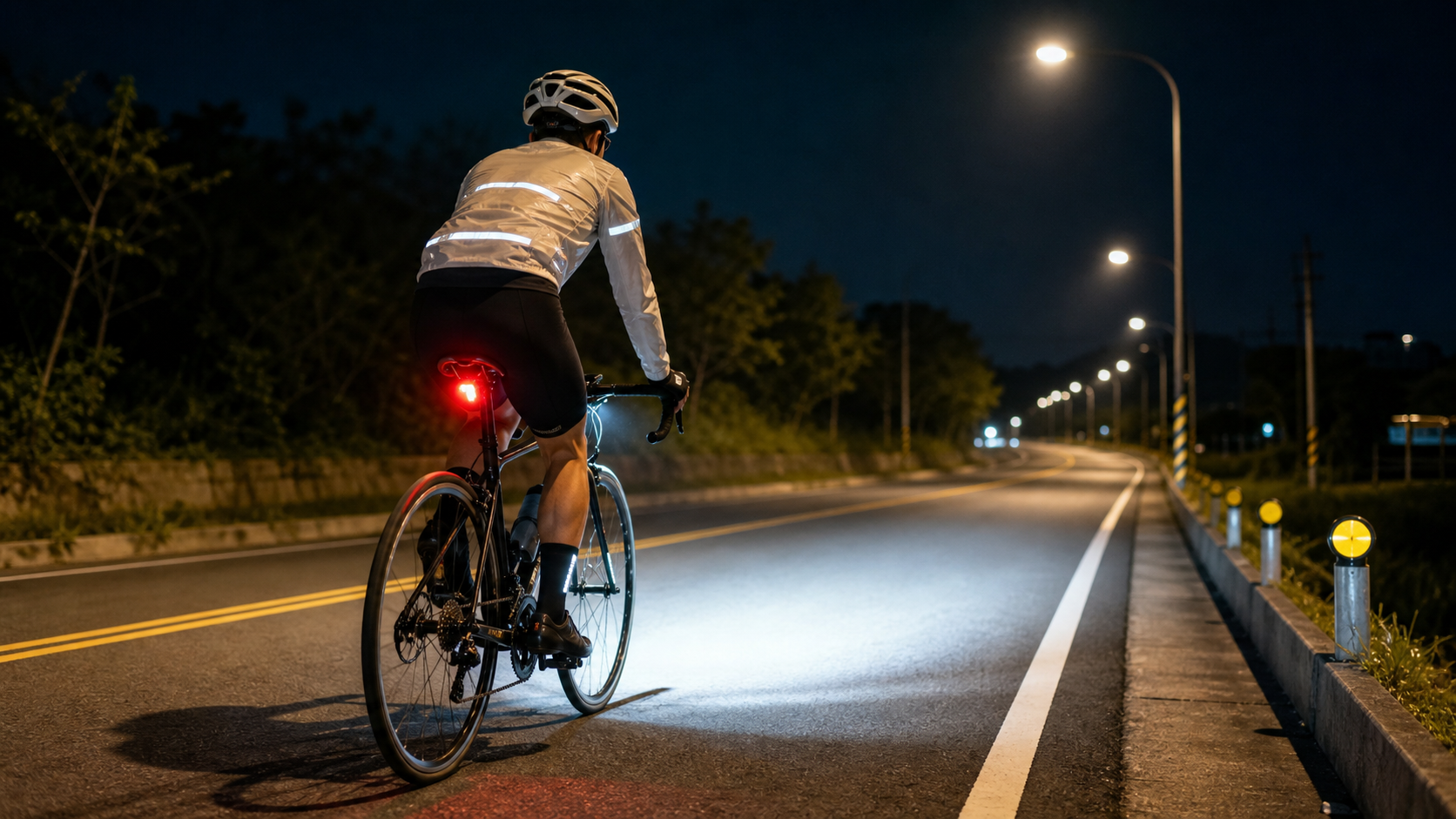
Introduction
Night riding after work is a daily choice for many Taiwanese commuter cyclists. The cooler temperatures and lighter traffic give night riding its unique appeal. However, reduced visibility, difficulty judging speeds, and more fatigued drivers make the risks of night riding far higher than daytime riding. According to Ministry of Transportation statistics, about 30% of bicycle accidents occur during periods of insufficient light.
This article provides a complete night-riding safety strategy, covering light specifications, reflective gear, clothing choices, and route planning.
Front Light Specifications
The Real Meaning of Lumens
Lights on the market are rated by “lumens” for brightness, but a higher lumen number isn’t always better—what matters is the beam shape and coverage area:
| Usage Scenario | Recommended Lumens | Special Requirements |
|---|---|---|
| City riding (ample streetlights) | 200–400 lm | Main purpose is to make you visible to vehicles |
| Suburban roads (sparse streetlights) | 600–1000 lm | Needs to illuminate road obstacles |
| Mountain road night riding (no streetlights) | 1000 lm and above | Needs both wide-angle + long-range dual modes |
| Mountain descents | 1500 lm and above | Reaction distance must be sufficient |
Beam Shape: Road Lights vs. Off-Road Lights
For road night riding, it’s recommended to choose lights that meet the German StVZO standard: the horizontal cutoff line design prevents glare for oncoming traffic while concentrating light on the road surface. Pure off-road lights (such as Lupine) are bright, but their scattered beam patterns can cause discomfort to oncoming vehicles and are unsuitable for general road use in Taiwan.
Battery and Runtime Management
- Rechargeable lights: Large-capacity batteries (2,000–5,000mAh) can support long-distance night rides
- Carry spare batteries: For mountain night rides, always bring a fully charged backup light or power bank
- Low-battery warning function: Choose lights with a low-battery indicator to avoid sudden shutdowns
Rear Lights and Reflective Gear
Rear Light Specifications
The main function of a rear light is to make vehicles behind you notice you earlier. It’s recommended to choose:
- Flashing mode: Flashing is more attention-grabbing than steady-on, with daytime visibility up to 1–2 km
- Wide-angle dispersion: Ensures vehicles approaching from the side can also see you
- 100 lm or above: Sufficient brightness remains effective in low-visibility conditions like rain or tunnels
The Necessity of Reflective Gear
Even with lights, reflective materials provide passive protection if lights fail or batteries run out:
- Frame reflective strips: Apply reflective stickers to the fork, top tube, and down tube
- Wheel reflective strips: Spoke reflectors create a dynamic visual effect with excellent long-distance recognition
- Pedal reflectors: Taiwanese regulations require bicycles to be equipped with pedal reflectors
- Clothing reflective strips: Choose cycling vests or jerseys with reflective designs
Clothing Recommendations
| Body Part | Night Riding Recommendation |
|---|---|
| Upper body | Fluorescent yellow, orange, or white with reflective strips |
| Helmet | Equipped with a rear light or choose a helmet with reflective design |
| Gloves | White or light-colored, making hand signals more visible when turning |
| Shoe covers | White reflective material, foot movement continuously attracts attention |
Route Selection Strategy
Preferred Route Types
- Urban roads with streetlights: Streetlights supplement your own lights for optimal visibility
- Dedicated bicycle lanes: No interference from cars and motorcycles, such as New Taipei City riverside bike paths and Kaohsiung bike paths
- Familiar existing routes: Hidden dangers on unfamiliar roads in the dark (potholes, corner angles) are hard to anticipate
Route Features to Avoid
- Rural roads with poor surface conditions and many potholes
- Mountain roadside sections without guardrails
- Industrial areas and freight hubs with frequent heavy vehicle traffic
- Tunnels (drastic light changes; visual adaptation takes time the moment you enter)
Practical Advice
Pre-Ride Preparation Checklist
- Fully charge front and rear lights, and carry backup light sources
- Inform riding companions or family of your route and estimated return time
- Confirm your phone has sufficient battery and set up emergency contacts
- Wear a reflective vest or night-riding-specific jersey
- Slow down before descents; night visual reaction distance is about 20–30% shorter than daytime
Special Rules for Group Night Rides
- Designate a lead rider with a front light (at least 1,000 lm)
- Designate a rear rider with a high-brightness tail light
- Maintain a compact formation to avoid being strung out and exposed to traffic
- On descents or unclear road sections, spread out and ride individually
Conclusion
The appeal of night riding is irreplaceable, but investing in safety is absolutely worthwhile. A good set of lights (front plus rear) costs no more than a few thousand NT dollars, yet allows you to be seen from a distance in the dark, greatly reducing the risk of being rear-ended. Remember: being visible is the most important safety guarantee for night riding. With proper gear, familiar routes, and letting others know your plans, night riding can be both safe and enjoyable.
Related Reading
- Bicycle Light Buying Guide: Lumens, Beam Patterns, and Taiwan Night Riding Needs
- Bicycle Light Selection Guide: Lighting Solutions for Safe Riding in the Dark
- Night Riding Safety for Long-Distance Rides: Light Setup and Route Planning
- The Complete Bicycle Light Buying Guide: Lumens, Taiwan Regulations, and Night Riding Safety Needs
再快都跟的上!? 單車跟隨攝影機之王 HOVERAir X1 PROMAX 全面實測 / 唯一!8K畫質&自行車專用模式和跟蹤信標&前後避障 / DJI Neo 可參考/ 公路車 / CT Yeh
1 年前
2024公路車車錶排行榜!2萬車友調查統計!今年黑馬是.../街頭車友民調/CT Yeh
2 年前
單車 一日北高 ( 雙城 ) 肥宅雙人瘋狂行 紀錄片 REACTO
10 年前
雷達尾燈 雷不雷? 邁金L508 智慧雷達尾燈 情境考驗實測 | 同場加映 2千元等級的專業車錶 C406 Pro | 公路車 | CT Yeh
3 年前
碟煞公路車 優缺點?換車一年半實際經驗分享 / 公路車 / CT Yeh
2 年前
碟煞公路車 銑面器 !? 原來銑完差這麼多! 降低蹭碟機率! | TIME 公路車 保養小記錄 | CT Yeh
3 年前
4K單車實境) 舊陽金P字道 第1P 仰德大道至小油坑 誤跟武嶺神人們 被拉爆爽飛天 Taiwan Cycling Climb Route Recommend
7 年前
單車賞雪 裝備準備及注意事項分享 | 公路車
5 年前