Cycling Hand Signals and Group Communication: Basic Safety Hand Signal Standards for Cycling in Taiwan
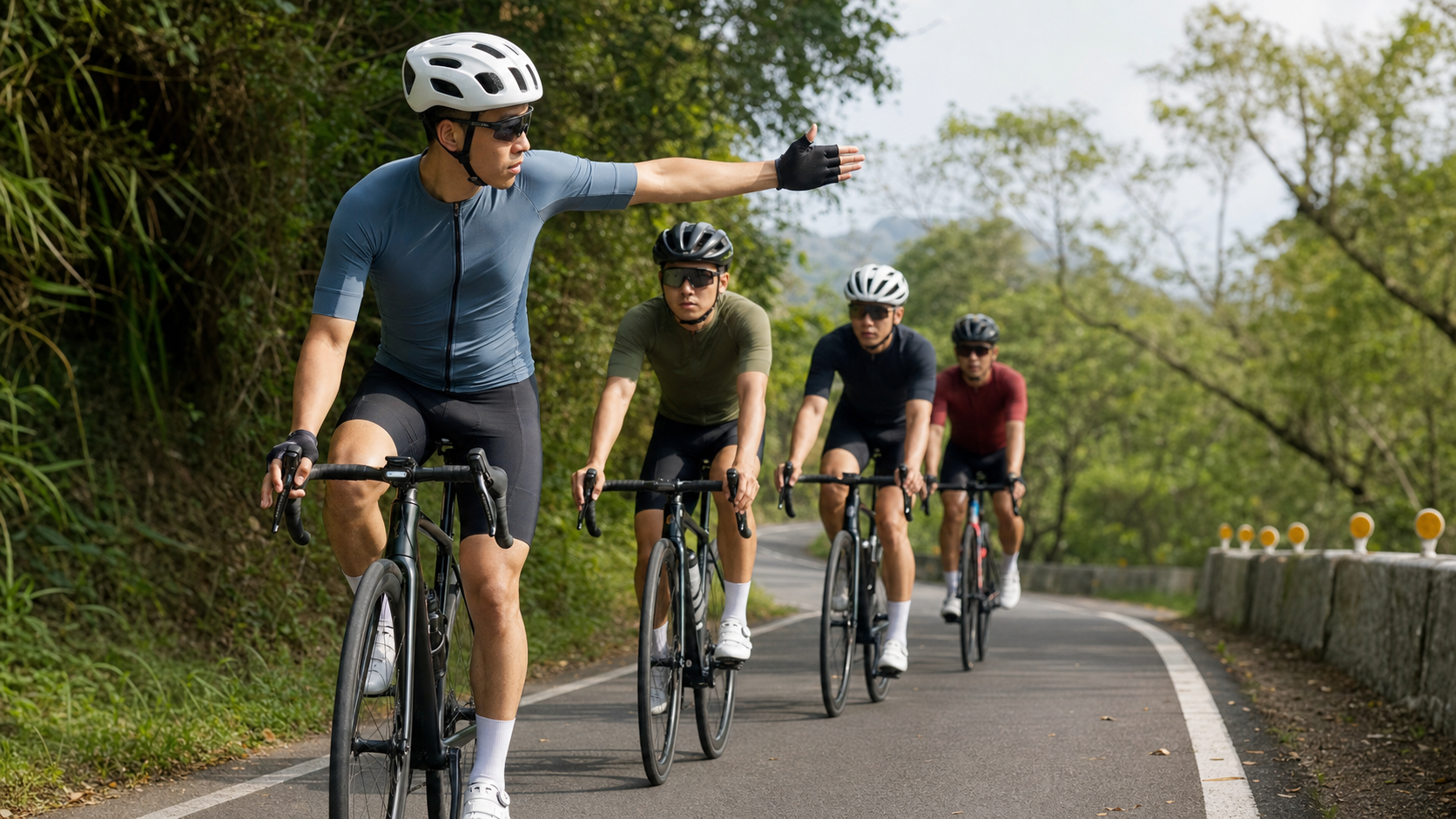
Introduction
During a group ride, your teammates cannot see the road ahead—their view is blocked by your back. In this situation, hand signals are the only real-time communication tool. A timely, correct signal can allow the entire group to brake collectively before a corner or safely avoid a pothole; a missing or incorrect signal can lead to a chain-reaction crash.
This article compiles the hand signal conventions commonly used in Taiwan’s cycling community. Whether you are a beginner or a veteran, mastering this shared language is essential preparation before joining a group ride.
Basic Directional Signals
Turn Signals
| Action | Signal Description | When to Use |
|---|---|---|
| Left turn | Extend left arm horizontally to the left | Approximately 20–30 meters before turning left |
| Right turn | Extend right arm horizontally to the right | Approximately 20–30 meters before turning right |
| Right turn (alternative) | Bend left arm upward, palm facing right | Use this alternative when the right hand is needed on the handlebar |
Key Principle: Signals must be made clearly before the turning maneuver, giving riders behind enough time to react. Taiwan’s Road Traffic Safety Rules also recognize hand signals as a legal method of indicating turns.
Road Hazard Warning Signals
Road hazard warnings are the most important part of group riding signals. Once the lead rider spots an obstacle, the information must be relayed immediately to the rear of the group.
Common Road Hazard Signals
- Road obstacle (left side): Point left hand downward, fingers toward the road, indicating the direction of the obstacle
- Road obstacle (right side): Point right hand downward, fingers toward the road
- Large pothole/severe obstacle: Swing the entire arm downward in a large motion to increase visual impact
- Stop/emergency braking: Extend arm backward, palm facing rear, waving up and down
- Slow down (non-emergency): Extend arm backward, palm facing down, waving slowly up and down
Advanced Road Hazard Signals
- Vehicle overtaking from behind: Raise right hand high and wave it back and forth, signaling the group to form a single-file line
- Sand/gravel on the road: Extend arm downward, spread fingers then close them, mimicking a scattering motion
- Railroad tracks/manhole covers: Cross both arms to form an X shape (one arm may suffice depending on the situation)
- Ride slowly: Lower the arm, gently push the palm backward, signaling the group to ease off the pace
Formation Adjustment Signals
| Signal | Meaning |
|---|---|
| Index finger rotating upward | Accelerate, prepare to sprint or pick up speed |
| Palm pushing forward (low position) | Everyone slows down |
| Arm swinging widely to the left | Move the entire line to the left |
| Arm swinging widely to the right | Move the entire line to the right |
| Tapping the top of the helmet | Police/law enforcement ahead, alert the group |
| Elbow extended outward then pulled back | Rotate the lead, signaling the next rider to come forward |
Supplementary Use of Verbal Communication
In Taiwan’s cycling culture, hand signals are typically combined with brief verbal calls relayed simultaneously:
- “Car!”: A vehicle is approaching from behind; call out loudly to pass the message forward
- “Stop!”: Emergency situation; everyone must prepare to brake immediately
- “Hole!” / “Pothole!”: Pothole on the road; pair with a hand signal indicating the direction
- “Sand!”: Loose gravel on the road; pair with a hand signal
- “Left!” / “Right!”: Directional warning; pair with a turn signal
Basic Principles of Signal Relaying
Relay Mechanism
The core concept of group riding signals is relaying—the signal from the rider at the front must be passed back sequentially by every rider in between, all the way to the last rider:
- The lead rider spots a pothole and makes the road hazard signal
- The second rider sees the signal, immediately replicates it, and passes it back
- All riders relay the signal in sequence until it reaches the rear
- Everyone must make the signal—never “look but not pass it on”
Common Beginner Mistakes
- Signals too small or too quick for riders behind to see clearly
- Giving up after signaling only once; signals should be held until the rider behind confirms
- Making the signal only at the moment of turning, without leaving enough reaction time
- Taking both hands off the handlebar to signal, causing instability—beginners should practice riding one-handed first before joining a group
Practical Advice
Preparation for Your First Group Ride
- Ask the ride leader about the signal system they use before departure (each group may differ slightly)
- Practice one-handed riding and various signal movements on flat roads at low speed
- Announce that you are a beginner before joining the group; you will usually be placed in the middle position
- When unsure about a signal’s meaning, first make a “slow down” motion, then ask—safety comes first
Advanced Tips
- Watch professional race broadcasts on Eurosport or YouTube to observe how pro riders demonstrate signals
- Build rapport with regular riding partners to reduce communication errors
- Debrief after each ride and discuss which sections of the route need better communication
Conclusion
Hand signals are not just a courtesy—they are the safety infrastructure of group riding. Every clear, timely signal protects both you and the riders behind you. Take the time to practice these movements in a parking lot or on low-speed sections of road. Once you join a group, your presence will not only add speed but also increase the entire group’s safety margin.
Related Reading
- Group Ride Hand Signals and Communication: The Unspoken Language of Safe Group Cycling
- Communication Between Riding Partners on Long Rides: Group Hand Signals, Pace Coordination, and Supply Division
- Group Riding Safety: A Complete Guide to Hand Signals, Positioning, and Braking Cues
- Skills and Coordination in Group Rides: Hand Signal Communication, Following Distance, and Principles for Avoiding Chain-Reaction Crashes
[教學] Premiere 影片 手震 修正 教學 防抖 單眼 影像 GoPro 穩定 Video Stabilization
8 年前
Insta 360 One 超級防手震技術實測
7 年前
風櫃嘴 | 全台最多大砲的單車路線 | 尋寶網攝影師告訴你怎麼擺拍起來才好看 | 熱門攝影地點巡禮
6 年前
一日北高/長距離團騎 常見問題補充篇 / 組團或跟團的眉角 / 壯車友容易被瘦車友慢性拉爆 / 原來屁股痛可能是這個原因...? / 風場配速法 / 公路車 / CT Yeh
2 年前
2024 如來神掌 百人約騎挑戰!feat. 秘境單車社團 / 神人們太可怕 / 全程錄影 x 完整坡度解析 / 公路車 / CT Yeh
2 年前
「悲情男車友」創作單曲 爆笑MV / 公路車 / CT Yeh / 4K劇情版
7 個月前
CT 喇低賽) 武嶺牽車 才是王道 西進牽車四小時內秘訣 攝手位置 如何判斷 防抽筋小秘訣
7 年前
備戰 戀戀197 賽前關門點分析 西濱團練 #公路車 4K高畫質
6 年前