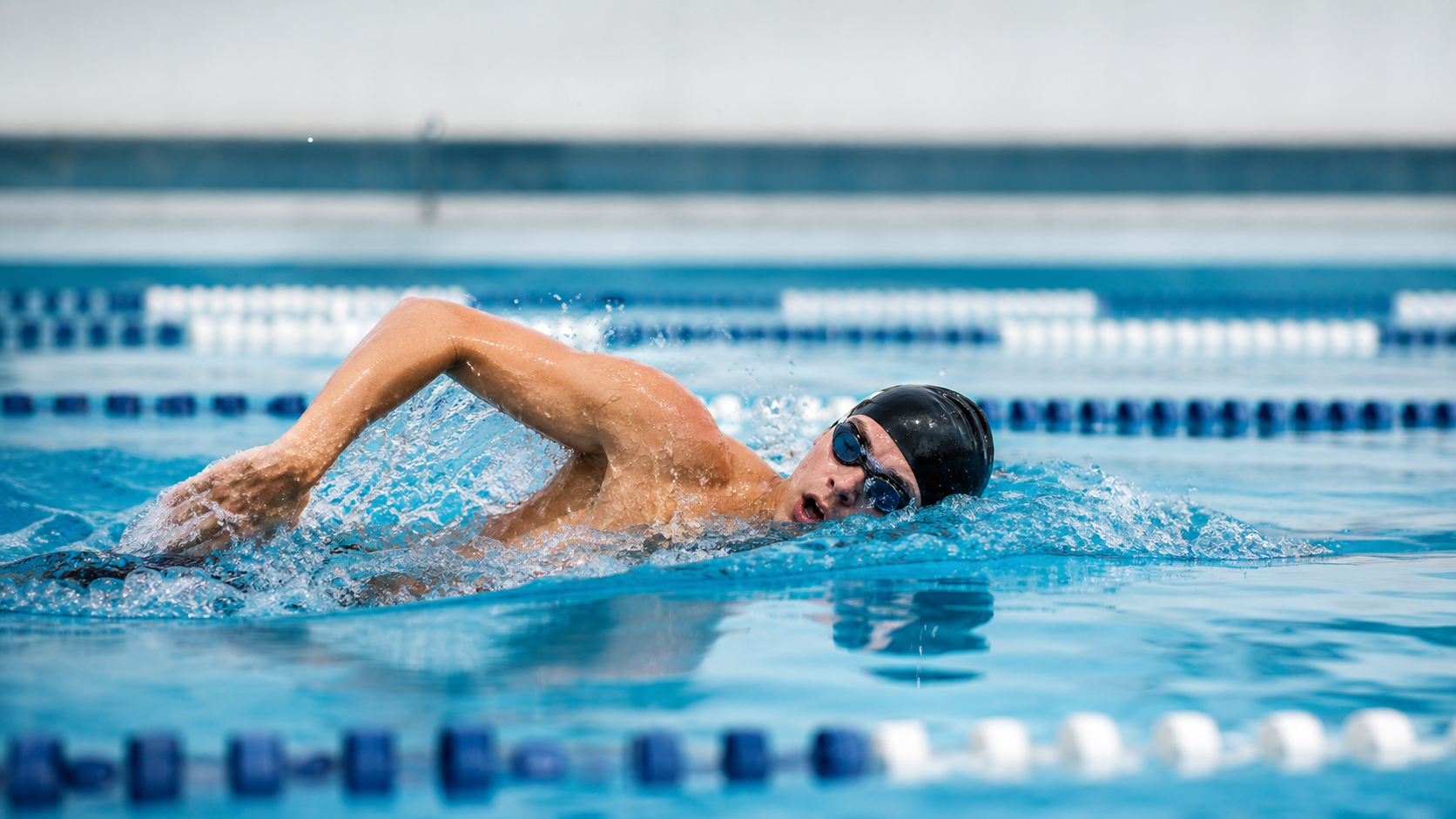
Introduction
In swimming training, there is one combination that many swimmers have a love-hate relationship with—Descending Sets. The rule is simple: swim each repeat faster than the previous one. It sounds easy, but executing it requires a high level of pace awareness, energy management, and a precise sense of your own fatigue levels.
Coaches value descending sets because they perfectly simulate the pacing demands of a race: a conservative start in the first half, a gradual build in the second half, and an all-out sprint in the final critical segment. This is not just technique—it’s training in race thinking.
The Design Logic of Descending Sets
Basic Structure
A descending set consists of multiple repeats of a fixed distance, with the target time for each repeat gradually decreasing:
Example: 4 × 100m, decreasing by 3 seconds per repeat
- Repeat 1: 1:40
- Repeat 2: 1:37
- Repeat 3: 1:34
- Repeat 4: 1:31
Setting the Decrement
The decrement (how many seconds faster each repeat should be) is the key. Too large or too small, and the training effect is lost:
| Distance | Recommended Decrement | Notes |
|---|---|---|
| 25m | 1–2 sec/repeat | Small decrement, requires precise control |
| 50m | 2–4 sec/repeat | Common speed training set |
| 100m | 3–6 sec/repeat | The main distance for threshold training |
| 200m | 5–10 sec/repeat | Highly effective for endurance pacing feel |
Rest Settings
The rest strategy in a descending set has a huge impact on the training effect:
- Fixed rest: A set rest interval between repeats (e.g., 20–30 seconds). The first repeat is fully recovered, while the last repeat is swum with significant fatigue. This is the most common design, simulating the fatigue-accelerated final stages of a race.
- Increasing rest: Longer rest for later repeats (e.g., 15→20→25→30 seconds), allowing each repeat to be swum closer to optimal condition. Suitable for pure speed development.
- Fixed send-off: Departing at a fixed interval (e.g., every 2:30). Later repeats naturally get less rest, with training intensity increasing implicitly.
Physiological Benefits of Descending Sets
Why are descending sets so effective? From a sports physiology perspective:
- Dynamic stimulation of the lactate threshold: The first few repeats are below the threshold, while later repeats gradually exceed it, teaching the body to maintain technique and speed while lactate accumulates.
- Progressive cardiorespiratory load: Heart rate increases with each repeat, approaching VO₂max on the final repeat, providing a strong aerobic stimulus.
- Neuromuscular speed activation: The all-out (or near all-out) final repeat activates fast-twitch muscle fibers, reinforcing the integration of stroke rate and stroke power.
- Pace perception ability: Each repeat requires actively monitoring “is this one faster than the last?” Over long-term training, a swimmer’s sense of speed improves dramatically.
Sample Workouts
Threshold-Oriented Descending Set
Suitable for swimmers competing in 400–1500m events:
Warm-up: 600m (200m easy + 4×100m mixed stroke)
Pre-set: 4×50m technique (catch-up or fingertip drag)

Main set (3 rounds):
  Round 1: 4 × 100m, fixed rest 20 sec, target pace decreasing by 4 sec
  Rest 2 minutes
  Round 2: 4 × 100m, fixed rest 20 sec, target pace decreasing by 4 sec (try to match Round 1 times)

Cool-down: 300m easy swim
Total: approximately 2600m
Speed-Oriented Descending Set
Suitable for 100–400m events or building speed feel:
Warm-up: 400m
Pre-set: 8×25m (odd repeats technique, even repeats accelerate)

Main set:
  6 × 50m, fixed rest 30 sec, decreasing by 1.5–2 sec per repeat
  Rest 3 minutes
  6 × 50m, fixed rest 30 sec (second round)

Cool-down: 200m
Total: approximately 1800m
Common Challenges in Executing Descending Sets
Challenge 1: First Repeat Too Fast
Many swimmers go all-out on the first repeat, leaving no room to build.
Solution: Swim the first repeat at a “comfortable to moderately easy” effort, ensuring enough room to accelerate. Use “target pace + 8–10 seconds” as a reference for the first repeat.
Challenge 2: Mid-Set Collapse
The first few repeats are easy, the last is all-out, but the middle repeats end up slower than the previous one.
Solution: Before each repeat, mentally preset “this one needs to be a few seconds faster than the last,” and confirm with the clock rather than relying on feel.
Challenge 3: Technique Breakdown on the Final Repeat
When accelerating under fatigue, form is often the first thing to go.
Solution: Consciously maintain accurate hand entry position and body rotation on the final repeat. Speed should come from “more efficient movement” rather than “struggling harder.”
Practical Tips
- For your first descending set, start with 4 × 50m—short distance, small decrement, and easy to feel the rhythm.
- Use the pool pace clock or a smart sports watch to track each repeat and confirm the descending pattern is happening.
- Do at least one descending set per week—it’s one of the most direct ways to improve race pace feel.
- Pair it with a “negative split” race strategy: in race simulations, deliberately hold back in the first half and gradually build to full effort in the second half—the same concept as a descending set.
- Record your final repeat time as a progress indicator—if your best final-repeat time keeps improving, it means your overall training status is on the rise.
Conclusion
The descending set is the ultimate whetstone for “pace awareness” in swimming training. It demands that you maintain clear speed judgment while fatigue accumulates, and accelerate at the moment it matters most. This ability is exactly what makes the difference in swimming a personal best in the final 50 meters or the last lap of a race.
Related Reading
- Swimming Speed Development Plans: Periodized Design of Short Sprint Sets
- Swimming Descending Rest Sets: Lactate Adaptation Training with Gradually Reduced Rest
- Designing the Main Set in Pool Training: Optimal Combinations of Distance, Intensity, and Reps
- Swimming Drill Sets: Optimal Proportions and Design Methods in Your Workout
一日北高/長距離團騎 常見問題補充篇 / 組團或跟團的眉角 / 壯車友容易被瘦車友慢性拉爆 / 原來屁股痛可能是這個原因...? / 風場配速法 / 公路車 / CT Yeh
2 年前
西進武嶺 免費訓練分析服務 Intervals | 練不夠還是練過頭?你哪一種類型選手?AI模型告訴你! | 備戰神器 | 公路車 訓練 | CT Yeh
4 年前
Nepest NOVA 碳條輪組:輕量、空力、舒適一次滿足!/ 公路車 / CT Yeh
7 個月前
西進武嶺配速器 3.0更新 / NEW 免功率FTP估算! / 大數據xAI體能模型 / 如何模擬人止關前集團效應 / 配速儲存功能 / AI全台自行車賽事行事曆 / 公路車 / CT Yeh
1 年前
西進武嶺 自製新版AI配速表產生器 x 賽前攻略 抱佛腳! 沒有功率計也可以產生配速表嗎?有什麼其他眉角賽前要注意的呢? | 西進武嶺 / 東進武嶺 KOM 攻略 | 公路車 | CT Yeh
4 年前
一起升級!海鷗盃LSD團練...JJSC Zone2招待 騎到手抖 / 公路車 / CT Yeh
2 天前
CT 喇低賽) 武嶺牽車 才是王道 西進牽車四小時內秘訣 攝手位置 如何判斷 防抽筋小秘訣
7 年前
Live) 備戰2019彰化經典百K 賽前攻略 (已完賽請看新影片
7 年前