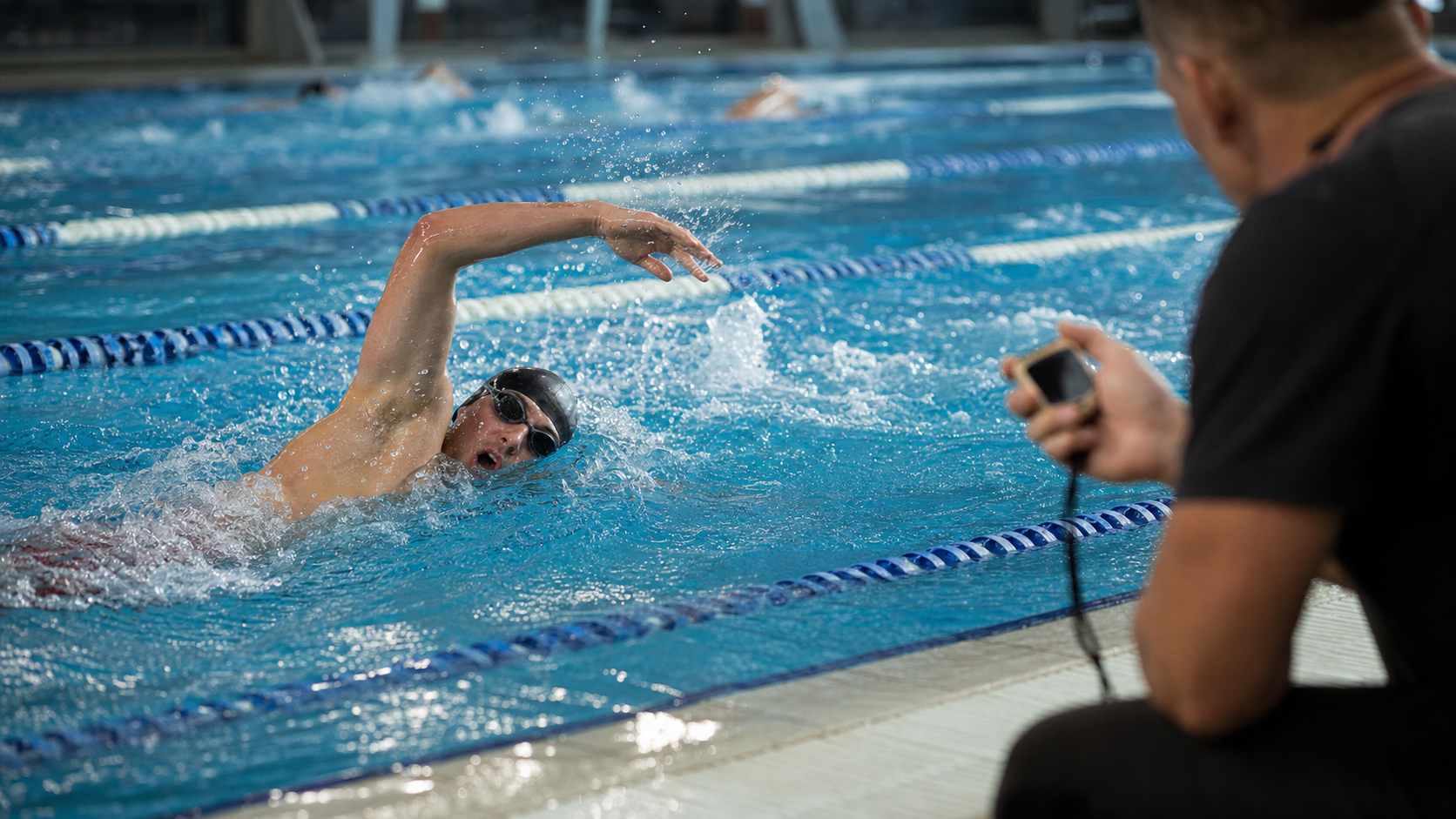
Introduction
Can you swim 400m at a pace faster than your personal best? It sounds impossible, but through Broken Swims, many swimmers actually do it.
The core concept of Broken Swims is: break a target distance into multiple smaller segments, inserting very short rests (usually 5–15 seconds) between each segment. The goal is to make each segment faster than your continuous swimming pace, so the total time is faster than a continuous all-out effort, even reaching above your target race pace.
This method has a long history in competitive swimming training and is an important tool for “letting your body know how fast it can swim.”
The Design Logic of Broken Swims
Basic Concept
When swimming a continuous 400m, your pace is limited by the following:
- The aerobic system takes time to reach maximum output
- Lactate accumulates over time, causing pace to drop in the latter stages
- Neural fatigue gradually reduces stroke rate
Broken Swims “reset” part of the fatigue through short pauses, allowing each small segment to start close to optimal condition. This way, even when you add up the rest time, the overall pace is still faster.
Design Examples
Goal: 400m Broken Swim
| Segment Format | Splitting Method | Rest | Target Effect |
|---|---|---|---|
| 4 × 100m | Rest 10 seconds every 100m | 10 sec × 3 times | Get used to 100m pace feel |
| 8 × 50m | Rest 10 seconds every 50m | 10 sec × 7 times | Train fast turns in and out |
| 2 × 200m | Rest 15 seconds every 200m | 15 sec × 1 time | Close to race conditions |
| 16 × 25m | Rest 5 seconds every 25m | 5 sec × 15 times | Build pure speed sensation |
Timing Methods
There are two ways to time Broken Swims:
- Pure swim time: Only count the swimming time of each segment, excluding rest, then add them up to compare with your continuous swim performance
- Total time including rest: Record the total time from the first start to the end of the last segment, used to evaluate overall training pace
Competitive swimmers typically use pure swim time, aiming to make the “sum of segment times” 5–10% faster than their best continuous swim.
Broken Swim Designs for Different Distances
100m Broken Swim
Break the 100m into 25m units, resting 5–10 seconds per segment:
- Segments: 4 × 25m, rest 5 seconds
- Goal: Swim each 25m segment at race pace +10% (faster than personal best)
- Training benefit: Strengthen explosive power and turn reaction time
400m Broken Swim
Break it into 100m units:
- Segments: 4 × 100m, rest 10 seconds
- Goal: Each 100m segment should be 3–5 seconds faster than the average 100m of a continuous 400m swim
- Training benefit: Build 400m pace feel, especially strengthening speed maintenance in the latter half
1500m Broken Swim
Use 300m or 500m units:
- Segments: 5 × 300m, rest 15 seconds; or 3 × 500m, rest 20 seconds
- Goal: Each segment’s pace should be 2–4 seconds per 100m faster than the average of a continuous 1500m swim
- Training benefit: Threshold speed strengthening, familiarizing with race lap pace rhythm
Comparing Broken Swims with Other Training
| Training Type | Primary Stimulus | Rest Length | Speed Target |
|---|---|---|---|
| Continuous Swim | Aerobic endurance | No rest | Approximately 80–90% max speed |
| Interval Training | VO2 max | 30–90 seconds | 90–100% max speed |
| Broken Swims | Speed sensation + pace control | 5–20 seconds | 95–105% target pace |
| Sprint Sets | Neural explosive power | 1–3 minutes | 100%+ max speed |
Broken Swims sit between interval training and continuous swimming, making them a unique “speed perception training.”
Key Considerations for Executing Broken Swims
Consideration 1: Strictly Time Your Rests
5 seconds means 5 seconds, not “leave when it feels about right.” The rest time is part of the design—too long and you lose the Broken effect; too short and you can’t maintain speed.
Consideration 2: Each Segment Should Be All-Out or Near All-Out
Broken Swims are not about “swimming a long distance slowly in pieces,” but rather “swimming a long distance fast in pieces.” If each segment’s speed is below target, you need to reassess the segment distance or rest settings.
Consideration 3: Maintaining Technique at Speed
When swimming fast, the things most likely to break down are hand entry angle and body rotation. Have a coach observe, or use the black line at the bottom of the pool to confirm you’re swimming straight without drifting.
Consideration 4: Suitable for Intermediate to Advanced Swimmers
For beginners who haven’t yet built foundational swimming technique, Broken Swims have limited effectiveness and may even reinforce poor technique. It’s recommended to introduce them only after at least 3–6 months of basic aerobic training.
Practical Application in Taiwanese Pools
In Taiwan’s 25m short-course pools, Broken Swims have a natural advantage: the wall at the turn end serves as a precise timing split point, making execution easy with a stopwatch.
Suggested implementation process:
- Set the goal for this Broken Swim (e.g., 400m in 4 × 100m format)
- Decide the target time per 100m before starting (3–5 seconds faster than your best continuous swim)
- Check the stopwatch immediately after each segment to confirm your time
- Finally, add up the pure swim times and compare against your continuous swim personal best
Practical Recommendations
- Do one Broken Swim session per week to let your body get used to the neural sensation of race pace.
- Design based on your target race distance: if preparing for a 1500m race, do a 1500m Broken Swim; if preparing for 400m, do a 400m Broken Swim.
- Record and compare segment times, tracking the consistency of each segment’s pace—even splits are a sign of technical maturity.
- Broken Swim performance can serve as a form indicator: if a Broken Swim is noticeably slower than usual, it means insufficient recovery, and you should adjust your training plan.
- Combine with turn practice: Broken Swims naturally strengthen turn technique—every push-off after touching the wall is a practice opportunity.
Conclusion
Broken Swims let you truly experience “how fast you can swim” for the first time in training. That sense of accomplishment from having every segment above target pace will translate into confidence and tactical ability in races. In your next training session, try breaking your target race distance into micro-intervals—you’ll find the boundary of speed is farther than you think.
Related Reading
- The Complete Guide to Pool Interval Training: Scientifically Improving Swimming Speed and Endurance
- Long-Distance Pace Training in Swimming: Speed Management from 1500m to 5000m
- Swimming Speed Development Plan: Periodized Design for Short Sprint Sets
- Building Rhythm in Long-Distance Swimming: Splitting Strategies for 1500m Pacing
西進武嶺 免費訓練分析服務 Intervals | 練不夠還是練過頭?你哪一種類型選手?AI模型告訴你! | 備戰神器 | 公路車 訓練 | CT Yeh
4 年前
教學) 如何做出專業 慢動作 影片 Slow Motion 120fps GoPro 7 ActionCam AX700 A99II
7 年前
滑雪新手們慘摔學習全紀錄(請開字幕),滑雪好好玩 | Snowboard + Ski | 岩原 スキー場 | 滑雪APP使用 | GoPro Max
6 年前
風櫃嘴 衝刺慢動作回放!
8 年前
#公路車 #西進武嶺 配速配瓦實驗 坡度分析 四小時內攻略 建大盃 NeverStop #西進武嶺攻略
6 年前
實景訓練台) 彰化經典百K 高強度喵團 90分鐘 跟著一起練功 2019 Indoor workout Changhua Classic 100 Taiwan
7 年前
一起升級!海鷗盃LSD團練...JJSC Zone2招待 騎到手抖 / 公路車 / CT Yeh
2 天前
團練) 4K NEKO 雙崎部落 間歇 狂拉 爽飛天 19/05/11
7 年前