Terrain Choices for Aerobic Running: Comparing Aerobic Effects of Flat Roads, Gentle Slopes, and Mountain Trails
Introduction
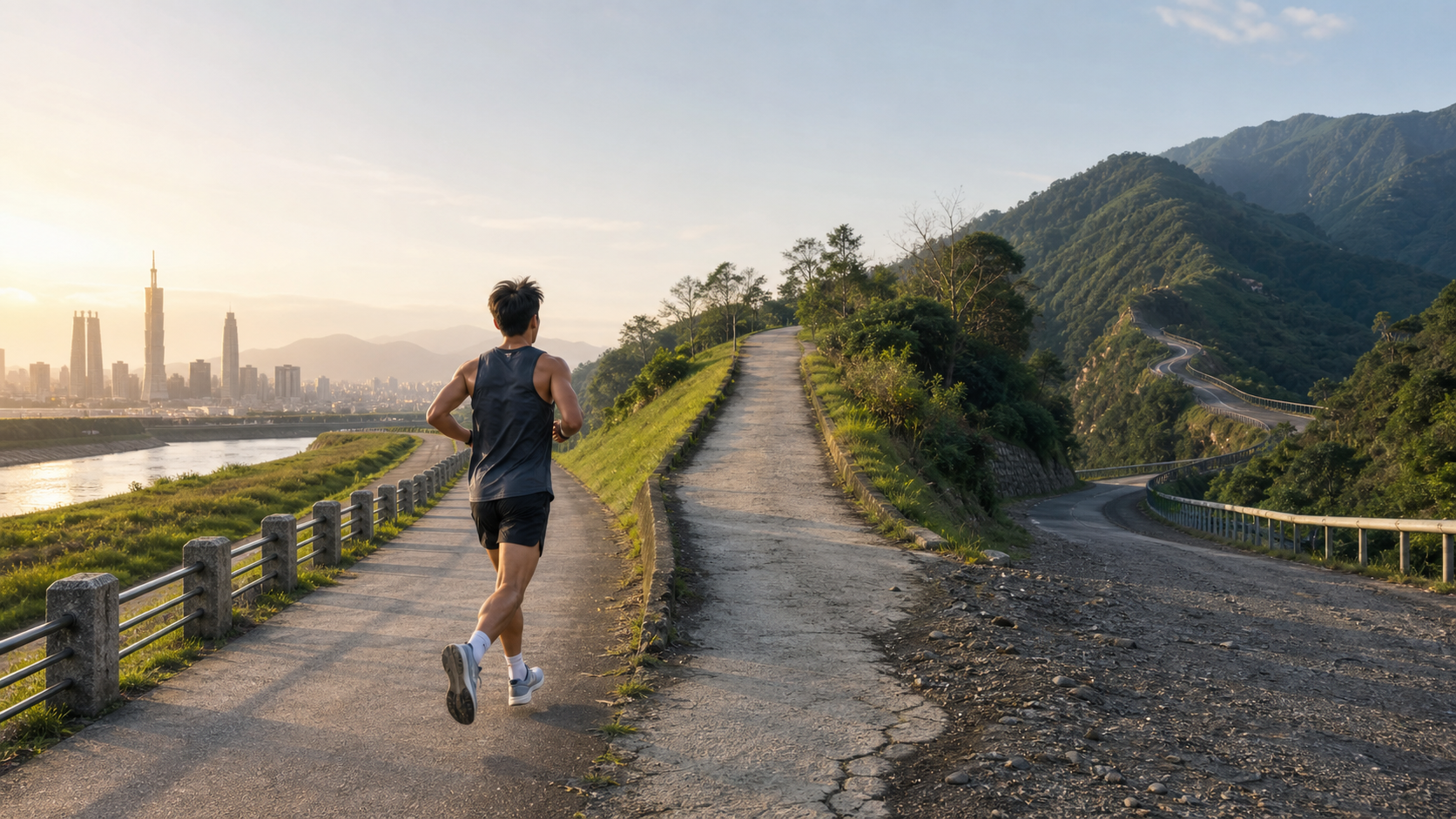
Road running training isn’t just about “how many kilometers you run”—the impact of terrain choice on training effectiveness is often underestimated. On this topographically diverse island of Taiwan, from the flat riverside paths of the Taipei Basin, the rolling hills of New Taipei City, to the steep mountain trails of Yangmingshan, each terrain offers distinctly different aerobic training stimuli. Understanding the training characteristics of each terrain can help runners design a more comprehensive aerobic base plan.
Comparison of Aerobic Training Characteristics Across Three Terrains
| Terrain Type | Slope Range | Primary Training Effects | Suitable Training Types | Injury Risk |
|---|---|---|---|---|
| Flat Road | 0–1% | Pace stability, rhythm | Long runs, MAF tests, speed training | Low (but repetitive fixed-impact) |
| Gentle Slope | 2–6% | Climbing aerobic strengthening, gluteal muscles | Aerobic hill climbs, power runs | Low to moderate (watch eccentric load on descents) |
| Mountain Trail/Steep Slope | 7%+ | Full-body muscle recruitment, peak cardiorespiratory output | Hill repeats, trail aerobic runs | Moderate (especially on descents) |
Flat Road Aerobic Running
Advantages
- Consistent pace, stable heart rate: Easiest to control intensity in Zone 2, ideal for precise aerobic training
- Suitable for long distances: Leg muscle fatigue accumulates more slowly, suitable for long runs of 20–30 km or more
- Running form optimization: Flat roads make it easier for runners to observe and correct form details
- Standard venue for MAF tests: Aerobic capacity assessment tests need to be conducted on flat roads for comparability
Disadvantages
- Single muscle recruitment pattern: Running only on flat roads long-term means the gluteal muscles (gluteus maximus, gluteus medius) and gastrocnemius are relatively under-recruited
- Mental monotony: Fixed terrain can make long runs feel tedious
- Hard-surface impact in urban environments: Taiwanese urban runners mostly run on concrete or asphalt, resulting in greater cumulative impact on the lower limbs
Recommended flat-road aerobic routes in Taiwan: Taipei Tamsui River/Kelung River riverside bike paths, Kaohsiung Love River Environmental Art Park, Taichung Fazih River bike path
Gentle Slope Aerobic Running
Advantages
- Increased cardiorespiratory stimulus: A 2–5% gentle slope can raise aerobic heart rate output without significantly increasing injury risk
- Strengthens gluteal and thigh muscles: Uphill running forces recruitment of the gluteus maximus and quadriceps, compensating for muscle weaknesses from flat-road running
- Improves running economy: Research shows that regular hill training can significantly enhance flat-road running efficiency
- Downhill training builds eccentric strength: The eccentric strengthening of the quadriceps from downhill running helps improve fatigue resistance in the latter half of a marathon
Cautions
- Slow down on uphills: If your heart rate exceeds the Zone 2 ceiling while climbing, immediately slow down or switch to brisk walking
- Don’t brake with your stride on downhills: Use short strides and high cadence on descents, avoid heavy “braking” foot strikes to reduce knee stress
Recommended gentle-slope routes in Taiwan: Taipei Shilin to the National Palace Museum (initial section of Yangde Avenue), New Taipei Xizhi Xin Shan Meng Lake, Tainan Guanziling
Mountain Trail Aerobic Running
Advantages
- Full-body muscle recruitment: Uneven terrain requires more stabilizer muscles (core, ankles, calves) to remain continuously engaged
- Peak cardiorespiratory stimulus: Steep slopes provide higher aerobic output stimulus than flat roads, achieving Zone 2–3 benefits in a shorter time
- Reduced joint impact: Dirt or gravel trails offer better cushioning than concrete, resulting in less cumulative joint damage over the long term
- Psychological richness: Mountain environments provide positive psychological benefits for running motivation (referred to in research as the “green exercise effect”)
Cautions
- Control intensity by heart rate, not pace: On mountain trails, pace cannot reflect true training intensity; heart rate must be the guide
- Descents are harder on the knees than ascents: Eccentric strength demands are high on trail descents; beginners to trail running should first strengthen their quadriceps
Recommended mountain trail routes in Taiwan: Taipei Neihu Dagon Creek Waterfront Park, New Taipei Shiding Thousand Island Lake Trail, Taoyuan Fuxing Shalunzi Creek Trail
Mixed-Terrain Aerobic Training Recommendations
The ideal aerobic training plan should mix all three terrains, with different emphases each week:
| Workout Type | Recommended Terrain | Description |
|---|---|---|
| Midweek aerobic recovery run (30–40 min) | Flat road | Control intensity, steady recovery |
| Midweek medium-distance aerobic run (50–60 min) | Gentle slope | Add varied stimulus |
| Sunday long run (90–120 min) | Mostly flat, with gentle slopes | Long distance, pace priority |
| 1–2 trail runs per month | Mountain trails | Full-body stimulus, mental refresh |
Practical Recommendations
- Beginners should build a flat-road base first: Before comfortably completing a 60-minute flat-road jog, frequent hill training is not recommended
- Use gentle-slope runs as a supplement to the weekly schedule: Schedule 1 aerobic route with climbing per week to improve overall conditioning
- Strengthen ankle joints before trail running: Do single-leg balance training and resistance-band ankle exercises to reduce the risk of sprains
- Mountain trails are especially dangerous after rain: Trails become slippery during Taiwan’s rainy season; wear trail running shoes and slow down
- Rotate between different terrains: Change your primary training terrain once a month to prevent the body from over-adapting to a single pattern
Conclusion
Taiwan’s geographical conditions are uniquely advantageous—from Taipei’s flat riverside paths to Yangmingshan’s magnificent mountain trails, you can find three distinctly different aerobic training environments within a single city. Make good use of this terrain resource, letting flat roads, gentle slopes, and mountain trails each play their role in your training schedule. Your aerobic base will be far more comprehensive and solid than if you trained on flat roads alone.
Related Topic Reading
- Muscle Strengthening for Road and Trail Running: Training Benefits of Uneven Terrain for the Calves
- Hill Running Training: What Abilities Do Uphills and Downhills Each Improve
- Road vs Trail vs Treadmill: Training Differences and Recommendations Across Three Running Environments
- Seasonal Planning for Aerobic Training: The Importance of Winter Mileage Building
一日北高/長距離團騎 常見問題補充篇 / 組團或跟團的眉角 / 壯車友容易被瘦車友慢性拉爆 / 原來屁股痛可能是這個原因...? / 風場配速法 / 公路車 / CT Yeh
2 年前
單車 梅山36灣 坡度介紹 路段介紹 空拍 (相關遊記影片,請參考說明或我的頻道喔,歡迎訂閱)
6 年前
太平山單車員工旅遊 | 這樣玩CP值最高!| 公路車
5 年前
單車 一日北高 ( 雙城 ) 肥宅雙人瘋狂行 紀錄片 REACTO
10 年前
台灣登山王之路 KOM 全程參賽4K臨空錄影 PART1 穿越峽谷地形! #東進武嶺 太魯閣 / 燕子口 / 天祥 / 西寶 PART1 (公路車 / CT Yeh)
3 年前
大武山後門26%歡樂陡坡!JJSC南台灣單車行Day2 / 被颱風追著跑 / 公路車 / CT Yeh
2 年前
元宇宙運動 ! RouvyAR 虛擬實境約騎! 台灣路段開箱 帶你日月潭環潭一圈 | 團騎競賽參加教學 | 常見小問題整理 三人共享一年不用一千 | 公路車 | 訓練台 | CTYeh
5 年前
實景訓練台) 彰化經典百K 高強度喵團 90分鐘 跟著一起練功 2019 Indoor workout Changhua Classic 100 Taiwan
7 年前