/no_think
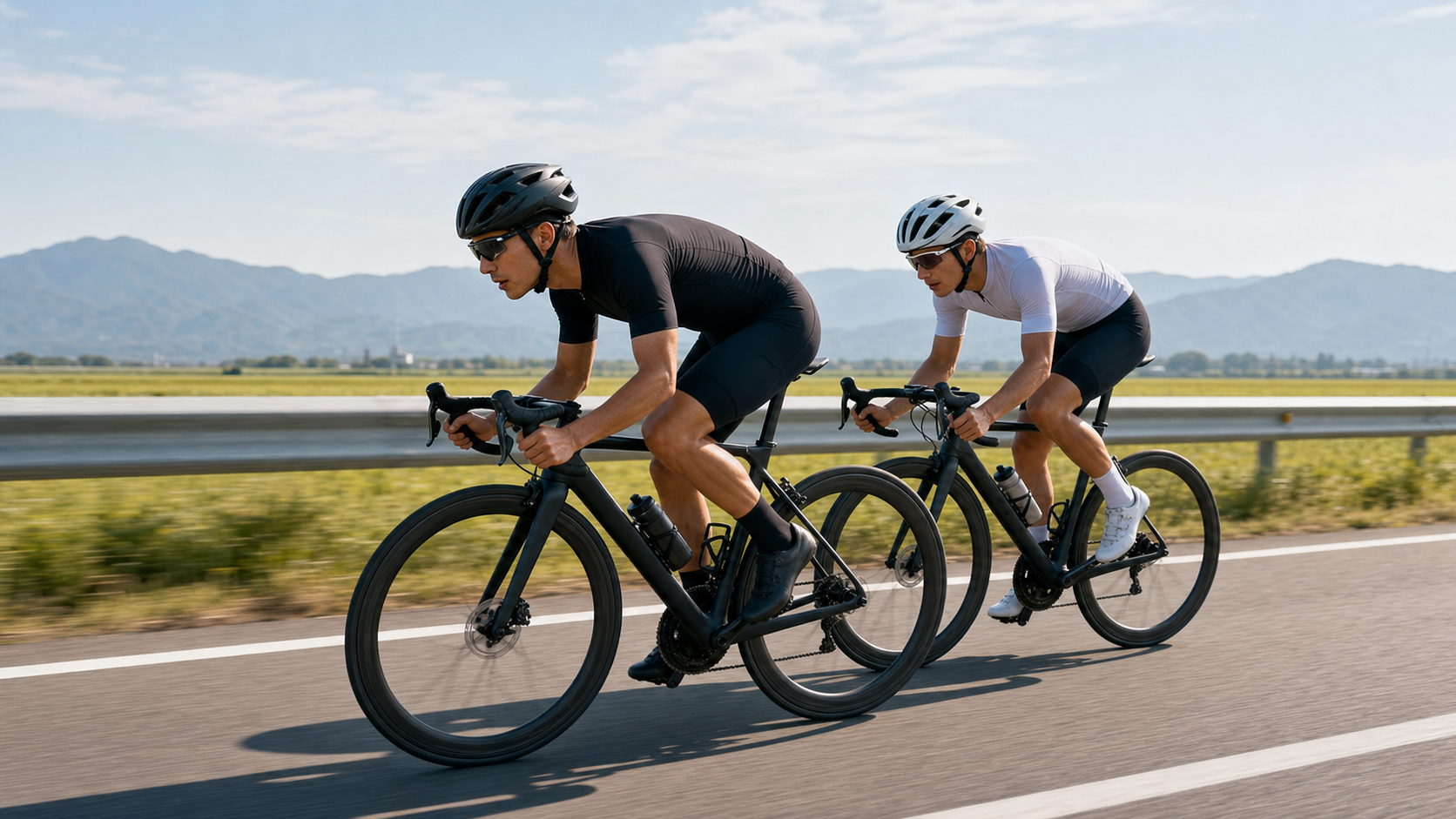
Introduction
In a road bike group race, an experienced rider with average fitness can often easily beat a stronger but less experienced newcomer who doesn’t understand drafting. Drafting—using the low-pressure air zone created by the rider ahead to reduce your own aerodynamic drag—is the most core energy management technique in road racing. Taiwan’s group riding and racing environment offers plenty of opportunities to practice drafting skills, but many riders still understand drafting only at the basic level of “following the bike ahead.”
The Physics of Drafting
The Structure of the Slipstream Zone
When the rider ahead moves at high speed, a “low-pressure slipstream zone” forms behind them. The characteristics of this zone are:
- Lower air density: The rider ahead has already pushed through the air, significantly reducing drag for those behind
- Turbulent flow characteristics: The slipstream is not completely still; it contains irregular airflow, and turbulence becomes more pronounced with distance
- Effective range: Typically most effective within 1–3 bike lengths directly behind the front rider
Energy Savings Under Different Conditions
| Following Condition | Energy Saved | Notes |
|---|---|---|
| Close follow (within 0.5 bike length) | 28–33% | Maximum benefit, requires high skill |
| 1 bike length | 22–27% | Safe and practical range |
| 2 bike lengths | 15–20% | Still effective but reduced benefit |
| 3+ bike lengths | 5–10% | Limited effect |
| Echelon (side-by-side offset) | 10–20% | Best choice in crosswind conditions |
Key Techniques for Effective Drafting
1. Judging the Optimal Following Distance
“Closer is better” is physically correct, but in actual riding you need to balance safety with benefit:
Beginner advice: Maintain a safe distance of 1–1.5 bike lengths, and only gradually move closer once you are familiar with the riding style of the rider ahead.
Advanced technique: On high-speed straight sections, you can close to 0.5–0.8 bike lengths; on corners and rolling terrain, maintain a buffer of 1–2 bike lengths.
Safety warning: Overlapping wheels is one of the most dangerous situations in group racing. If the rider ahead swerves suddenly, the rear wheel of the rider behind can be knocked out, potentially causing a chain-reaction crash through the whole group. Beginners must strictly avoid overlapping wheels.
2. Position Choice: Directly Behind vs. Offset Behind
Directly behind: Most effective, but with limited visibility. Points to note:
- Observe the road ahead through the shoulders or sides of the rider in front
- Maintain continuous visual scanning (don’t just stare at the front wheel)
Offset behind (slightly to the side): Better visibility, allowing you to see road conditions ahead earlier. Slightly less energy savings but improved safety; suitable when the rider ahead brakes frequently or when road conditions are complex.
3. Echelon Formation in Crosswind Conditions
When there is a noticeable crosswind, the most effective drafting position is not directly behind, but “downwind”—on the side opposite the crosswind source:
- Right crosswind: The whole group lines up diagonally to the left, with riders behind following to the left
- Left crosswind: The group lines up diagonally to the right
- Limitations of the echelon: The width of an echelon is limited; riders further back are often pushed out of the effective slipstream, creating a “split peloton”
Drafting Strategy in Group Movement
The Technique of Rotation
In a small breakaway group, rotating the lead is key to maintaining collective speed:
Standard rotation process:
- After the lead rider finishes their “time up front,” they pull out to the left (or right)
- Slightly ease off to let the riders behind pass through
- Drop back to the end of the line and settle into the recovery position
- As the front of the line gradually passes by, move up again
Recommended lead time in a breakaway group:
| Group Size | Lead Time per Rider | Rotation Pace |
|---|---|---|
| 2-rider breakaway | 1–2 minutes | Longer turns |
| 3–4 riders | 30–60 seconds | Medium pace |
| 5–8 riders | 15–30 seconds | Fast rotation |
Energy Management While Hidden in the Pack
In a large peloton, drafting technique becomes an energy conservation strategy:
- Front positions (top 10%): Most stable speed but requires self-pacing, higher energy expenditure
- Middle positions (10–40%): Best drafting benefit, stable speed; the optimal position for conserving energy over long distances
- Rear positions (40–70%): Occasional “accordion effect,” greater speed fluctuations, which can actually lead to higher energy expenditure
- Very back (beyond 70%): The accordion effect is most severe here, often requiring hard braking followed by re-acceleration; not recommended for extended stays
Drafting Ethics and Race Rules
In organized racing, drafting behavior is governed by certain ethical and regulatory norms:
- The moral issue of “not taking turns”: If a rider in a breakaway consistently refuses to take the lead, it is considered unethical and may cause other riders to refuse cooperation
- UCI rules: Some UCI-sanctioned events have explicit rules on drafting distance (e.g., drafting is prohibited in individual time trials)
- Local race rules: Rules vary across races in Taiwan; check the drafting regulations before the event
Practical Advice
- Start practicing in small groups: When first learning to draft, practicing in a small group of 3–5 riders builds confidence and technical awareness more easily than in a large group.
- Learn to read the signals of the rider ahead: Watch for shoulder movements, hand signals, brake lights, etc., and anticipate their actions in advance.
- Keep a relaxed grip on the handlebars: Tense arms reduce your sensitivity to road surface and airflow; a light grip allows faster reactions to the movements of the rider ahead.
- Practice echelons in different wind speeds: Taiwan’s coastal routes (such as Provincial Highway 61) often have strong crosswinds, making them a great opportunity to practice crosswind drafting.
Conclusion
Drafting is the fundamental language of road bike group racing. Once you master it, you’ll find group riding becomes easier, safer, and more enjoyable. Starting today, consciously practice following distance control, position selection, and rotation rhythm in every group ride. Accumulate real-world experience and make drafting your racing weapon—at the final sprint moment, you’ll have more explosive power in reserve than your rivals.
Related Reading
- Team Rotation and Drafting Tactics: Why Following Saves Energy, the Principles of Formation, and Etiquette and Safety in Amateur Group Rides
- The Science of Cycling Collective Tactics: A Quantitative Aerodynamic Study of Team Drafting
- Positioning Strategy for Group Race Sprints: Timing of Rotation and Judging the Launch Point
- A Complete Analysis of Professional Cycling Team Tactics: Formations, the Drafting Effect, and the Final Sprint Launch
公路車 爬坡 破PR 紀錄 小技巧 分享
6 年前
如何 搶 #中央山脈 報名 #公路車 #報名 #搶票
7 年前
西進武嶺 自製新版AI配速表產生器 x 賽前攻略 抱佛腳! 沒有功率計也可以產生配速表嗎?有什麼其他眉角賽前要注意的呢? | 西進武嶺 / 東進武嶺 KOM 攻略 | 公路車 | CT Yeh
4 年前
CT 喇低賽) 武嶺牽車 才是王道 西進牽車四小時內秘訣 攝手位置 如何判斷 防抽筋小秘訣
7 年前
一日北高/長距離團騎 常見問題補充篇 / 組團或跟團的眉角 / 壯車友容易被瘦車友慢性拉爆 / 原來屁股痛可能是這個原因...? / 風場配速法 / 公路車 / CT Yeh
2 年前
一個測試有沒有認真練車的方法😂 #公路車
10 個月前
多機位拍片神器 DJI Action 2 拍出速度張力感 | 類空拍機視角 4陣列麥克風超強降風噪 實測! | 公路車 | CT Yeh
3 年前
備戰 戀戀197 賽前關門點分析 西濱團練 #公路車 4K高畫質
6 年前