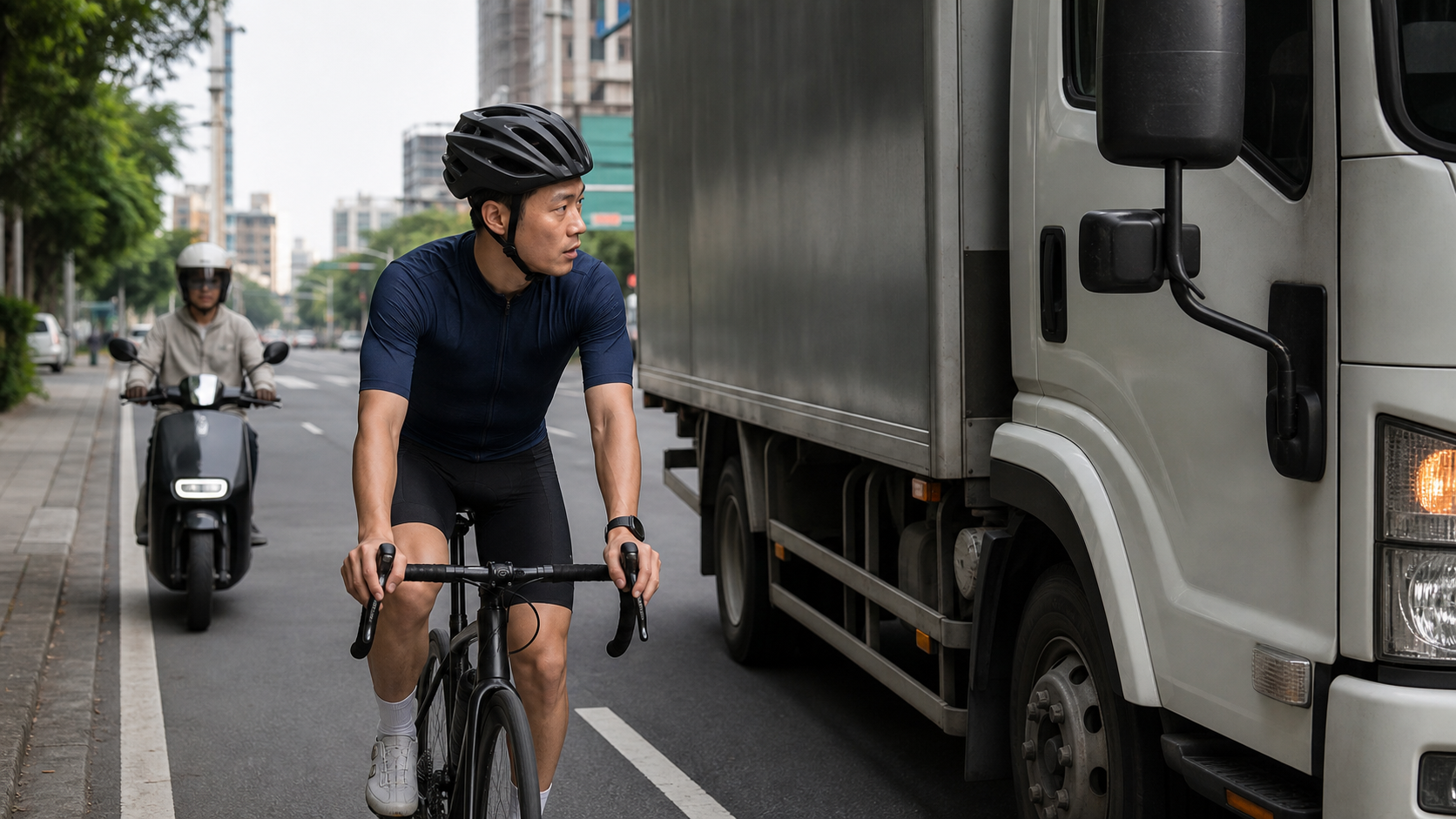
Introduction
When cycling in Taiwan, the most fatal dangers are often not what you can see, but what you cannot—hidden in the blind spots beside large vehicles. Statistics show that over 40% of serious cycling accidents involve blind-spot issues when large vehicles turn. Additionally, with the surge in electric scooters and electric bicycles, silently approaching electric vehicles have become a new type of potential threat.
This article will systematically analyze the blind-spot scenarios cyclists face on Taiwan’s roads, along with corresponding proactive defense strategies.
Blind Spots of Large Vehicles
Blind-Spot Zones of Trucks, Buses, and Dump Trucks
When large vehicles (trucks, buses, dump trucks) turn, the following areas are blind zones for the driver:
| Blind-Spot Location | Dangerous Scenario | Distance Range |
|---|---|---|
| Front right of the vehicle | Area swept by the outer wheel difference when turning right | 1–3 meters from the front |
| Middle-to-rear right side | Blind spot of the right-side mirror pillar | 1–2 meters beside the vehicle |
| Both rear sides | Reversing, left-turn outer wheels | 2–3 meters on each rear side |
| Below the large left-side mirror | Low-profile riders/children | When close to the vehicle |
The Outer Wheel Difference (Inner Wheel Difference) Trap
The outer wheel difference is one of the most common causes of large-vehicle accidents in Taiwan:
- Definition: When turning, the rear wheels of a large vehicle have a smaller turning radius than the front wheels, causing the rear wheels to sit closer to the curb than the front wheels
- Dangerous distance: For large vehicles over 12 meters, the rear wheels may shift inward by 1–2 meters when turning
- Identification method: The front starts turning left, but the rear is still on the right—at this point, the right side is about to become a fatal danger zone
Response strategies:
- When riding in the same direction as a large vehicle, stay at least 3–5 meters behind it
- When a large vehicle is preparing to turn, never stop beside either rear side
- When stopped at a red light, do not stand on the right side of a large vehicle (even as a pedestrian)
The Silent Threat of Electric Scooters and Electric Bicycles
Why Electric Vehicles Are More Dangerous
When traditional fuel-powered scooters approach, the engine sound provides an auditory warning. Electric scooters (such as Gogoro) and electric bicycles approach almost silently, depriving riders of a crucial sensory dimension:
- At low speeds: Electric vehicles are almost completely silent, making them hard to hear below 30 km/h
- When overtaking: A silent pass catches the overtaken rider off guard, making lane changes risky
- At intersections: It is impossible to judge an oncoming vehicle’s speed and distance by sound
Proactive Defense Strategies
- Check mirrors more frequently: In the age of electric vehicles, mirror checks should be increased to once every 10–15 seconds
- Hand signal + mirror double-check before lane changes: Relying solely on hearing to judge safe distance is no longer sufficient
- Avoid sudden leftward moves: Before moving left, confirm there is at least 5 seconds of safe distance behind you
Dangerous Pedestrian Behavior Patterns
Common High-Risk Scenarios
- Suddenly stepping out from beside parked vehicles: Pedestrians emerging from between parked cars are completely outside the rider’s field of vision
- Distracted pedestrians on phones: Unconsciously drifting onto bike lanes or toward the curb
- Escalator/MRT exits: Large crowds suddenly pouring out, with unpredictable movement directions
- Umbrellas on rainy days: The umbrella edge blocks vision, greatly reducing pedestrians’ awareness of their surroundings
Areas with High Pedestrian Presence
- Near schools during drop-off and pick-up times
- Within 50 meters of MRT stations and bus stops
- Stretches with wet markets and convenience stores
- Residential areas with dense parking spaces
Managing Compound Blind Spots at Intersections
Intersections are where blind-spot risks are most concentrated:
- Slow down early: Begin decelerating 50 meters before the intersection; do not pass through at high speed
- Maintain lateral distance from large vehicles: While waiting at an intersection, keep at least 1.5 meters of side clearance from buses and trucks
- Confirm eye contact: Making “eye contact” with the driver is the most effective way to confirm they have noticed you
- Do not run yellow lights: Oncoming vehicles may still be crossing during yellow; running the light carries far greater risk than waiting
- Be extra cautious at night intersections: When lighting is insufficient, others will have a harder time seeing you
Practical Advice
- Assume you are not seen: Predict danger based on the assumption that “the other party has no idea I am here”; it is better to wait one extra second
- Increase visual presence: Fluorescent clothing, blinking lights, and reflective gear raise the chances of being spotted
- Learn the “five-second rule”: When you spot a vehicle that may pose a threat, give yourself five seconds to assess its movement intentions before proceeding
- Stay away from the sides of large vehicles: Whenever possible, keep your distance; riding close alongside is a high-risk behavior
Conclusion
Cyclists are relatively vulnerable on the road—this is not a pessimistic attitude, but a realistic assessment. Understanding the blind-spot zones of large vehicles, the silent nature of electric vehicles, and the unpredictability of pedestrians, and turning “proactive defense” into a habit in daily riding, is the only way to keep cycling safely through Taiwan’s complex urban roads.
Related Reading
- Being Seen Is Safety: A Complete Guide to Cycling Visibility Gear and Lighting Systems
- Traffic Safety While Riding: Proper Riding Behavior in Taiwan’s Road Conditions
- Road Bike Descending Safety on Mountain Roads: Cornering Line Selection and Speed Control
- Vision Protection for Cyclists: A Guide to UV, Flying Insects, and Eyewear Selection
2025 彰化經典百K 多視角VLOG / 今年摔好多 / 全新LIVE系統測試 / 公路車 / CT Yeh
1 年前
一日北高/長距離團騎 常見問題補充篇 / 組團或跟團的眉角 / 壯車友容易被瘦車友慢性拉爆 / 原來屁股痛可能是這個原因...? / 風場配速法 / 公路車 / CT Yeh
2 年前
高雄綠園道鐵路自行車道 / 外地人能輕鬆駕馭 還是整路崩潰? / 2025 全線開通 春節實地探索一次!(附GPS連結)/ 公路車 / CT Yeh
1 年前
2025 台北自行車展 逛展VLOG / 新奇商品探索 居然有這些神奇小物 / TT表演賽對戰德國91 / 巧遇 EVA 廷威 AYA 小D 四爺 夏美 松哥 .. / CT Yeh
1 年前
大武山後門26%歡樂陡坡!JJSC南台灣單車行Day2 / 被颱風追著跑 / 公路車 / CT Yeh
2 年前
碟煞公路車 優缺點?換車一年半實際經驗分享 / 公路車 / CT Yeh
2 年前
再快都跟的上!? 單車跟隨攝影機之王 HOVERAir X1 PROMAX 全面實測 / 唯一!8K畫質&自行車專用模式和跟蹤信標&前後避障 / DJI Neo 可參考/ 公路車 / CT Yeh
1 年前
備戰 戀戀197 賽前關門點分析 西濱團練 #公路車 4K高畫質
6 年前