Introduction
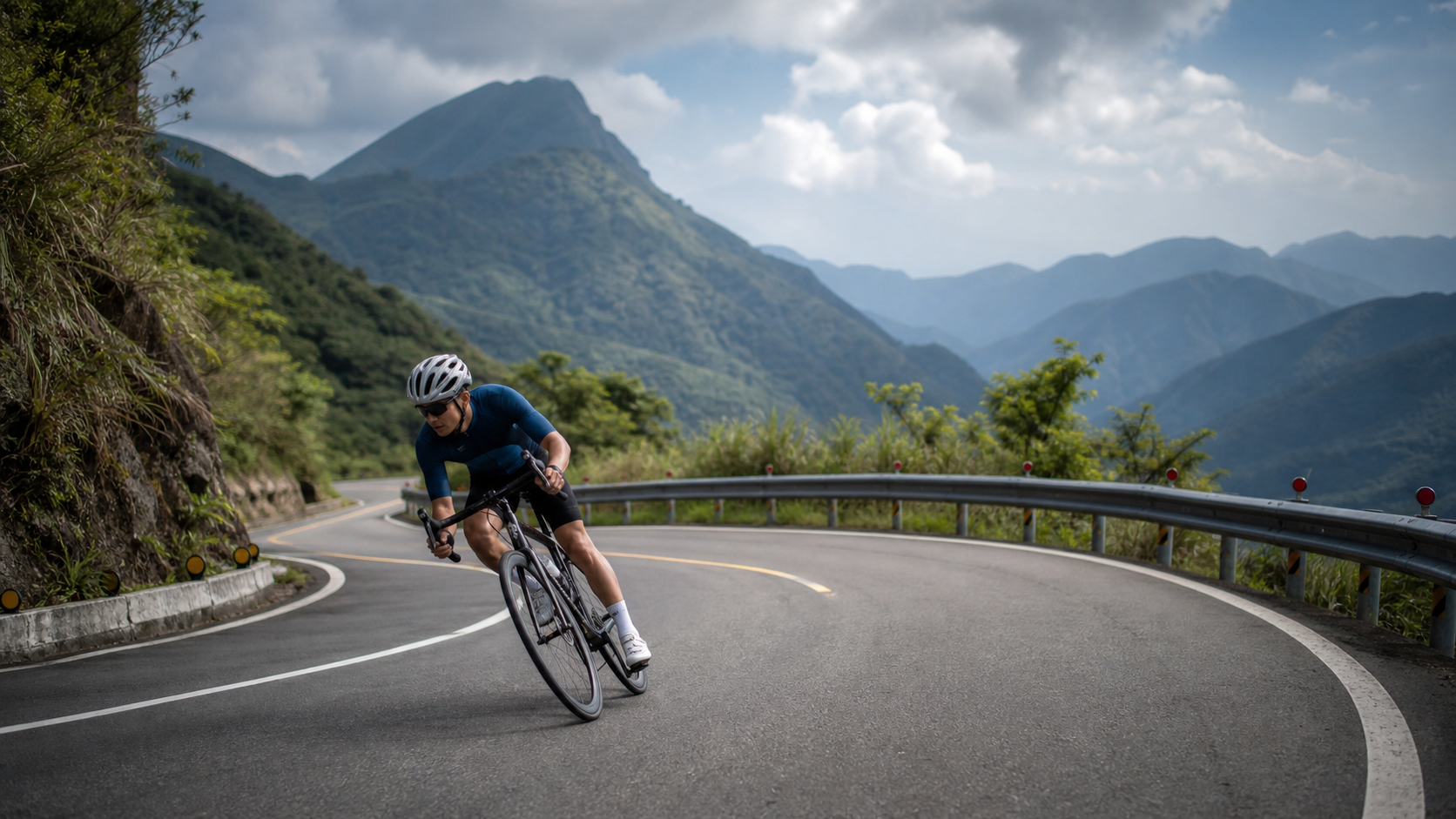
Taiwan’s mountain roads are a paradise for road cyclists—Yangmingshan, Wuling, Taipingshan, Smangus… countless spectacular routes await your exploration. However, descending is also where the most severe accidents and fatalities occur. In corners taken at speeds exceeding 60 km/h, any misjudgment can lead to irreversible consequences.
Descending skill is not innate; it is built progressively through proper knowledge accumulation and deliberate practice. This article will systematically break down the core techniques for descending Taiwan’s mountain roads, allowing you to enjoy the thrill of speed while conquering every corner within a safe framework.
Speed Assessment Before Entering a Corner
Judging Sight Distance and Braking Points
The core principle of descending is: complete your braking before entering the corner. Braking inside a corner forces lateral friction (maintaining steering) and longitudinal friction (braking force) to compete for the same tire grip, dramatically increasing the risk of losing control.
The sight-distance method for assessing corner entry speed:
| Visible Sight Distance | Recommended Maximum Corner Entry Speed | Principle |
|---|---|---|
| Full corner exit visible | Determined by grip | Can enter the corner at full speed |
| Exit not visible (blind corner) | Conservative estimate, ready to stop at any moment | “Only ride what you can see” |
| Oncoming traffic may cross the line | Reduce speed by an additional 20–30% | Common situation on Taiwan’s mountain roads |
Special Hazard Factors on Taiwan’s Mountain Roads
- Oncoming vehicles crossing the center line: Some of Taiwan’s older mountain roads have overly sharp corners that force large vehicles to cross the line
- Gravel and falling rocks: After typhoons and heavy rain, mountain road surfaces are especially littered with debris; reduce speed and ride cautiously
- Damaged pavement: Frost cracks, ruts, and construction patches are very common on mountain roads
- Harsh afternoon glare: West-facing descents suffer severe backlighting in the late afternoon, significantly impairing visibility
Cornering Line Selection
Basic Concepts of the Ideal Racing Line
The goal of the ideal racing line is to maximize the corner’s effective radius, allowing for the highest possible speed:
- Corner entry: Enter from the outside of the corner (for a right-hand turn, start from the left side near the edge)
- Apex: Pass through the innermost point at the middle of the corner
- Corner exit: Extend outward toward the outside of the corner
Limitations for use on Taiwan’s public roads:
A full racing line requires borrowing the oncoming lane, which is absolutely not applicable on public roads. The legal and safe approach on Taiwan’s mountain roads is the “shortened cornering line”:
- Move to the right side before entering the corner (staying within your own lane)
- At the apex, you may drift slightly toward the left side of your lane (still within your lane)
- Return to the right side after exiting the corner
- Never cross the center line
Descending Braking Technique
Intermittent Braking (Different from Continuous Light Braking on Normal Roads)
On long descents, you should not apply continuous light braking; instead, use an intermittent approach:
- Brake for 3–5 seconds: Decelerate sufficiently
- Release the brakes for 2–3 seconds: Allow the braking system to cool and let the tires briefly regain full grip
- Repeat the cycle
Dangers of continuous light braking:
- Rim brakes: Overheated rims can cause inner tube blowouts (especially on long descents in summer)
- Disc brakes: Overheated rotors cause brake fade, resulting in a sudden loss of braking power
Emergency Response in a Corner
Entering a corner too fast to complete the turn (the most dangerous situation):
- Do not panic-brake: Hard braking while leaned over will immediately cause a front-wheel washout and loss of control
- Increase your lean angle: Lower the bike as much as possible within a safe range
- Look toward the corner exit: Your bike goes where your eyes look
- If you truly cannot make the corner: Release the brakes and let the bike run wide—it’s better to run off the road than to wash out mid-corner
Descending Psychology and Physical Management
The Impact of Fatigue on Descending
Descending after a long climb is especially dangerous:
- Muscle fatigue compromises steering precision
- Reduced attention and prolonged reaction times
- Overconfidence (the climb is done, now it’s easy)
Recommendation: After finishing a climb, take a brief rest at the start of the descent, replenish fluids and food, and only begin descending once your focus has recovered.
Extra Caution on Unfamiliar Roads
| Situation | Recommended Strategy |
|---|---|
| Riding a route for the first time | Probe at low speed in the first half to familiarize yourself with the surface and corner characteristics |
| After rain or on wet surfaces | Reduce overall speed by more than 30% |
| Nighttime descending | Never exceed the range of your lights; night vision reaction distance is insufficient |
| Descending in a group | Maintain a much larger gap than usual; do not race each other |
Practical Advice
- Scout the route before riding it: While climbing, pay attention to the corner angles and road surface quality of the descent ahead
- Practice low-speed cornering regularly: Practice balance and lean-angle control in parking lots or on low-speed sections
- Never race strangers on descents: You don’t know their skill level; racing is a high-risk behavior
- Tell family or teammates your route: In case of an accident, someone will know where to find you
Conclusion
The thrill of descending is intoxicating, but remember: every safe descent is the combined result of skill and caution. There are no shortcuts to descending mountain roads—only through continuous practice, respecting physical limits, and understanding road conditions can you truly master speed. Enjoy every corner while carrying a mindset of respect for the road—that is the true art of descending.
Related Reading
- Advanced Descending Technique: Body Control for High-Speed Cornering on a Road Bike
- Descending Technique After Climbing: Safe Braking Control and Cornering Lines
- The Complete Guide to Descending Skills: The Physics of Weight Distribution, Visual Guidance, and Braking Timing, with Progressive Practice Methods
- Climbing Technique for Consecutive Corners: Exit Acceleration and Entry Braking Timing
大禹嶺 到 武嶺牌樓 全程前後實況錄影 | 北進武嶺 | 東進武嶺 | KOM | 訓練台 | 坡度分析 | Taiwan KOM Last 10 km HARD | 公路車
6 年前
CT 喇低賽) 武嶺牽車 才是王道 西進牽車四小時內秘訣 攝手位置 如何判斷 防抽筋小秘訣
7 年前
碟煞公路車 優缺點?換車一年半實際經驗分享 / 公路車 / CT Yeh
2 年前
大武山後門26%歡樂陡坡!JJSC南台灣單車行Day2 / 被颱風追著跑 / 公路車 / CT Yeh
2 年前
公路車 爬坡 破PR 紀錄 小技巧 分享
6 年前
單車 梅山36灣 坡度介紹 路段介紹 空拍 (相關遊記影片,請參考說明或我的頻道喔,歡迎訂閱)
6 年前
一日北高/長距離團騎 常見問題補充篇 / 組團或跟團的眉角 / 壯車友容易被瘦車友慢性拉爆 / 原來屁股痛可能是這個原因...? / 風場配速法 / 公路車 / CT Yeh
2 年前
富士山KOM 賽事篇 VLOG!/ 小野田出沒!/ 完整路段分析 / 武嶺要騎多快才能拿環?/ 台灣選手 第20回Mt.富士ヒルクライム 参加!/ 公路車 / CT Yeh
2 年前