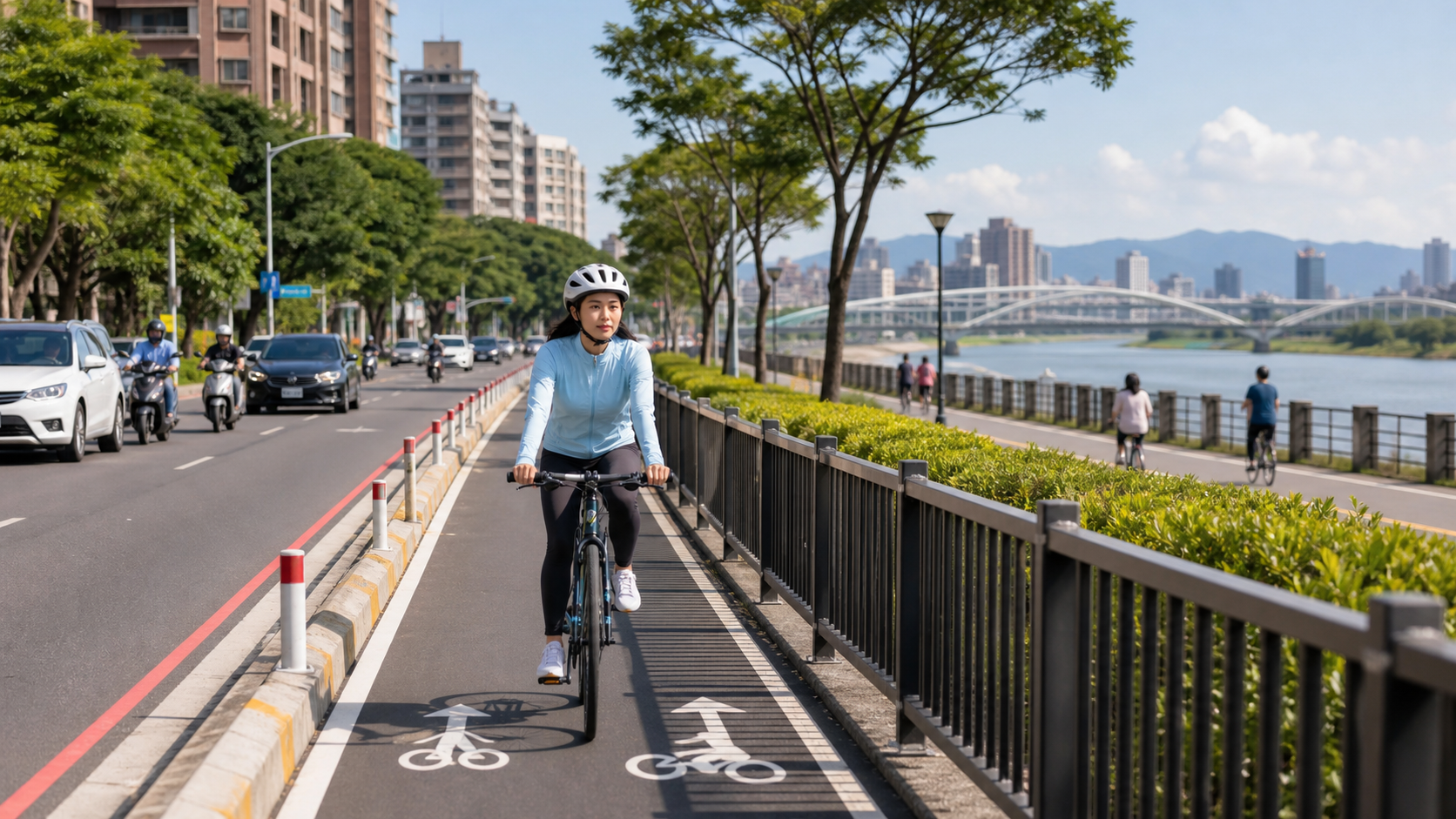
Introduction
In recent years Taiwan has invested heavily in cycling infrastructure, with counties and cities rolling out dedicated bike lanes, shared bike roads, and shared pedestrian-bike sidewalks. However, each of these road types comes with different usage rules, and many riders often confuse them or unknowingly break the rules.
This article systematically summarizes the definitions, regulations, and penalties for the various types of bike lanes in Taiwan, helping every rider stay on the right path while asserting their legitimate right to use the road.
Classification System for Taiwan’s Bike Lanes
Four Main Types Under Ministry of Transportation Rules
| Type | Definition | Applicable Rules |
|---|---|---|
| Dedicated Bike Lane | For bicycles only, physically separated or marked | Pedestrians and motorcycles prohibited |
| Priority Bike Lane | Bicycles have priority; pedestrians may use it but must yield | Speed must not exceed 30 km/h |
| Shared Pedestrian-Bike Path | Shared by pedestrians and bicycles, pedestrians have priority | Bicycles must yield to pedestrians and ride slowly |
| General Lane (incl. slow lane) | Shared with motorcycles and cars, bicycles ride in the outermost lane | Follows general road rules |
Identifying a Dedicated Bike Lane
In Taiwan, a legally designated dedicated bike lane should have the following markers:
- Bicycle icon markings on the road surface
- Text markings reading “Bike Lane” or “Bicycles Only”
- Distinctively colored pavement (green is most common)
- Roadside standing signage
Riding Rules for Major Bike Lanes
Riverside Bike Paths (New Taipei City, Taipei City)
One of the most complete dedicated bike lane systems in Taiwan, spanning over 130 kilometers:
- Speed Limit: Usually posted at 20–25 km/h, with some sections at 30 km/h
- Motorcycles and Pedestrians Prohibited: In principle these are bicycle-only spaces (some sections are shared with pedestrians)
- Operating Hours: Most sections have no time restrictions, though some have nighttime controls
- Overtaking Etiquette: Ring your bell before overtaking at speed, and keep a safe lateral distance
Rail-Trail Bike Paths Converted from Former Railways
These include the Houfeng Bikeway and Neiwan Line Bikeway, converted from decommissioned railways:
- Motor vehicles are generally prohibited
- Some sections are shared with pedestrians, and bicycles must yield to them
- Lights should be used in tunnel sections depending on visibility
Rules for Riding on General Roads
Required Route and Position
Under Article 124 of the Road Traffic Safety Rules, cyclists riding on general roads must:
- Ride in the Slow Lane: On roads with a designated slow lane, cyclists must ride within it
- No Slow Lane: Ride on the right side of the road, keeping an appropriate distance from parked vehicles (if any) to avoid sudden door openings
- No Double-Riding: Bicycles designed for a single rider may not carry a second passenger (an adult may carry a child under 18)
- No Riding Side by Side: Riding abreast in a way that obstructs traffic is prohibited
Safe Distance from Parked Vehicles
Parked vehicles are densely packed along urban roads in Taiwan, and “dooring” (being struck by a suddenly opened car door) is a common cause of rider injury:
- It is recommended to keep at least 1–1.5 meters of distance from roadside parked cars
- Slow down when passing parking spaces to guard against doors opening suddenly
- Watch for signs of movement inside vehicles (such as a head moving, visible in side mirrors)
Special Rules by County and City
| County/City | Special Rule | Notes |
|---|---|---|
| Taipei City | Some sidewalks allow cycling (where marked) | Must slow down and yield to pedestrians |
| New Taipei City | Riverside bike paths limited to 25 km/h | Enforcement is stepped up on busy holidays |
| Taichung City | The Green Corridor bikeway has posted speed limits | Follow the signage for each section |
| Kaohsiung City | Electric assist prohibited on some sections along the Love River bike path | Watch for section-specific signage |
| Nantou County | Sun Moon Lake bike path limited to 20 km/h | Heavy tourist traffic requires strict compliance |
Penalties for Violations
| Violation | Fine |
|---|---|
| Riding on a prohibited section (e.g. expressways) | NT$300–600 |
| Illegal double-riding | NT$300 |
| Failing to yield to pedestrians at a pedestrian-priority sign | NT$300 |
| Speeding (on sections with a posted limit) | From NT$300 |
| Riding against traffic | NT$300 |
Practical Tips
- Check the rules for your destination before you go: Detailed county/city regulations can be found on each local transportation bureau’s website
- When riding on a sidewalk: Look for signage — only ride where a “shared pedestrian-bike path” is marked; assume it is not allowed if unmarked
- Get familiar with local routes before riding outside your home area: Use Strava Heatmap or Google Maps’ cycling route feature
- Respect other road users: Even where the rules permit it, slow down and yield in crowded areas — courteous riding builds a better cycling environment for everyone
Conclusion
Taiwan’s cycling infrastructure is rapidly improving, but the details of local regulations remain a blind spot for many riders. Understanding the type and rules of the section you’re riding on isn’t just about avoiding fines — it’s about taking responsibility for yourself and other road users. Legal, courteous riding is the foundation for building a better cycling culture in Taiwan.
Related Reading
高雄綠園道鐵路自行車道 / 外地人能輕鬆駕馭 還是整路崩潰? / 2025 全線開通 春節實地探索一次!(附GPS連結)/ 公路車 / CT Yeh
1 年前
靠單車減肥35公斤 心得分享與整理
7 年前
2026 車錶排行榜!誰是最多車友正在使用?練家子最愛哪款?🏆 (2萬名車友數據) / 公路車 / CT Yeh
5 個月前
超開放的自行車錶!可以玩遊戲裝APP!?/ SRAM合併的 Hammerhead Karoo深入開箱!/ 即時爬坡偵測 / 全球導航地圖 / Garmin Bryton / CT Yeh
1 年前
多到選擇障礙... 換個單車把帶想一個小時 / BTP / 編織&軟木特有材質超吸睛! / 公路車 / CT Yeh
1 年前
台中大雪山 膏王領騎 震到都沒畫面了 公路車
5 年前
#公路車 #Fitting 靠人工智慧APP 幫你調整單車
6 年前
4K單車實境) 舊陽金P字道 第1P 仰德大道至小油坑 誤跟武嶺神人們 被拉爆爽飛天 Taiwan Cycling Climb Route Recommend
7 年前