Introduction
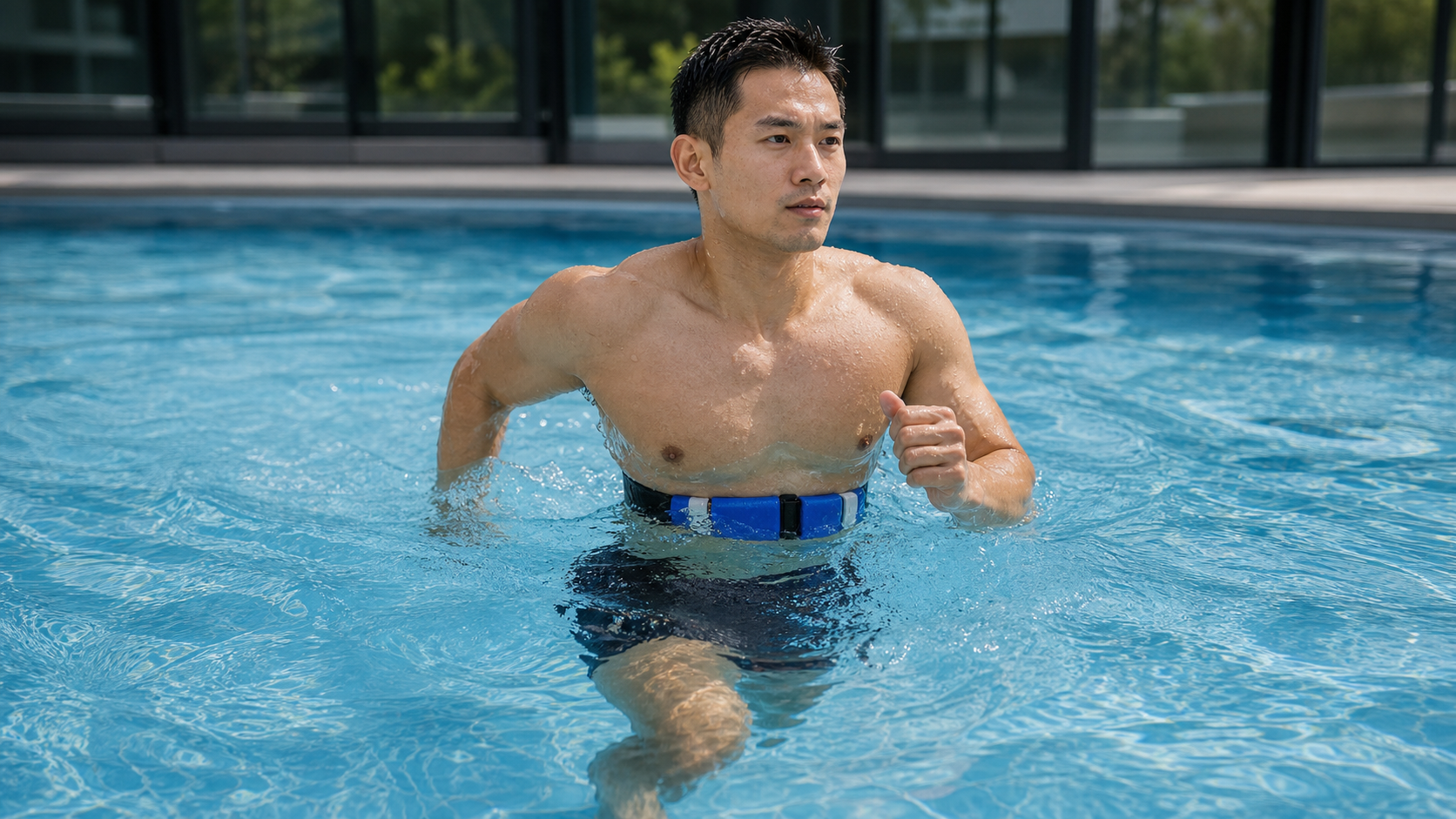
Aqua Jogging, known in Chinese as “水中跑步” or “深水跑步,” is a training method performed in a pool deep enough to cover the chest, where you wear a buoyancy belt and simulate running motions on land. Because your feet never touch the bottom, ground impact is virtually zero, while water resistance provides a muscle recruitment pattern close to actual running. This makes Aqua Jogging one of the best-supported options in sports science for injury replacement training specific to running.
The Scientific Basis of Aqua Jogging
High Similarity to Running Gait Patterns
Unlike swimming, Aqua Jogging’s movement pattern closely mirrors land running:
- Hip flexion and extension: The rhythm of forward swing and backward drive is nearly identical to land running
- Core rotational resistance: Water resistance makes anti-rotation core training more effective
- Running neural patterns: Preserves the neuromuscular coordination of land running, preventing “movement amnesia” when returning after injury
Research shows that injured runners who performed Aqua Jogging training for 4–6 weeks at the same heart rate as their land running experienced significantly less decline in running economy upon return compared to those who stopped training entirely.
Differences in Heart Rate and Oxygen Uptake Correspondence
One important characteristic of Aqua Jogging to understand: at the same perceived effort, heart rate in water is typically 10–15 bpm lower than on land. This is because water pressure increases venous return, and the cooling effect of water lowers core temperature, causing the heart to pump more blood per beat at the same power output.
| Training Mode | Heart Rate Difference at Same Perceived Effort | Coping Strategy |
|---|---|---|
| Easy land run at 120 bpm | In water, may only be 108–112 bpm | Rely primarily on RPE, not heart rate alone |
| Tempo land run at 150 bpm | In water, approximately 138–142 bpm | Accept the lower heart rate; confirm breathing is sufficiently hard |
| Land intervals at 170 bpm | In water, approximately 158–162 bpm | Shorten interval rest periods to maintain intensity perception |
Proper Aqua Jogging Technique
Basic Posture
- Keep your body at roughly 80 degrees upright (slightly forward-leaning, not fully vertical)
- Look forward with a relaxed neck
- Swing your arms naturally back and forth, mimicking arm swing from land running
- When driving the leg forward, raise the knee to hip height; when pushing back, fully extend the leg
- The kicking motion should originate from the hips, not just knee flexion
Common Mistakes
- Leaning too far back (buoyancy belt too strong or core instability)
- Leg motion resembling pedaling rather than running (distinguish between “running” and “treading water”)
- Slapping the water surface with your hands (hands should cut into the water to reduce unnecessary drag)
Sample Training Plans
Early Injury Phase (Weeks 1–2)
Goal: Maintain aerobic base, familiarize with the movement
- Warm-up: Easy water walking for 5 minutes
- Main set: Aqua Jogging for 20–30 minutes at an easy pace (RPE 4–5)
- Cool-down: Stretch and float in the water for 5 minutes
Mid-Recovery Phase (Weeks 3–6)
Goal: Simulate quality training, maintain speed stimulus
- Warm-up: 10 minutes easy
- Main set: 4–6 rounds of “3 minutes at a faster pace + 2 minutes easy”
- Cool-down: 10 minutes easy + stretching
Rapid Recovery Phase (After Week 6)
Goal: Combine water and land training in parallel, transitioning gradually
- Monday: Aqua Jogging 40 minutes (moderate intensity)
- Wednesday: Land run 20 minutes + Aqua Jogging 20 minutes
- Friday: Aqua Jogging 45 minutes (including intervals)
- Weekend: Attempt an easy 30–40 minute land run
Practical Tips
- Choose the right buoyancy belt: Common brands include Aqua Jogger, AquaBell, and others, available at major sporting goods stores in Taiwan or online, priced around NT$800–2,000. Make sure the belt supports your body weight so both feet stay completely off the bottom.
- Selecting a deep-water lane: Not all pools have deep-water sections. Confirm in advance that the water is at least 1.6 meters deep (usually sufficient for runners under 175 cm), or use the deep end of a diving pool.
- Wear training apparel rather than swimwear: Water resistance is part of the training stimulus during Aqua Jogging; shorts with slightly more drag are more effective than tight swim briefs.
- Use music for pacing: For interval training in the water, waterproof earphones with metronome-style music help maintain rhythm and prevent pacing from falling apart.
Conclusion
Aqua Jogging is currently the most complete alternative training method in running sports science for maintaining aerobic capacity and running neural patterns after injury. It requires no new skills to learn—all you need is a pool and a buoyancy belt to get started. Injury doesn’t have to mean a training halt; by correctly continuing to run in the water, your season doesn’t have to be completely reset by a single setback.
Related Reading
- Swimming Cross-Training for Runners: Aerobic Maintenance Strategies During Injury
- Research on the Benefits of Aqua Jogging as Replacement Training After Running Injuries
- Swimming Cross-Training for Road Runners: Complementary Benefits of Zero-Impact Water Aerobics
- Swimming as Cross-Training for Runners: How to Effectively Supplement Aerobic Capacity
西進武嶺 免費訓練分析服務 Intervals | 練不夠還是練過頭?你哪一種類型選手?AI模型告訴你! | 備戰神器 | 公路車 訓練 | CT Yeh
4 年前
2018 田中馬拉松 全程健跑 VR 360 環景錄影 體驗現場狂野加油氣氛! Insta 360
7 年前
2016/05/13 單車 冷水坑下滑
10 年前
水金九不厭五分 10度寒流冷到不願停!feat. 卡卡 / 公路車 / CT Yeh
6 個月前
#PUSHBIKE 原來這麼好玩! 小朋友 滑步車 初體驗 超可愛
6 年前
Never Stop 西進武嶺 前後雙機 完整全程錄影 訓練台 實境
8 年前
[防寒衣體驗] 鐵人魂 三鐵 防寒衣試穿會 於松運 深水游泳池 鯨魚池
8 年前
實景訓練台) 彰化經典百K 高強度喵團 90分鐘 跟著一起練功 2019 Indoor workout Changhua Classic 100 Taiwan
7 年前