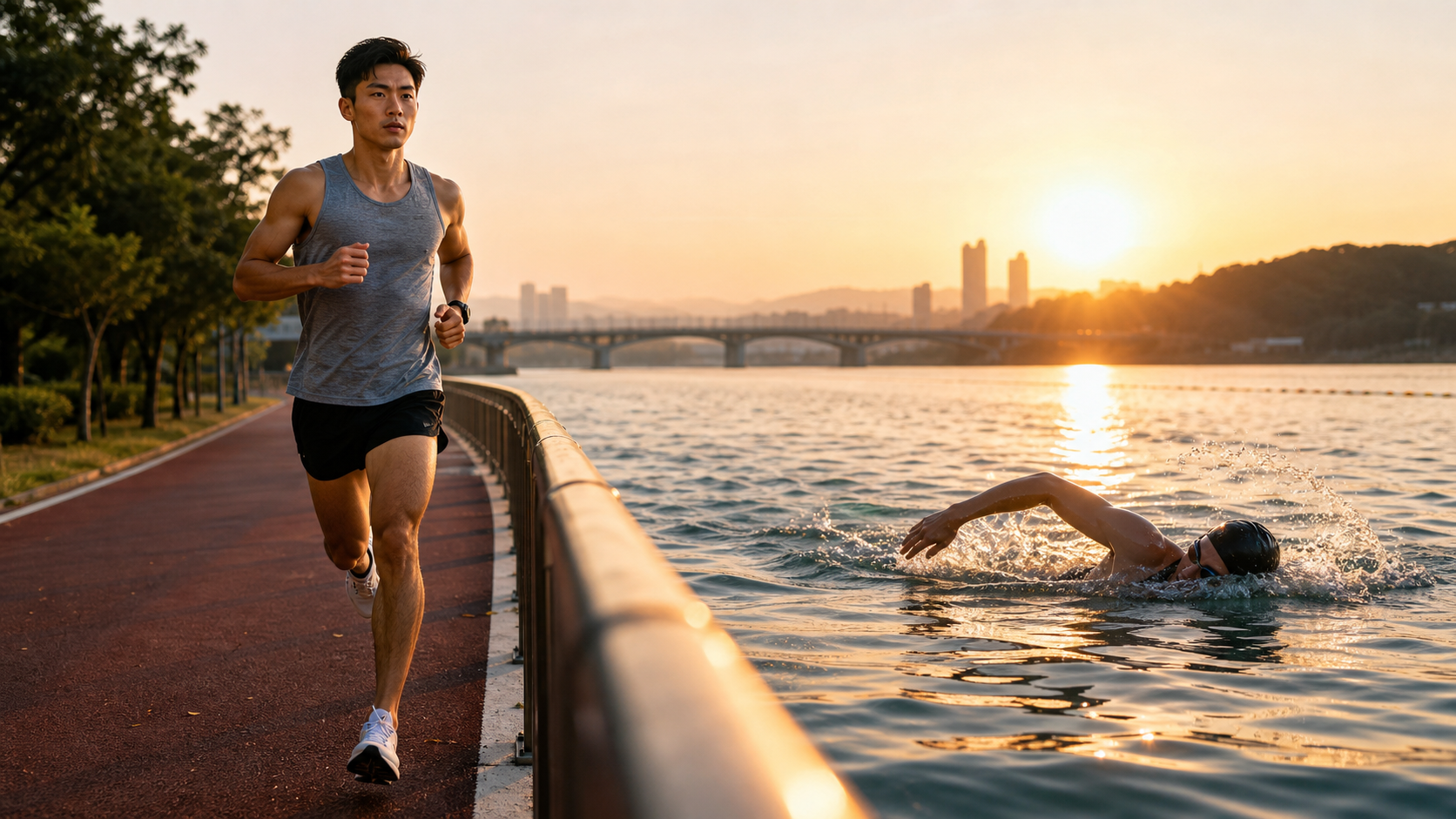
Introduction
Many runners who start trying swimming face a common dilemma: “How much time should swimming take? Will it affect the results of my running training?” There is no standard answer to this question, but there is scientific evidence to follow. Swimming and road running are highly complementary in terms of physiological adaptation—swimming strengthens the runner’s upper body and core strength, broadens the scope of cardiorespiratory stimulation, and provides a low-impact recovery option; while running reinforces the bone-loading capacity and leg power output that swimmers lack. The key lies in finding the optimal balance between the two.
Physiological Complementarity of Swimming and Running
Division of Labor Among Dominant Muscle Groups
| Muscle Group | Usage Level in Running | Usage Level in Swimming | Complementary Effect |
|---|---|---|---|
| Quadriceps | ★★★★★ | ★★ | Swimming reduces risk of fatigue accumulation |
| Gluteus Maximus | ★★★★ | ★★★ | Both strengthen it, effects multiply |
| Latissimus Dorsi | ★ | ★★★★★ | Swimming compensates for running’s upper body weakness |
| Core Muscles | ★★★ | ★★★★ | Swimming enhances core stability |
| Calves and Plantar Arch | ★★★★★ | ★ | Care needed—running volume should not be cut too much |
Complementarity of Cardiorespiratory Stimulation
The cardiorespiratory stimulation from running comes from weight-bearing aerobic work, which places higher impact on bones, tendons, and ligaments. Swimming is non-weight-bearing cardiorespiratory training. Combining the two can:
- Increase total aerobic training volume without increasing injury risk
- Provide different breathing rhythm challenges (swimming’s breath-holding constraints train the respiratory muscles)
- Broaden the scope of cardiorespiratory adaptation, avoiding the adaptation plateau of a single sport
Weekly Training Allocation Recommendations for Different Goals
Running-First, Swimming-Secondary (Marathon Training Period)
Suitable for: Runners seriously preparing for a marathon, with weekly mileage already at 50–70 km
| Week Type | Running | Swimming | Notes |
|---|---|---|---|
| Regular Week | 5 sessions (50–70 km) | 1–2 sessions (40 min each) | Swimming as recovery-day activity |
| High-Volume Week | 5–6 sessions (70–90 km) | 1 session (30 min) | Reduce swimming to maintain running volume focus |
| Taper Week | 3–4 sessions (30–40 km) | 2 sessions (45 min each) | Swimming fills the fitness gap after tapering |
Swimming and Running Equally Weighted (General Fitness Maintenance)
Suitable for: Fitness enthusiasts with no specific race goals who want balanced physical development
One-Week Sample Schedule:
- Monday: Running 45 minutes (easy pace)
- Tuesday: Swimming 45 minutes (technique + aerobic)
- Wednesday: Running 50 minutes (including 20 minutes tempo run)
- Thursday: Rest or easy cycling
- Friday: Swimming 50 minutes (aerobic intervals)
- Saturday: Long run 70–90 minutes
- Sunday: Swimming 30 minutes (easy recovery swim)
Transition During Injury
Suitable for: Those with minor lower-limb injuries requiring a temporary reduction in running volume
- Reduce running volume to 30–50% of usual
- Increase swimming to 4–5 sessions per week, split evenly between Aqua Jogging and regular swimming
- Ensure total aerobic training time does not fall below 80% of pre-injury levels
Precautions and Common Misconceptions
Misconception 1: More Swimming Means Better Running
Although swimming is beneficial, excessively increasing swimming volume will consume recovery resources and degrade the quality of running workouts. It is recommended that beginners swim no more than 3 times per week, with total time not exceeding 40% of running training time.
Misconception 2: Running Immediately After Swimming
When scheduling swimming + running on the same day, it is recommended to swim first and run afterward (or split them between morning and afternoon), because body temperature drops after swimming and muscles need a full warm-up before high-intensity running.
Misconception 3: Poor Swimming Technique Doesn’t Affect Results
Poor swimming technique wastes a great deal of energy on inefficient movements, causing fatigue far beyond expectations and affecting the next day’s running workout. It is recommended to spend 2–4 weeks initially improving swimming technique before adding aerobic training purposes.
Practical Advice
- Make swimming a fixed recovery-day activity: The simplest approach is to replace one weekly “easy cycling or walking” recovery day with a 30–40 minute easy swim, without adding training stress while achieving better active recovery.
- Use heart rate monitoring to integrate both sports: Purchase a waterproof sports watch (such as Garmin, Polar) to record heart rate synchronously during swimming and running, allowing more accurate assessment of total training load.
- Taiwan’s “run-swim” community: In recent years, more and more “run-swim clubs” have emerged in Taiwan, combining running groups with swimming training and regularly hosting courses by the pool—very suitable for beginners.
Conclusion
There is no absolute formula for the ratio between swimming and road running, but one principle always holds: keep training goals at the core and injury prevention as the baseline. For marathon runners, swimming is a supplementary tool; for general fitness enthusiasts, a 50/50 split is also perfectly reasonable. Find the rhythm that suits you, and let swimming become a long-term partner in your running career, not a short-term stopgap.
Related Reading
- Swim Cross-Training for Runners: The Complementary Benefits of Zero-Impact Water Aerobics
- Swimming and Running Cross-Training: How to Improve Overall Cardiorespiratory Endurance
- Cross-Discipline Training for Swimmers: The Supporting Role of Running and Cycling
- Swimming as Cross-Training for Runners: How to Effectively Supplement Aerobic Capacity
西進武嶺 免費訓練分析服務 Intervals | 練不夠還是練過頭?你哪一種類型選手?AI模型告訴你! | 備戰神器 | 公路車 訓練 | CT Yeh
4 年前
靠單車減肥35公斤 心得分享與整理
7 年前
一日北高前的高裝檢 | 北高 360 | 挑戰11小時的裝備 | 一日雙塔 | 補給
6 年前
戰略) Zwift Race 如何咬在第一集團 如何評估自己要開多少推力 (請開1.5倍速看)
7 年前
一日北高常見問題大集合 | 攻略 | 路線 | 訓練 | 補給 | 自行車 單車 | 一日雙城 | 雙塔 | TWB北高360 | 屁股痛
6 年前
一日北高/長距離團騎 常見問題補充篇 / 組團或跟團的眉角 / 壯車友容易被瘦車友慢性拉爆 / 原來屁股痛可能是這個原因...? / 風場配速法 / 公路車 / CT Yeh
2 年前
CT暗黑廚房) 車友必備 宇宙無敵鮮蚵湯 幫助訓練恢復 天然食補 好市多 超肥鮮蚵 破PR
7 年前
#PUSHBIKE 原來這麼好玩! 小朋友 滑步車 初體驗 超可愛
6 年前