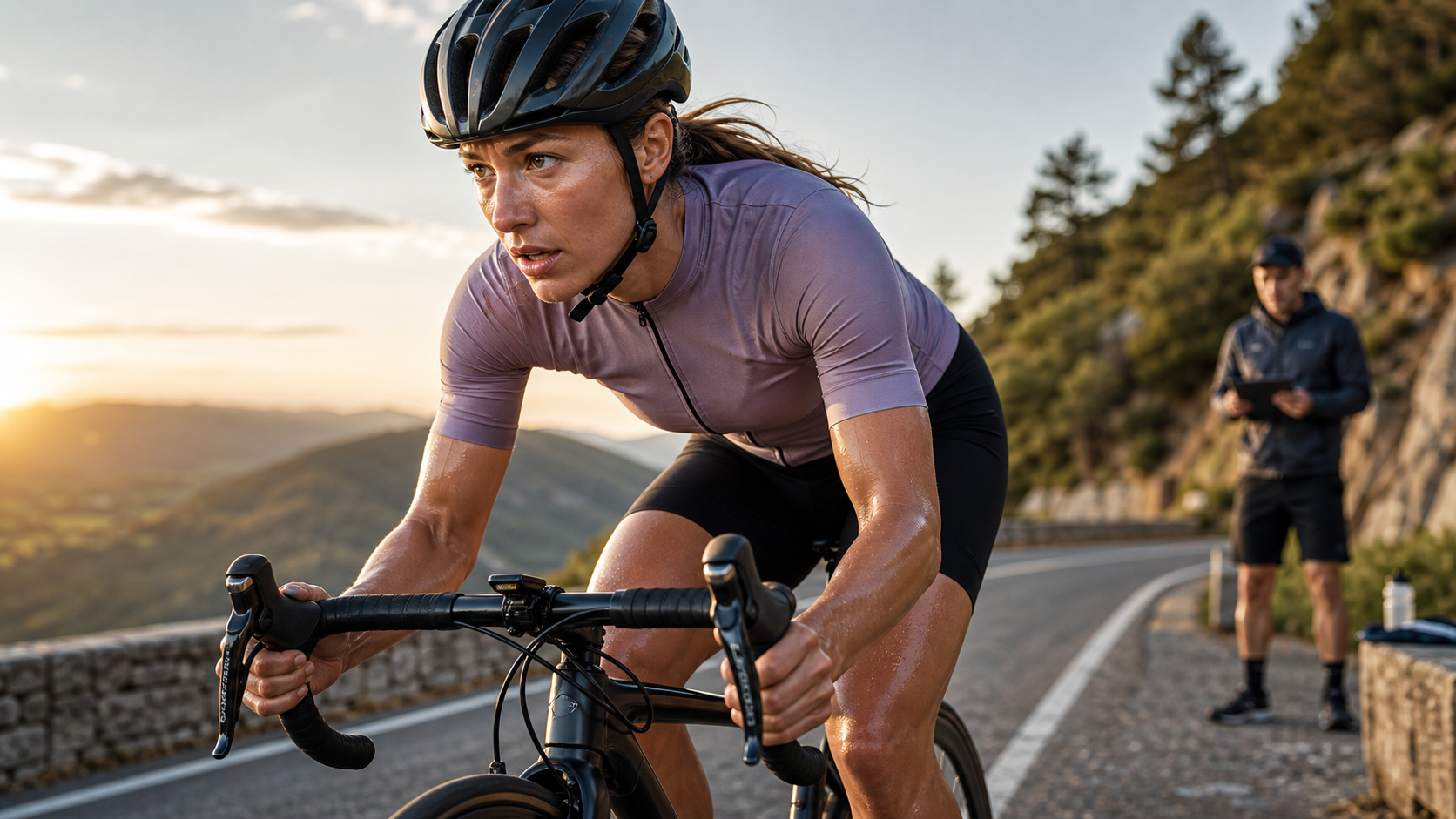
Introduction
“What’s your FTP?” is a common question among cyclists, but an absolute FTP number means relatively little unless it’s divided by body weight. An 80kg rider with a 280-watt FTP and a 60kg rider with the same 280-watt FTP will perform very differently on a climb. This is where Power-to-Weight Ratio (W/kg) comes in — it’s a universal language that allows riders of different builds to be compared fairly, and it’s the core metric for evaluating mountain climbing ability.
Calculating W/kg and Classification Standards
How to Calculate
W/kg = FTP (watts) ÷ Body Weight (kg)
For example: a rider weighing 68kg with an FTP of 280 watts has W/kg = 280 ÷ 68 ≈ 4.12 W/kg
FTP is typically estimated as 20-minute maximum power × 0.95, then divided by “body weight at the time power was measured” (not weight in full riding gear, but usually morning fasted weight).
Globally Recognized Classification (Male Baseline)
| Category | W/kg Range | Description |
|---|---|---|
| Cat 1 (World Class) | 5.60+ | World Tour riders, elite Tour de France climbers |
| Cat 2 (Elite) | 5.00–5.60 | Professional Continental level, top amateurs |
| Cat 3 (Advanced) | 4.00–5.00 | National-level racing, serious amateur riders in structured training |
| Cat 4 (Upper Intermediate) | 3.20–4.00 | Proficient enthusiasts who can complete climbing events |
| Cat 5 (Intermediate) | 2.50–3.20 | General trained amateur riders |
| Cat 6 (Entry Level) | Below 2.50 | Beginners or casual riders |
Female riders’ classification is typically adjusted down by about 0.4–0.5 W/kg, reflecting physiological differences (muscle mass proportion and gender gap in VO2max).
W/kg Requirements by Terrain
Flat-Road Cruising (0–1% Gradient)
At high speed on flat roads, air resistance is the dominant force (70–90% of total resistance). W/kg becomes far less important — absolute power output (watts) and riding position/aerodynamic efficiency are the deciding factors.
- Cruising at 35km/h: requires roughly 2.8–3.5 W/kg (a 70kg rider needs about 200–245 watts)
- Cruising at 40km/h: requires roughly 4.0–5.0 W/kg
- Time trial speed of 45km/h: requires 5.5 W/kg or above, or excellent aerodynamic equipment
Moderate Climbs (3–5% Gradient, Sustained 15–30 Minutes)
This is the most common climbing terrain in Taiwan (such as Yangmingshan or the lower section of Wuling). Gravity begins to dominate, and the W/kg effect becomes clear.
| Performance Goal | Estimated W/kg Required |
|---|---|
| Staying with a general group ride | 2.8–3.2 W/kg |
| Climbing comfortably without falling behind | 3.2–3.8 W/kg |
| Contesting the KOM on the same segment | 4.0–4.5 W/kg |
Long High-Mountain Climbs (5–8% Gradient, Sustained Over 1 Hour)
Wuling (elevation 3,275m) is the sacred mountain for Taiwanese cyclists. Its average gradient is roughly 4–5%, but combined with altitude effects (thinner air, reduced VO2max), the real-world challenge far exceeds what the gradient numbers suggest.
- Completing Wuling within 5 hours: requires roughly 3.8–4.2 W/kg of sustained power
- Completing Wuling within 4 hours: requires roughly 4.5–5.0 W/kg
- Professional level (under 3 hours): requires 5.0 W/kg or above
Short, Steep Climbs (10%+ Gradient, Sustained 3–8 Minutes)
This terrain demands the most extreme W/kg, and the contribution of W’ (anaerobic work capacity) becomes much more significant.
- Completing a typical steep urban climb in Taiwan (such as Taipei’s Sanjing Road): 2.8 W/kg or above
- Attacking on a climb to stay with race pace: 5.0–6.0 W/kg (in short bursts)
Strategies to Improve W/kg
Increase the Numerator: Raise FTP
This is the most direct path — systematically raising FTP through sweet spot training, threshold training, and HIIT programs. A rider with an existing training base can typically improve FTP by 5–15% per year.
Decrease the Denominator: Reduce Body Fat
For 80% of amateur riders, losing weight is an easier way to improve W/kg than raising FTP.
| Body Weight | FTP | W/kg | W/kg if FTP stays the same and weight drops to 65kg |
|---|---|---|---|
| 72kg | 252W | 3.50 | 3.88 W/kg (+11%) |
| 68kg | 245W | 3.60 | 3.77 W/kg (+4.7%) |
| 65kg | 240W | 3.69 | 3.69 W/kg (baseline) |
But be careful: deliberately losing weight too fast (more than 0.5–0.8kg per week) damages muscle mass and recovery capacity, causing FTP to drop and defeating the purpose. The correct approach is to adjust diet slowly and steadily during a non-peak training period, losing no more than 0.5kg per week.
Comparing the Two Approaches Realistically
- Raising FTP by 10% requires 3–6 months of structured training
- Losing 2.5kg (assuming an original weight of 70kg) similarly brings about a 3.6% improvement in W/kg, and is achievable for most people within 1–2 months
- Best strategy: combine aerobic base training with dietary adjustment during the off-season, letting both improve gradually
Common Myths Clarified
Myth 1: Higher W/kg is always better, so you should lose weight at any cost
False. Being underweight leads to lower bone density, weakened immunity, and poor post-training recovery, which is harmful to a long-term cycling career.
Myth 2: W/kg doesn’t matter on flat roads
On flat roads, absolute power is more critical, but W/kg still affects acceleration from a stop and performance on short climbs.
Myth 3: Once W/kg is set, it doesn’t change
W/kg fluctuates dynamically with training status, season, and age. It may decline in winter due to reduced training, and may reach a personal peak during pre-race peaking periods.
Practical Recommendations
- Test your FTP once per season and record your body weight at the same time to build a W/kg progress curve
- Set terrain-specific goals: riders targeting Wuling should treat 3.8 W/kg as their “qualifying line”
- Don’t pursue aggressive weight loss during high training volume periods, as this causes an energy deficit
- Use the W/kg tracking features in intervals.icu or TrainingPeaks to visualize your progress
- Taiwan’s summer heat can make you feel heavier, but the W/kg numbers don’t lie — adjust your expectations based on the data rather than doubting the equipment
Conclusion
W/kg is the fairest and most direct quantitative measure of a cyclist’s climbing ability. Different terrain demands vastly different W/kg — flat roads rely on absolute power, gentle grades rely on efficiency, and long high-mountain climbs are decided almost entirely by W/kg. Understanding where your own W/kg stands relative to the demands of your target terrain is the key to building a meaningful training and weight management plan. The goal isn’t to chase a perfect number, but to be able to complete the ride you’ve set your heart on — and to ride it more easily, faster, and with more confidence.
Related Reading
- Improving Power-to-Weight Ratio (W/kg): Strategies for Boosting Power While Managing Weight
- Weight Management for Climbers: The Relationship Between W/kg and Climbing Speed
- Power-to-Weight Optimization Guide: How to Improve W/kg Without Sacrificing Health
- Climbing and Body Weight: Training and Diet Strategies for Improving W/kg
西進武嶺 8000名單車友數據分析 PART1 | 從新手到高手數量/瓦數/推力比/FTP推力比/功率計使用率 大解析 | 公路車 | CTYeh
5 年前
RAMP FTP Test 直播 究竟能撐到幾瓦 訓練台 Gravat Zwift
6 年前
車友來我家測FTP...好硬啊🤣 #cycling #公路車
2 年前
如果Pogačar騎西進武嶺可以多快?會破2嗎?各種情況深度推估探討 / 公路車 / CT Yeh
2 年前
ThinkRider 智騎 XXPRO 訓練台,高階機種功能 只要 1/3價格!? 實測功率對比、噪音實測 / 公路車 / CT Yeh
1 年前
單車AI教練!全新 ChatGPT4o 幫你分析訓練成果!排武嶺課表,分析騎車姿勢! 太神了! / 公路車 / CT Yeh / feat. 緯緯
2 年前
全台首發!邁金P715踏板功率計!市場價格撼動者再出招 / 功率對比實測 / FAVERO ASSIOMA 可參考! / 公路車 / CT Yeh
1 年前
西進武嶺配速器 3.0更新 / NEW 免功率FTP估算! / 大數據xAI體能模型 / 如何模擬人止關前集團效應 / 配速儲存功能 / AI全台自行車賽事行事曆 / 公路車 / CT Yeh
1 年前