Introduction
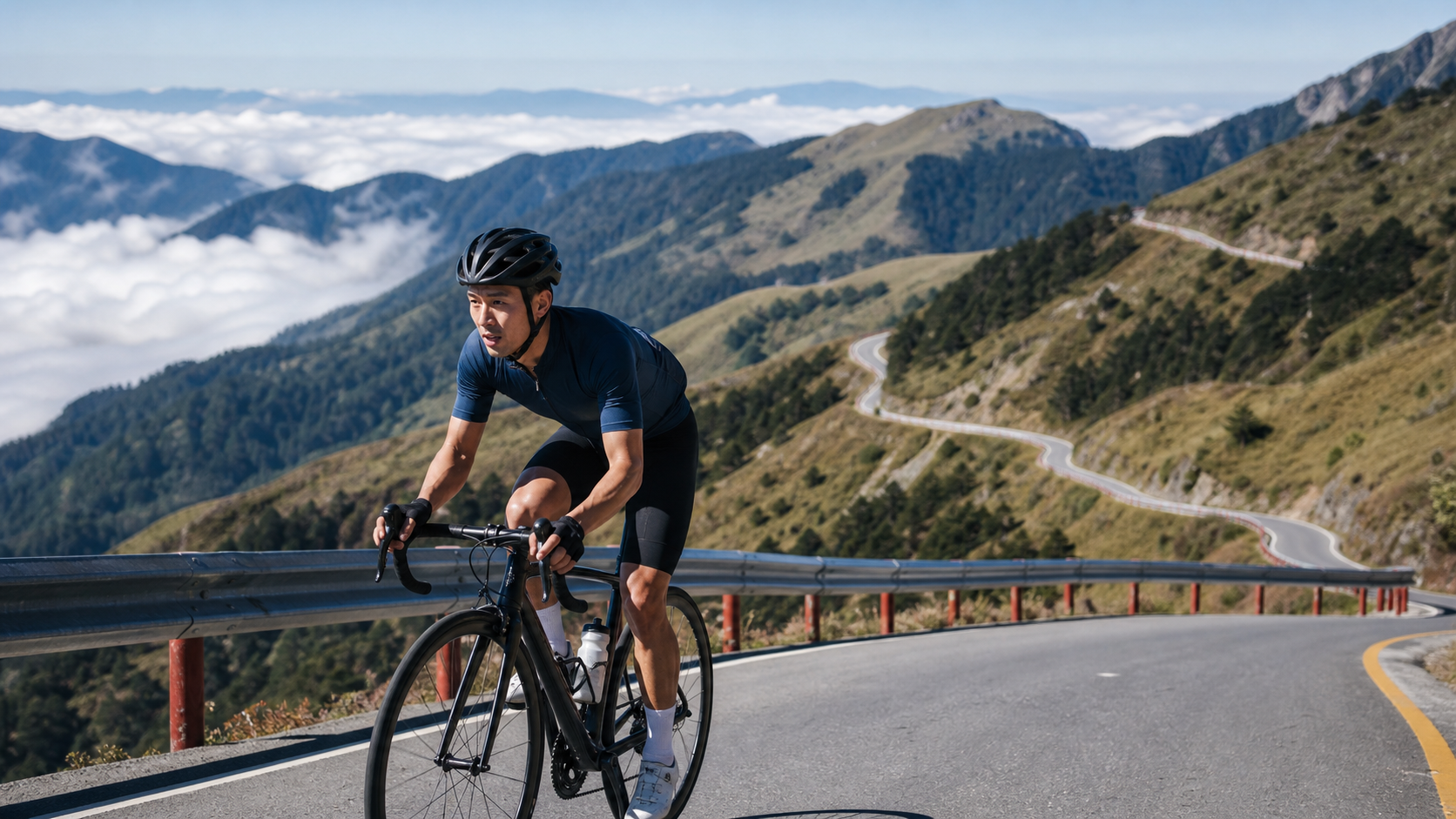
Taiwan is an island covered in mountains, with the Central Mountain Range boasting numerous peaks exceeding 3,000 meters. Among them, Provincial Highway 14A (Cingjing—Wuling—Dayuling) is one of the few roads in the world where cyclists can reach an elevation of 3,275 meters. This geographical advantage gives Taiwanese riders access to high-altitude training resources that riders from flatland countries can hardly match.
The stimulus that high-altitude environments provide to the cardiopulmonary system is multi-dimensional. Not only does it increase hemoglobin concentration and oxygen-carrying capacity, but it also forces the cardiopulmonary system to find more efficient ways to operate under hypoxic conditions. Understanding these mechanisms can help Taiwanese riders make more systematic use of mountain routes to reap the “high-altitude training effect.”
Effects of High-Altitude Environments on the Human Body
As altitude increases, atmospheric pressure drops, and the partial pressure of oxygen (PO2) in the air decreases accordingly:
| Altitude | Atmospheric Pressure (hPa) | Oxygen Partial Pressure (mmHg) | Relative Oxygen Content |
|---|---|---|---|
| Sea level | 1013 | 159 | 100% |
| 1000 m | 899 | 141 | 89% |
| 2000 m | 795 | 125 | 79% |
| 3000 m | 701 | 110 | 69% |
| 3275 m (Wuling) | 678 | 106 | 67% |
At Wuling, the oxygen partial pressure is only 67% of that at sea level. Even when pedaling at the same effort, the amount of oxygen reaching the muscles is significantly reduced, and the cardiopulmonary system must work harder to maintain the same output.
Key physiological responses:
- Increased ventilation: Breathing rate and depth increase, expelling more CO2, which raises blood pH (respiratory alkalosis)
- Elevated heart rate: At the same intensity, heart rate at altitude is 10–20 bpm higher than at low altitude
- Increased erythropoietin (EPO) secretion: The kidneys sense hypoxia and increase EPO secretion, stimulating the bone marrow to produce more red blood cells
- Rise in 2,3-DPG: 2,3-diphosphoglycerate increases in red blood cells, promoting the release of oxygen from hemoglobin to the muscles
The Core Benefit of Altitude Training: Live High, Train Low
The most scientifically supported form of altitude training is “Live High, Train Low (LHTL)”: living at altitude (accumulating hypoxic stimulus to increase red blood cells) while training at low altitude (where training quality is higher and high-intensity intervals are possible).
How this works in practice in Taiwan:
- Living: Cingjing Farm (1,750 m), Nantou Lushan (1,200 m)
- Training: Descending to Puli (430 m) or Sun Moon Lake (748 m) for intensity sessions
However, the full benefits of LHTL require 3–4 consecutive weeks to manifest. For most amateur Taiwanese riders, a more practical approach is “weekend mountain riding.”
Cardiopulmonary Training Benefits of Taiwan’s Mountain Routes
Hehuan Mountain Wuling (3,275 m)
Starting from Wushe (1,148 m), the ride covers approximately 55 km with about 2,100 m of cumulative climbing. The hypoxic stimulus in the latter half of the ride (above 2,500 m) is highly significant—heart rate at the same power output runs 15–20 bpm higher than on flat terrain, making it an excellent high-intensity hypoxic workout.
Taipingshan (1,950 m)
Approaching from the Yilan side, the gradient is steady, making it ideal for extended Zone 3–4 climbing sessions, with the altitude providing a moderate hypoxic stimulus.
Alishan (2,216 m)
From Chiayi to Alishan, 52 km with approximately 2,100 m of climbing, suitable for long endurance climbs, with the higher-altitude sections providing hypoxic stimulus.
Safety Considerations for High-Altitude Riding
- Recognizing altitude sickness: Headache, nausea, and dizziness are early symptoms of Acute Mountain Sickness (AMS); if they occur, descend immediately
- Acclimatization: For your first ride on high-altitude routes like Wuling, it is recommended to stay overnight in Cingjing (1,750 m) the night before to give your body time to adapt
- Dealing with cold: Temperatures at the summit of Wuling can drop to 5–10°C, and the contrast with the summer heat at lower elevations is stark—bring windproof jacket and pants for the descent
- Pacing control: Do not pace high-altitude climbs based on your flatland standards; control your rhythm by “perceived exertion,” as heart rate will often be higher than usual
Practical Recommendations
- Ride mountain routes 1–2 times per month: Schedule monthly high-altitude rides on a regular basis to accumulate hypoxic stimulus; this is more effective than occasional one-off rides
- Record your high-altitude heart rate: Establish heart rate baselines at different elevations to track your acclimatization progress
- Combine with triathlon or multi-day rides: If your schedule allows, staying 2–3 days at altitude yields far greater benefits than a same-day round trip
- Avoid high-altitude training 3–4 weeks before races: The benefits of altitude training take 2–3 weeks to materialize, but recovery from training fatigue also takes time, so race scheduling requires careful planning
Conclusion
Taiwan’s high-mountain roads are a unique cardiopulmonary training resource for Taiwanese riders. Every attempt at Wuling is not merely about chasing mileage numbers—it is a deep stimulus to the cardiopulmonary system in a hypoxic environment. Without relying on artificial hypoxic tents, Taiwanese riders can enjoy the same high-altitude training conditions that European professionals must travel overseas to obtain. Making full use of this geographical advantage is a smart shortcut to improving cardiopulmonary endurance.
Related Reading
- Riding Around Taiwan’s Hundred Peaks: Climbing Adjustments for High-Altitude Cold and Low Pressure
- The Physiology of High-Altitude Riding: Scientific Preparation for Riding in Taiwan’s Mountains
- High-Altitude Cycling Training: The Hypoxic Effects and Adaptation Strategies of Wuling at 3,275m
- High-Altitude Training Guide: How Flatland Riders Can Use the Altitude Effect to Improve Performance
台灣登山王之路 KOM 全程參賽4K臨空錄影 PART1 穿越峽谷地形! #東進武嶺 太魯閣 / 燕子口 / 天祥 / 西寶 PART1 (公路車 / CT Yeh)
3 年前
台中大雪山 膏王領騎 震到都沒畫面了 公路車
5 年前
太平山單車員工旅遊 | 這樣玩CP值最高!| 公路車
5 年前
#北橫 + #北進武嶺 最硬的員工旅遊 EP1 | #公路車 #拉拉山 | 明池 | 武嶺 | 武陵農場 | 雲海 | Taiwan Cycling Route Wulin
6 年前
大武山後門26%歡樂陡坡!JJSC南台灣單車行Day2 / 被颱風追著跑 / 公路車 / CT Yeh
2 年前
#公路車 #Vo2Max #最大攝氧量 測驗 體驗 | 心肺測試
6 年前
大武山20%魔王陡坡【JJSC南台灣遊騎Day2】!屁股真的要裂開了...凡士林抹滿也沒用?神秘金教堂還有超便宜夜市
3 個月前
新竹羅平 x 天湖部落 大禹嶺級變態陡坡! 4K超高畫質 空拍 | 公路車
5 年前