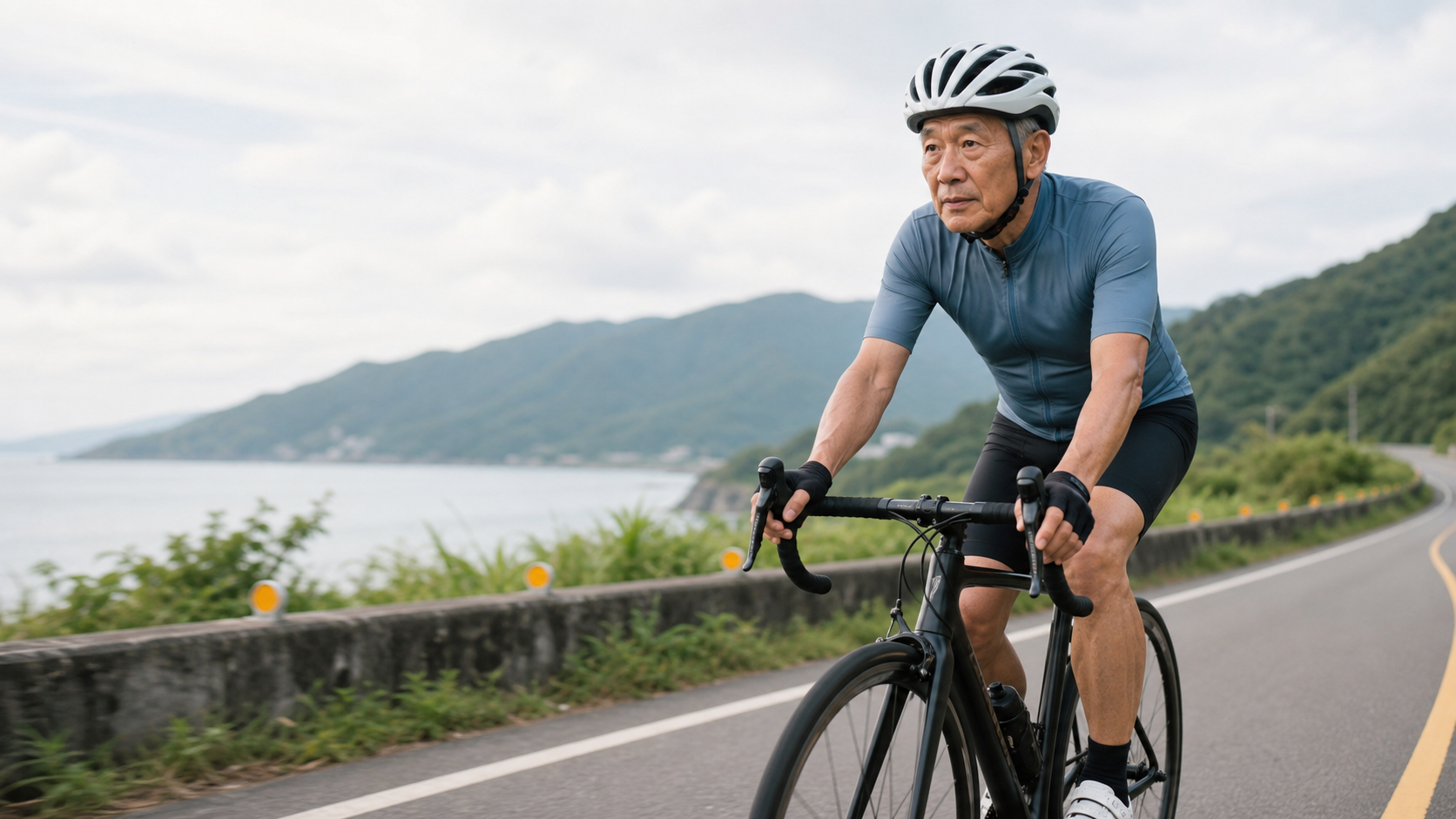
Introduction
Cycling is an exceptionally age-friendly sport: low-impact, sustainable, and with easily adjustable intensity, allowing people of all ages to participate safely. However, the reality of physiological aging cannot be avoided—maximum heart rate, VO2max, and muscle strength all naturally decline with age. For Taiwanese riders over 50, training strategies must be adjusted accordingly to maintain aerobic capacity while protecting the body, and to continue enjoying the pleasure of riding.
The good news is: research shows that 60–70-year-old senior athletes who adhere to regular aerobic training often have VO2max values 50–80% higher than their sedentary peers of the same age, and can even rival many average adults in their 30s–40s. Aging is not a reason to stop improving, but a reminder that smarter training is needed.
The Effects of Age on Cardiopulmonary Function
| Physiological Indicator | Natural Decline per Decade | Degree of Mitigation Through Training |
|---|---|---|
| Maximum Heart Rate (HRmax) | 5–8 bpm | Low (difficult to change) |
| VO2max | Approximately 10% | High (maintainable through training) |
| Stroke Volume | 5–10% | Moderate to High |
| Lactate Threshold Power | 10–15% | High |
| Heart Rate Recovery Speed | Slower | Moderate |
| Muscle Mass | 3–8% | Moderate to High |
The decline in maximum heart rate is the most definitive effect of age on the cardiopulmonary system and is nearly impossible to reverse through training. This means that even if older riders train exceptionally well, their HRmax will be lower than in their youth, and training zones calculated based on a fixed heart rate must be regularly updated with age.
Conversely, the lactate threshold ratio (the ratio of threshold power to VO2max power) can be maintained at a higher level through training, meaning older riders can sustain riding “closer to their maximum capacity.”
Cardiopulmonary Training Principles for Older Riders
Principle One: Extend Recovery Time
Riders over 50 require 20–30% more recovery time after the same training load than they did when younger. At least 48–72 hours are needed for full recovery after high-intensity training, rather than the 24–48 hours of their younger years.
Principle Two: Reduce High-Intensity Frequency
Younger riders can perform high-intensity training 2–3 times per week, but riders over 60 are advised to reduce VO2max or threshold training to once per week, keeping the rest of their training in Zone 1–2.
Principle Three: Place Greater Emphasis on Zone 2 Training
Zone 2 training is especially important for older riders because it effectively maintains mitochondrial function and improves fat metabolism efficiency, while requiring far less recovery than high-intensity training. Three to four 60–90-minute Zone 2 sessions per week form the core training volume for older riders.
Principle Four: Incorporate Strength Training
Cycling is a predominantly cardiorespiratory aerobic sport with limited effectiveness in maintaining muscle mass (especially fast-twitch muscle fibers). Two weekly sessions of leg strength training (squats, leg presses, single-leg deadlifts) are recommended to combat age-related sarcopenia.
Age-Adjusted Guidelines for Training Volume and Intensity
| Age Group | Weekly Training Hours | High-Intensity Frequency | Recovery Days |
|---|---|---|---|
| 40–49 | 8–12 hr | 2 times per week | 1–2 days |
| 50–59 | 6–10 hr | 1–2 times per week | 2 days |
| 60–69 | 5–8 hr | 1 time per week | 2–3 days |
| 70 and above | 3–6 hr | 1 time every 2 weeks | 2–3 days |
Special Considerations for Older Taiwanese Riders
Cardiovascular Health Screening
Before starting higher-intensity training, riders over 50 in Taiwan are advised to undergo:
- General health check-ups (blood pressure, blood lipids, blood glucose)
- Exercise stress ECG (Stress ECG) to rule out asymptomatic ischemic heart disease
- If there is a history of heart disease, hypertension, or diabetes, the training plan should be adjusted under a physician’s guidance
Bone Density Considerations
Pure cycling has limited effectiveness in maintaining bone density (as it is a non-weight-bearing exercise). It is recommended to combine it with 2–3 sessions per week of walking, hiking, or light running to maintain bone health.
Climate Adaptation
Older riders have poorer thermoregulation abilities, and Taiwan’s summer heat places greater thermal stress on older cyclists. It is recommended to avoid riding during the high-temperature period from 10 a.m. to 4 p.m. in summer.
Practical Recommendations
- Use Rate of Perceived Exertion (RPE) to Supplement Heart Rate Monitoring: Due to the decline in HRmax, older riders’ heart rate zones differ from those of their youth; RPE (subjective fatigue on a 1–10 scale) should be used as an auxiliary measure
- Value “How You Feel” Over “Numerical Performance”: Stop comparing yourself to your younger self, and set reasonable goals based on your current physical condition
- Group Rides Help with Consistency: Taiwan has many senior cycling communities; a regular riding group provides motivation and safety assurance
- Adequate Sleep and Nutrition Are Even More Critical: Older riders’ muscle repair relies more heavily on high-quality sleep, and protein intake requirements (approximately 1.2–1.6g per kilogram of body weight per day) are no lower than those of younger riders
Conclusion
The physiological changes brought by age are real, but they do not mean that the joy and benefits of cycling will disappear along with them. Adjusting training pace and allocating intensity and recovery more intelligently are the key strategies for older riders to continue enjoying cycling and maintaining good cardiopulmonary health. Those Taiwanese riders who persist in riding up Wuling at 60 or 70 years old are the best proof: age is not an endpoint, but a new starting point that requires wiser handling.
Related Reading
- The Impact of Age on Cycling Cardiopulmonary Performance and Training Adjustment Strategies
- Age and Cycling Performance: VO2max Decline Rate and Maintenance Strategies
- Cycling Aging Physiology: How to Maintain Peak Performance After 40
- Power Maintenance for Riders Over 45: Training Strategies to Counteract VO2max Decline
#公路車 #Vo2Max #最大攝氧量 測驗 體驗 | 心肺測試
6 年前
2025 自行車錶排行榜 兩萬車友大數據 / Garmin Bryton 排名會大洗牌嗎? / 全新的碼表前身分析 /公路車 / CT Yeh
1 年前
靠單車減肥35公斤 心得分享與整理
7 年前
2026 車錶排行榜!誰是最多車友正在使用?練家子最愛哪款?🏆 (2萬名車友數據) / 公路車 / CT Yeh
5 個月前
西進武嶺 免費訓練分析服務 Intervals | 練不夠還是練過頭?你哪一種類型選手?AI模型告訴你! | 備戰神器 | 公路車 訓練 | CT Yeh
4 年前
#公路車 #Fitting 靠人工智慧APP 幫你調整單車
6 年前
一日北高/長距離團騎 常見問題補充篇 / 組團或跟團的眉角 / 壯車友容易被瘦車友慢性拉爆 / 原來屁股痛可能是這個原因...? / 風場配速法 / 公路車 / CT Yeh
2 年前
一個測試有沒有認真練車的方法😂 #公路車
10 個月前