Introduction
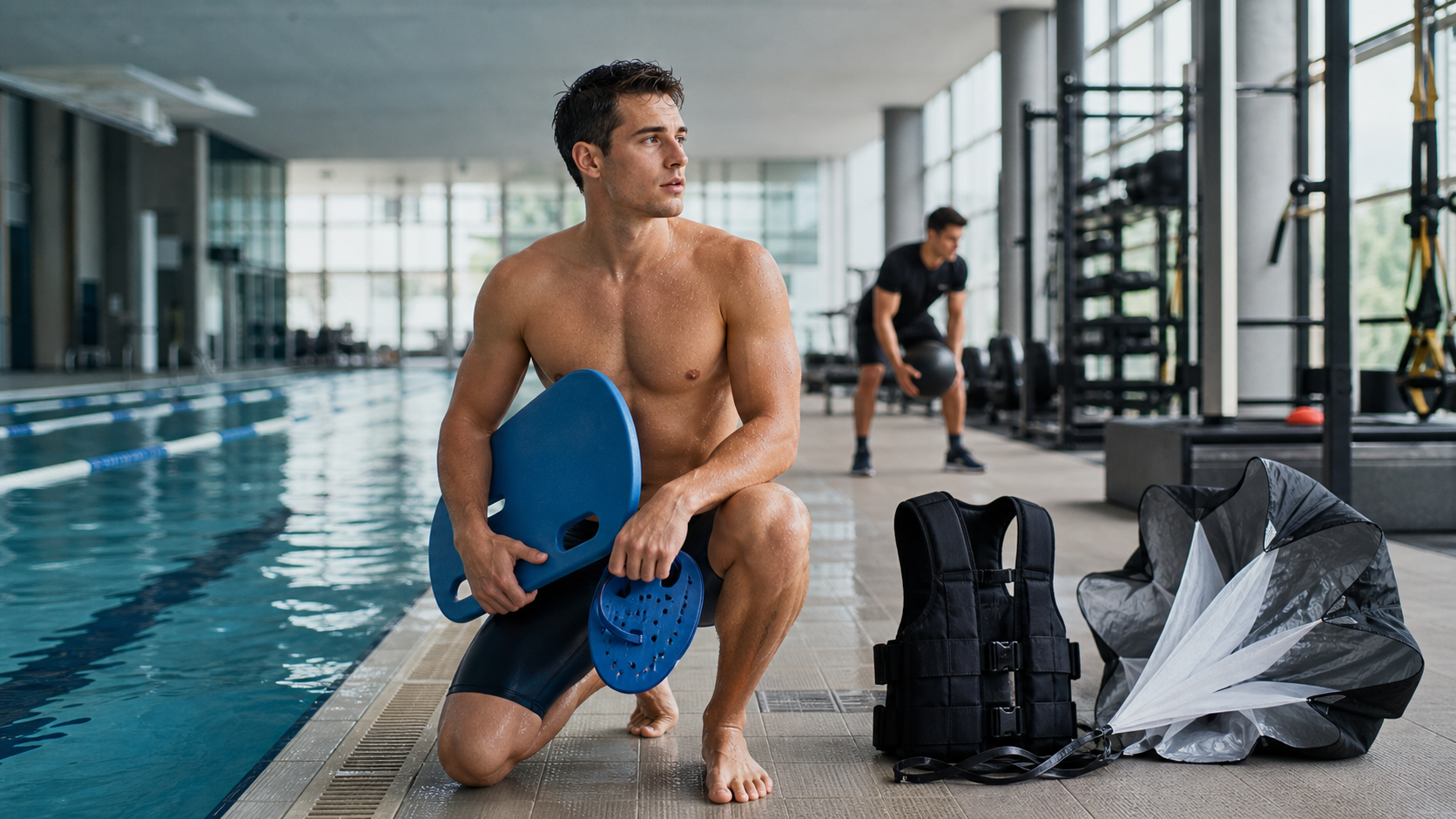
Various aids used in swimming training, such as hand paddles, resistance vests, drag chutes, and kickboards, have long been regarded as water-specific tools for technique or conditioning. However, with the development of sports science, researchers have found that the muscle recruitment patterns activated by these tools overlap significantly with many functional land-based movements. Understanding the functional transfer benefits of various water resistance training aids can help runners, cyclists, and triathletes design more effective cross-training programs.
Muscle Recruitment Analysis of Common Swimming Aids
Hand Paddle
Hand paddles increase the surface area of the hand, intensifying resistance on every stroke, primarily strengthening:
- Latissimus Dorsi: The primary muscle in the pulling motion
- Posterior Deltoid: Completes the latter phase of the stroke
- Rotator Cuff: Stabilizes the shoulder joint, preventing excessive internal rotation of the humerus
- Transversus Abdominis: Core anti-rotation stability, preventing body sway
Land Transfer Benefits: A strengthened latissimus dorsi directly improves a cyclist’s upper-body stability on the bike, reducing back fatigue over long rides; for runners, both arm swing efficiency and core stability are enhanced.
Kickboard
When using a kickboard, the upper limbs support the front while the lower limbs perform kicking training, strengthening:
- Quadriceps (butterfly kick)
- Gastrocnemius and Soleus: Ankle dorsiflexion/plantarflexion
- Anterior-posterior core stability: Maintaining a horizontal body position
Land Transfer Benefits: The kicking motion of the kickboard mimics part of the muscle pattern used in cycling pedaling, providing supplementary training for a road cyclist’s pedaling muscular endurance.
Pull Buoy
Placing a pull buoy between the legs allows the lower limbs to float, training pure upper-body pulling:
- Eliminates lower-limb interference, forcing the upper body to fully drive forward propulsion
- Strengthens the recruitment efficiency of the aforementioned latissimus dorsi and core
- Helps develop the correct “high-elbow catch” technique
Land Transfer Benefits: The core stability enhancement is the most pronounced, directly benefiting a runner’s anti-rotation capacity.
Water Resistance Vest or Drag Chute
Increasing water resistance forces the whole body to work harder against resistance:
| Aid | Primary Function | Suitable Audience |
|---|---|---|
| Drag Chute | Swimming speed training, increases resistance | Competitive swimming, triathlon |
| Water Resistance Vest | Increases full-body resistance, boosts aerobic output | Aqua Jogging users |
| Resistance Tether (resisted swimming) | Anchored to the pool edge, swimming in place | Primarily strength training |
Functional Movement Design for Water Resistance Training
Water-Specific Resistance Drills for Runners
The following is a list of water resistance drills for runners:
- Water High-Knee Running (with resistance belt): Simulates hip flexion during fast running, strengthening the iliopsoas
- Water Lateral Shuffle (water depth up to the waist): Simulates agility training, strengthening hip abductors
- Water Lunge Squats: Strengthens the quadriceps and glutes; water resistance makes the movement more stable
- Water Arm Swing Resistance Training: Using hand paddles or water dumbbells to strengthen arm swing muscles
Water Core Resistance Drills for Cyclists
- Water Plank (holding the pool edge, body parallel to the water surface): Strengthens deep core muscles
- Water Lateral Kicks (standing in deep water): Strengthens hip joint stability, improving pelvic stability while riding
- Hand Paddle Upper-Body Resistance Swimming: Builds upper-back strength, improving upper-body fatigue tolerance while cycling
Safety Considerations
- Resistance aids must be used with proper technique: Using hand paddles before technique is stable can easily lead to shoulder impingement syndrome; it is recommended to ensure basic swimming technique before introducing aids.
- Fatigue from water resistance training is easily underestimated: The aquatic environment makes it difficult to perceive true fatigue levels; it is recommended to reduce training volume by 20–30% when first using a new aid and observe recovery the following day.
- Use with caution for children and beginners: Resistance vests and drag chutes should be used by adults with swimming proficiency; beginners are not advised to use them.
Practical Recommendations
- Start with a single aid: When first introducing water resistance training, it is recommended to begin with only a kickboard or pull buoy, then add hand paddles once accustomed, avoiding changing too many movement variables at once.
- Availability in Taiwan: Major sporting goods chains (Decathlon, GoSport) all sell basic swimming aids; hand paddles cost approximately NT$300–600, kickboards approximately NT$200–400, making the entry barrier low.
- Compare with land-based strength training: The latissimus dorsi trained with hand paddles in the water can be compared with land-based chin-ups to observe the correlation in sensation between the two, enhancing muscle awareness.
Conclusion
The value of swimming aids extends far beyond the water. The back strength developed through proper hand paddle use, the full-body aerobic power cultivated by drag chutes, and the lower-limb propulsion built with kickboards can all manifest in different forms during land-based sports. For endurance athletes seeking to maximize cross-training benefits, incorporating swimming aids into a systematic training plan is an advanced strategy worth trying.
Related Reading
- Proper Use of Resistance Training Aids (Hand Paddles/Resistance Pants)
- The Complete Guide to Swimming Resistance Tools: Application Strategies for Hand Paddles, Drag Chutes, and Resistance Tethers
- Swimming Resistance Training: Integrating Paddles, Drag Chutes, and Pull Buoys into Workout Plans
- Kickboards and Hand Paddles Serve Different Purposes: How to Use Training Aids Correctly
訓練台體驗) 2019台北自行車展 三大家 訓練台體驗 Tacx Neo Flux 2 Xepdo Apx Wahoo Kickr
7 年前
3D 列印車褲墊 / 舒適改善? / 無痕 x 分區壓縮 / ATK & Decider系列 / JE22黑科技 / #公路車 #CTYEH
11 個月前
#公路車 #Fitting 靠人工智慧APP 幫你調整單車
6 年前
西進武嶺 免費訓練分析服務 Intervals | 練不夠還是練過頭?你哪一種類型選手?AI模型告訴你! | 備戰神器 | 公路車 訓練 | CT Yeh
4 年前
#PUSHBIKE 原來這麼好玩! 小朋友 滑步車 初體驗 超可愛
6 年前
一日北高 實用 單車手機架!Bone蹦克磁吸單車手機綁 //環島/室內訓練 / 導航的APP推薦 / 日本島波海道取景 / 公路車 / CT Yeh
2 年前
洗單車神器 吹水機! 實際洗車用用看 暴力洗鍊條大法 | 公路車 | CT Yeh
4 年前
大家都在開箱的...單車用藍芽對講耳機真的有幫助嗎? SENA BiKom 20 長距離旅遊 & 海鷗繞圈賽 實際體驗心得 / 公路車 / CT Yeh
9 個月前