Introduction
VO2max (maximal oxygen uptake) is the gold-standard indicator of aerobic endurance, referring to the maximum amount of oxygen the body can consume per minute per kilogram of body weight (ml/kg/min). In exercise physiology laboratories, this value requires a graded treadmill test combined with breath-by-breath gas analysis equipment to measure precisely, costing anywhere from several thousand New Taiwan Dollars.
However, for the average runner, knowing the exact value matters less than understanding the trend of the value. While various field tests are less accurate than laboratory testing, they are entirely sufficient for tracking personal progress trends—and they’re free.
Why Is VO2max Important for Runners?
VO2max sets the physiological ceiling of your running performance:
- The higher your VO2max, the less effort required at the same training intensity
- Marathon pace is typically run at 75–85% of VO2max intensity
- It is one of the most sensitive long-term indicators for evaluating training effectiveness
But it’s important to emphasize: VO2max is just one indicator. Running economy, lactate threshold speed, and psychological factors are equally critical. A runner with a high VO2max doesn’t necessarily run faster than one with a lower VO2max.
Comparison of Various Field VO2max Estimation Methods
Method 1: Cooper 12-Minute Run Test
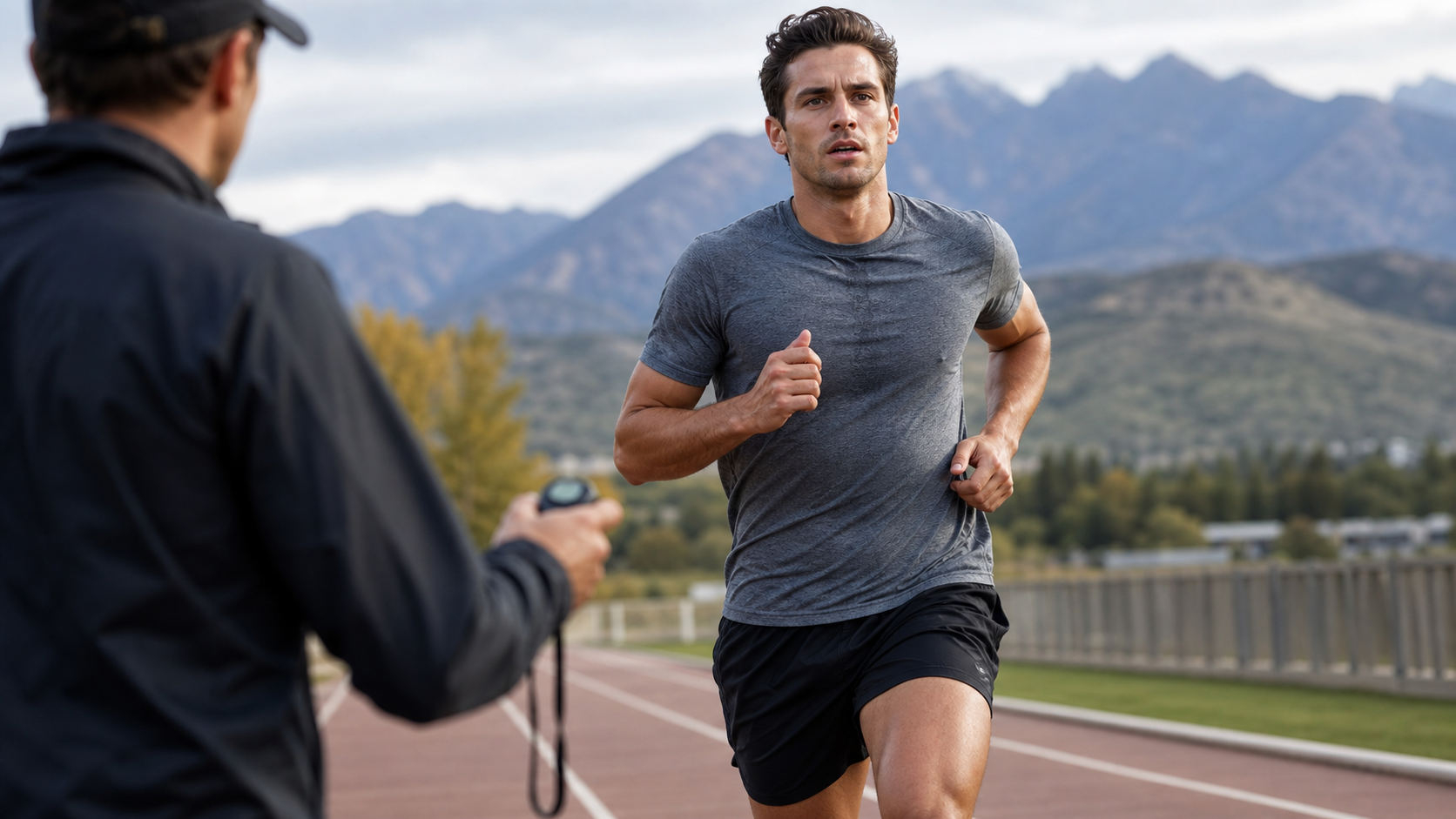
Test protocol: On a flat track, run as far as possible at maximal effort for 12 minutes, recording the total distance (in meters).
Calculation formula (Cooper, 1968):
VO2max (ml/kg/min) = (distance in meters - 505) / 45
Example: Ran 2,800 meters in 12 minutes
VO2max ≈ (2800 - 505) / 45 ≈ 51.0 ml/kg/min
Advantages: Simple to administer, only requires a timer and a track, high reliability (correlation coefficient r = 0.90)
Disadvantages: Requires high-intensity maximal effort, pacing strategy is important; not suitable for beginners or those with cardiovascular risk
Method 2: 15-Minute Maximal Effort Test (Léger & Boucher, 1980 modification)
Similar to the Cooper test, recording the maximal distance over 15 minutes, but with a different formula:
VO2max ≈ 14.49 + 2.143 × V15 - 0.0148 × V15²
Where V15 = average speed over the 15-minute run (km/h)
Research shows the 15-minute version is slightly more accurate than the 12-minute version in certain populations, but the difference is minimal.
Method 3: Garmin/COROS Watch Automatic Estimation
Modern running watches use the Firstbeat Analytics algorithm, continuously estimating VO2max through the real-time relationship between heart rate and pace, requiring no dedicated test.
Accuracy research: Multiple studies show Garmin’s VO2max estimates have a correlation coefficient of r = 0.83–0.93 with laboratory values, with an average error of approximately ±3–4 ml/kg/min.
Advantages: Passive estimation, no additional testing required, convenient for long-term trend tracking
Disadvantages: Estimates may be inaccurate initially (first 3–5 runs); wrist-based optical heart rate has greater error than chest straps
Method 4: Jack Daniels VDOT Back-Calculation
If you have race results from any distance, you can directly input the time into Jack Daniels’ VDOT calculator (runsmartproject.com/calculator or vdoto2.com) to back-calculate VO2max.
Example: Marathon time of 3 hours 45 minutes → VDOT ≈ 43.4
(VDOT and VO2max are very close numerically and can be treated as equivalent)
Advantages: No additional testing required, utilizes existing race results, error mainly depends on race-day condition
Disadvantages: If race pacing strategy is flawed, the estimate deviation is larger
Method 5: 1-Mile Maximal Effort Test (Simplified Bleep Test)
Run 1 mile (1.6 km) at maximal effort, recording time (in minutes) and heart rate:
VO2max ≈ 0.21 × (age × 0.99) + 0.22 × sex (male=1, female=0)
         - 0.15 × weight(kg) / height(m) + 0.11 × resting heart rate - 0.86 × time(min)
(Rogers et al. 1995 simplified version, error approximately ±5%)
Summary Table of Accuracy Comparison Across Methods
| Method | Reliability (r value) | Average Error | Equipment Required | Suitable For |
|---|---|---|---|---|
| Cooper 12-minute run | 0.90 | ±4 ml | Track, timer | Intermediate runners and above |
| Watch automatic estimation | 0.83–0.93 | ±3–4 ml | Smart running watch | All runners |
| VDOT back-calculation | ~0.95 | ±3 ml (when in good form) | None (uses race results) | Those with race records |
| 15-minute maximal run | 0.88 | ±4–5 ml | Track, timer | Intermediate runners and above |
Practical Recommendations for Taiwanese Runners
Option A (own a Garmin/COROS watch): Use the watch’s VO2max estimate directly to track trends, recording once every 3 months. Pair this with a 10km time-trial race and cross-validate using the VDOT back-calculation.
Option B (no smart watch): Perform a Cooper 12-minute run once per quarter, record the distance and calculate VO2max, and track the long-term trend.
Notes on Interpreting VO2max
- Personal trends matter more than absolute values: Your VO2max going from 43 to 47 is more meaningful than someone already at 55
- Weather has a significant impact: High heat and humidity (Taiwan’s summer) can underestimate VO2max test results by approximately 5–10%
- Fatigue state interference: Tests should be performed after adequate rest; testing during a fatigued training phase will underestimate results
- Sex and age differences: Female averages are approximately 15% lower; VO2max begins declining around age 35 by roughly 10% every 10 years
Practical Advice
- Perform the same testing method every 3 months, keeping test conditions consistent (same track, similar weather, similar race preparation status)
- Do not test during periods of accumulated fatigue or at the peak of racing season; choose a recovery period after tapering
- VO2max values are primarily used to evaluate training direction, not to set pace—pace training should be based on lactate threshold testing
Conclusion
VO2max is a window into your aerobic potential. Although every field test has some error, the value of regularly tracking trends far outweighs the pursuit of precise absolute values. Choose one method starting today, record it every quarter, and in a few years you’ll see the complete journey of your fitness evolution.
Related Reading
- Practical Applications of VO2max in Road Running: The Relationship Between Maximal Oxygen Uptake and Race Pace
- Cycling VO2max Testing: Comparison of Laboratory Gold Standard and Field Testing
- Road Running Aerobic Testing: Field Assessment Methods with the 12-Minute Run and Cooper Test
- Is Watch-Estimated VO2max Accurate? Analysis of the Gap Between Algorithm Values and Laboratory Testing
#公路車 #Vo2Max #最大攝氧量 測驗 體驗 | 心肺測試
6 年前
西進武嶺 免費訓練分析服務 Intervals | 練不夠還是練過頭?你哪一種類型選手?AI模型告訴你! | 備戰神器 | 公路車 訓練 | CT Yeh
4 年前
再快都跟的上!? 單車跟隨攝影機之王 HOVERAir X1 PROMAX 全面實測 / 唯一!8K畫質&自行車專用模式和跟蹤信標&前後避障 / DJI Neo 可參考/ 公路車 / CT Yeh
1 年前
實景訓練台) 彰化經典百K 高強度喵團 90分鐘 跟著一起練功 2019 Indoor workout Changhua Classic 100 Taiwan
7 年前
戀戀197 血脈噴張 多視角剪輯版 最艱難的市民競賽組 M30 M35 參賽記錄 請開字幕 4K高畫質 #公路車
6 年前
一日北高前的高裝檢 | 北高 360 | 挑戰11小時的裝備 | 一日雙塔 | 補給
6 年前
多機位拍片神器 DJI Action 2 拍出速度張力感 | 類空拍機視角 4陣列麥克風超強降風噪 實測! | 公路車 | CT Yeh
3 年前
一個測試有沒有認真練車的方法😂 #公路車
10 個月前