Introduction
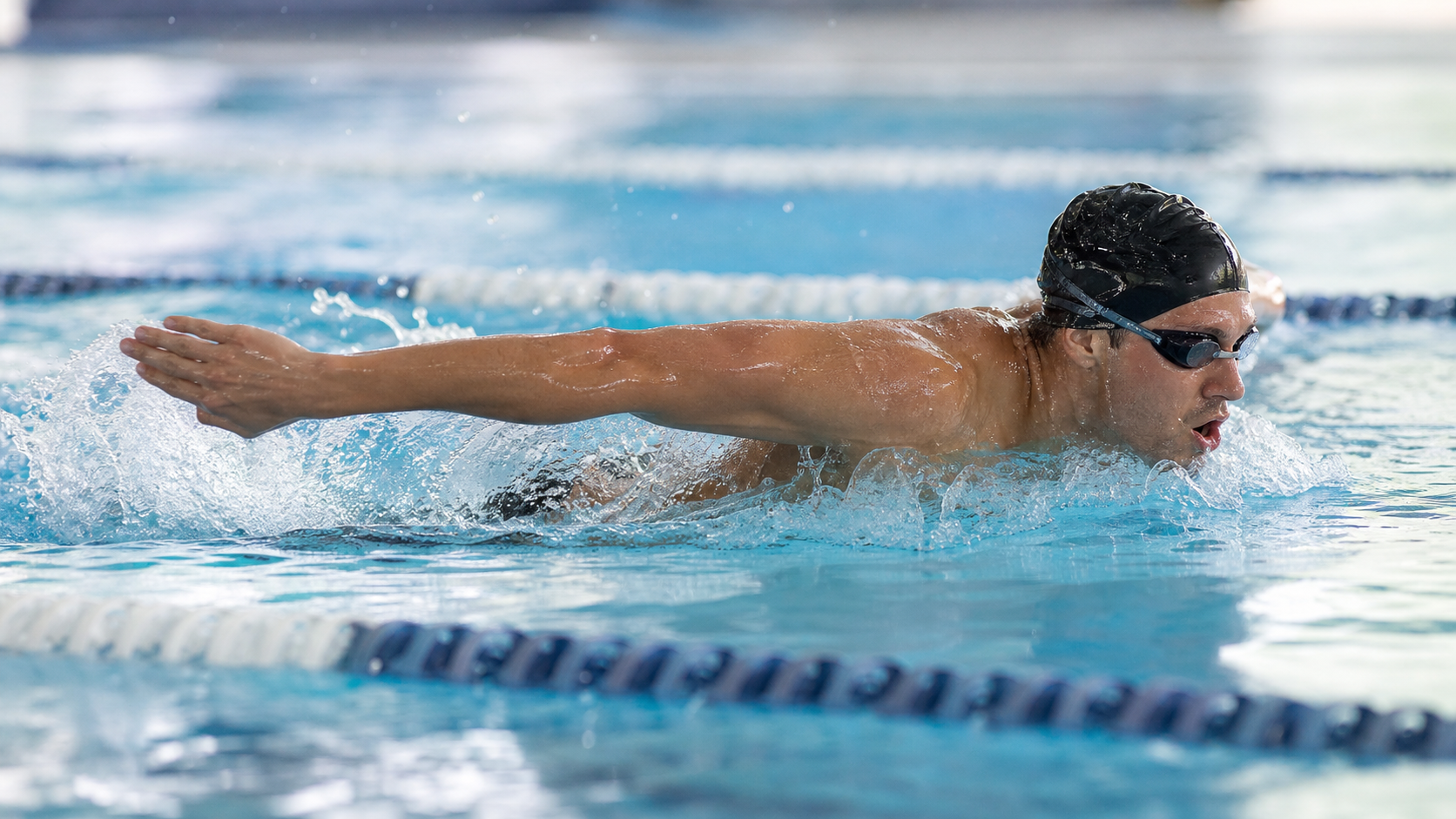
Butterfly is widely regarded as the most difficult of the four competitive strokes, and many recreational swimmers who have been swimming for over a decade have given up on learning it entirely. But the beauty of butterfly lies precisely in its smooth, undulating motion—when the technique is right, the swimmer’s body rises and falls across the water’s surface like a dolphin, powerful yet graceful. At the heart of it all is the drive of the hips.
The undulating rhythm of butterfly: it’s not the shoulders moving, it’s the hips
The biggest misconception among swimmers new to butterfly is “using the shoulders to lift the arms out of the water,” which results in dragging the body out of the water with brute force and exhausting themselves within 25 meters.
The correct butterfly undulation is a full-body wave (body undulation) that “starts from the head and extends through the hips.” The sequence of movements is as follows:
- The head presses down into the water, and the wave travels downward to the shoulders
- As the shoulders press down, the hips are passively lifted (the first kick coordinates with this movement)
- After the arms enter the water, the hips press down, generating wave propulsion once again (the second kick coordinates with this movement)
- As the arms pull back to the thighs, the body wave carries the arms out of the water for the recovery
| Butterfly kick timing | Corresponding movement | Function |
|---|---|---|
| First kick | Arms entering the water and extending | Stabilizes the body, assists forward motion |
| Second kick | Arms pushing through to the thighs | Primary propulsion, helps lift the arms out of the water |
Key training points for hip drive
The hip movement in butterfly may look simple, but it requires highly coordinated core muscle engagement:
Core training: The hip wave comes from alternating contractions of the abdominal muscles and lower back muscles. On land, the “dolphin wave” drill (lying prone, performing a sequential wave from the head and neck down through the tailbone) is the most direct simulation exercise.
In-water breakdown drills:
- Keep both arms pressed against the sides, using only the body wave plus kicking for propulsion (dolphin kick drill), to feel the vertical amplitude of the hips
- Use a paddle board, keeping the arms in a fixed position, focusing on practicing the power transfer of the hip wave
- Underwater butterfly (entirely underwater, no breathing allowed), to strengthen the connection between the body wave and the kick
Arm and hip synchronization: the hardest piece
The most common point of breakdown in butterfly technique is the timing of the arm recovery. Many swimmers pause briefly after pulling their arms to the thighs before lifting them out of the water. This pause interrupts the continuity of the wave, making the recovery feel heavy and awkward.
The correct approach is: the impact of the second kick should directly “spring” the arms out of the water. This requires the timing of the kick and the completion of the push to happen almost simultaneously—only with perfect coordination can that signature “dolphin emergence” feeling be achieved.
- After the arms leave the water, they should move forward quickly from outside the shoulders with a low-hand (small-thumb recovery) or thumb-down orientation to reduce air resistance
- The entry point of the arms should be on the extension line of shoulder width—not too wide (increases drag) or too narrow (breaks the streamline)
Practical advice
Here are the key points of a recommended butterfly coordination training session:
- Before each session: Do 10 dolphin wave stretches on land to awaken the spinal wave sensation
- Main technique set: 25m butterfly × 8 reps, resting 30 seconds after each rep, focusing on one technical point per rep (first rep only on kick timing, second rep only on arm recovery angle, and so on)
- Supplementary drill: Half butterfly (only the entry and pull phases, with the recovery done as a freestyle arm swing forward)—this variation allows you to practice upper and lower body coordination separately
- Pace control: Butterfly training should target “the fastest speed at which you can still execute the technique correctly,” not all-out sprinting; practicing technique under fatigue often reinforces bad habits
Conclusion
The essence of butterfly lies not in strength but in rhythm. When the wave energy of the hips synchronizes perfectly with the arms’ entry, pull, and recovery, butterfly becomes a smooth, enjoyable stroke. It takes time and patience, but the moment you feel that “flow,” you’ll understand why swimmers are willing to spend years pursuing that sensation.
Related Reading
- The Science of Butterfly Undulation: A Guide to Hip Drive and Rhythmic Coordination Training
- Butterfly Undulation: Coordinating the Rise and Fall of the Chest and Hips
- Excessive Lower Back Arch in Butterfly: Corrective Drills for Insufficient Hip Drive
- Coordination Training for Butterfly Dolphin Kick and Body Undulation
一起升級!海鷗盃LSD團練...JJSC Zone2招待 騎到手抖 / 公路車 / CT Yeh
1 天前
[教學] Premiere 影片 手震 修正 教學 防抖 單眼 影像 GoPro 穩定 Video Stabilization
8 年前
西進武嶺 自製新版AI配速表產生器 x 賽前攻略 抱佛腳! 沒有功率計也可以產生配速表嗎?有什麼其他眉角賽前要注意的呢? | 西進武嶺 / 東進武嶺 KOM 攻略 | 公路車 | CT Yeh
4 年前
2023桃園團體繞圈賽 / 海鷗繞圈賽 | 全程空拍數據版 | 公路車 | CT Yeh
2 年前
[教學] Dashware 教學 如何製作有 速度 功率 心律的 騎車影片 Guages Video
8 年前
風櫃嘴 衝刺慢動作回放!
8 年前
2025 海鷗團體繞圈賽 網路直播 超激烈裁判長視角 / EIPC 李廷威、Waypoint 等眾多高手競爭 / feat. 卡密兒主持 / 海鷗繞圈賽
9 個月前
大禹嶺 到 武嶺牌樓 全程前後實況錄影 | 北進武嶺 | 東進武嶺 | KOM | 訓練台 | 坡度分析 | Taiwan KOM Last 10 km HARD | 公路車
6 年前