Introduction
For many beginners, the biggest challenge in backstroke is not the arm movement, but the psychological fear of “floating face-up on the water.” Once this mental hurdle is overcome, however, swimmers often face a second problem: the hips keep sinking, forming an inclined plane with the head high and feet low, making swimming laborious and slow. The root of this problem can usually be traced back to a seemingly trivial factor: head position.
How Head Position Affects Hip Buoyancy
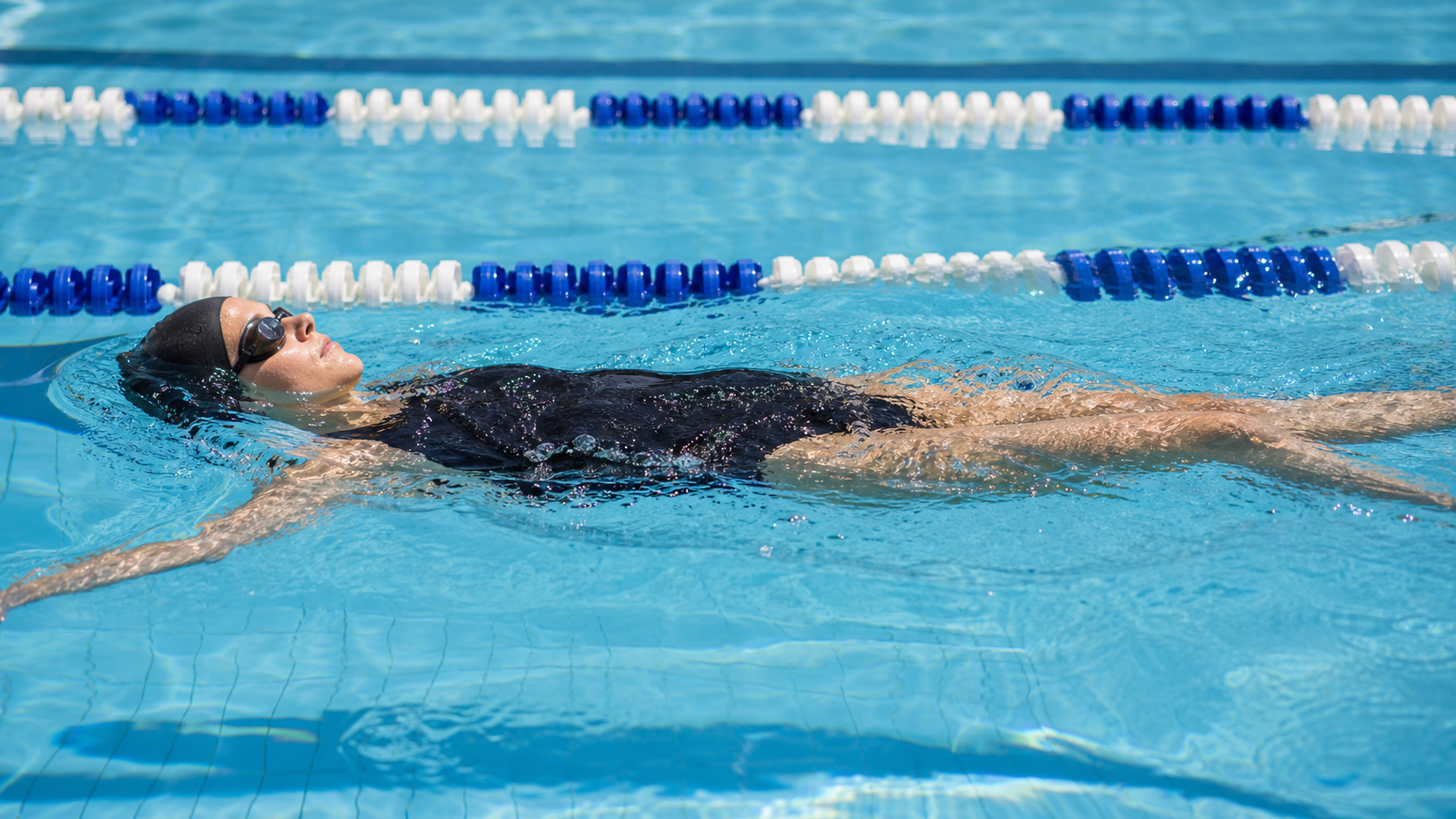
The body’s balance in water follows the principle of leverage. When you lie on your back in the water, your body pivots around the hips (center of gravity), with the head and feet forming the two ends.
When the head is raised (trying to look toward the feet): the head end gains weight, the feet end (hips) are forced downward, the body forms an inclined plane, and drag increases significantly.
When the head position is correct (ears below the water surface, eyes toward the ceiling or slightly toward the feet): weight distribution is balanced, the hips float up naturally, and the body stays horizontal.
| Head Position | Ear Position | Hip Height | Swimming Drag |
|---|---|---|---|
| Head raised too high | Completely above water | Clearly sinking | Extremely high |
| Slightly raised | Partially submerged | Slightly sinking | Higher |
| Correct position | Ears below the waterline | Horizontal | Lowest |
| Head lowered too much | Head largely submerged | Feet sinking | Higher |
Other Factors Affecting Hip Buoyancy
Besides head position, the following factors also directly affect body alignment in backstroke:
Core tension: If the abdomen is completely relaxed, the lower back will arch, causing the hips to sink. When swimming backstroke, maintain slight core engagement, imagining the navel gently drawing toward the spine.
Kick efficiency: The backstroke kick (an up-and-down leg motion driven by the hips) not only provides propulsion but also helps keep the legs horizontal. Too small a kick amplitude or overly stiff ankles will cause the legs to sink.
Breathing habits: Backstroke does not require active breathing, but many swimmers still have an unconscious habit of lifting the head (breathing anxiety). This habit must be overcome through conscious training.
Body composition: Swimmers with a higher body fat percentage naturally have better buoyancy, while those with a higher muscle ratio (especially in the lower body) need more active kicking to maintain a horizontal position.
Balance Key Points in the Backstroke Pull
The relationship between the backstroke pull and balance is often overlooked. Each time the arm enters the water, the body sways slightly from the impact of entry. Proper technique minimizes this effect:
- Entry point: The arm should enter the water on the extension line of the shoulder, with the index or middle finger entering first and the palm facing outward. Avoid entering directly above the head (which causes side-to-side rocking)
- Pull depth: During the pull, the elbow bends downward and the palm “feels the wall.” Depth should be 15–30 cm; too shallow makes the push ineffective, too deep affects speed
- Body roll: Backstroke also involves side-to-side rotation, at about 30–40 degrees. This rotation is the power source for the arm entry and does not conflict with backstroke balance
Practical Tips
The following training methods can help improve head position and body balance in backstroke:
- Static float drill: Keep both arms against your sides, propelling only with the kick and without pulling. Practice maintaining a horizontal body while kicking until you feel the correct sensation of the hips floating up.
- Water bottle balance drill: Place a small water bottle (with a little water inside) on your forehead and try to swim 25m without letting it fall. This drill quickly corrects the unconscious habit of lifting the head.
- On-land mirror drill: Lie flat on the floor, simulate the backstroke position, and confirm head placement (chin slightly tucked, back of the head on the floor).
- With a flutter board: Hold a kickboard between your knees and practice only the upper-body pull, focusing on head position without kick interference.
Conclusion
Backstroke body balance is a technical element where “once it feels right, it is right.” The first time you experience your hips floating up naturally and your body parallel to the water surface, you will discover that backstroke can be this effortless. Adjusting head position often takes only a few millimeters of difference, yet it brings a completely different swimming experience. Next time you practice backstroke, focus on the position of the occiput and feel the line where the water sits right at the edge of the earlobe.
Related Reading
- Backstroke Body Balance: Why Backstroke Swimmers’ Hips Cannot Sink
- The Key to Stroke Correction: How Head Position Affects Full-Body Alignment
- Core Backstroke Technique: The Triangular Relationship Between Body Roll, Straight-Arm Entry, and Steady Kicking
- Streamlined Entry: The Impact of Head Position on Overall Drag
一日北高/長距離團騎 常見問題補充篇 / 組團或跟團的眉角 / 壯車友容易被瘦車友慢性拉爆 / 原來屁股痛可能是這個原因...? / 風場配速法 / 公路車 / CT Yeh
2 年前
CT 喇低賽) 武嶺牽車 才是王道 西進牽車四小時內秘訣 攝手位置 如何判斷 防抽筋小秘訣
7 年前
戰略) Zwift Race 如何咬在第一集團 如何評估自己要開多少推力 (請開1.5倍速看)
7 年前
西進武嶺 自製新版AI配速表產生器 x 賽前攻略 抱佛腳! 沒有功率計也可以產生配速表嗎?有什麼其他眉角賽前要注意的呢? | 西進武嶺 / 東進武嶺 KOM 攻略 | 公路車 | CT Yeh
4 年前
抖肩舞 台灣x日本交流版 (台灣 vs 前橋) 赤城山登山賽 coincidance
8 年前
[教學] Premiere 影片 手震 修正 教學 防抖 單眼 影像 GoPro 穩定 Video Stabilization
8 年前
風櫃嘴 | 全台最多大砲的單車路線 | 尋寶網攝影師告訴你怎麼擺拍起來才好看 | 熱門攝影地點巡禮
6 年前
一日北高常見問題大集合 | 攻略 | 路線 | 訓練 | 補給 | 自行車 單車 | 一日雙城 | 雙塔 | TWB北高360 | 屁股痛
6 年前