Introduction
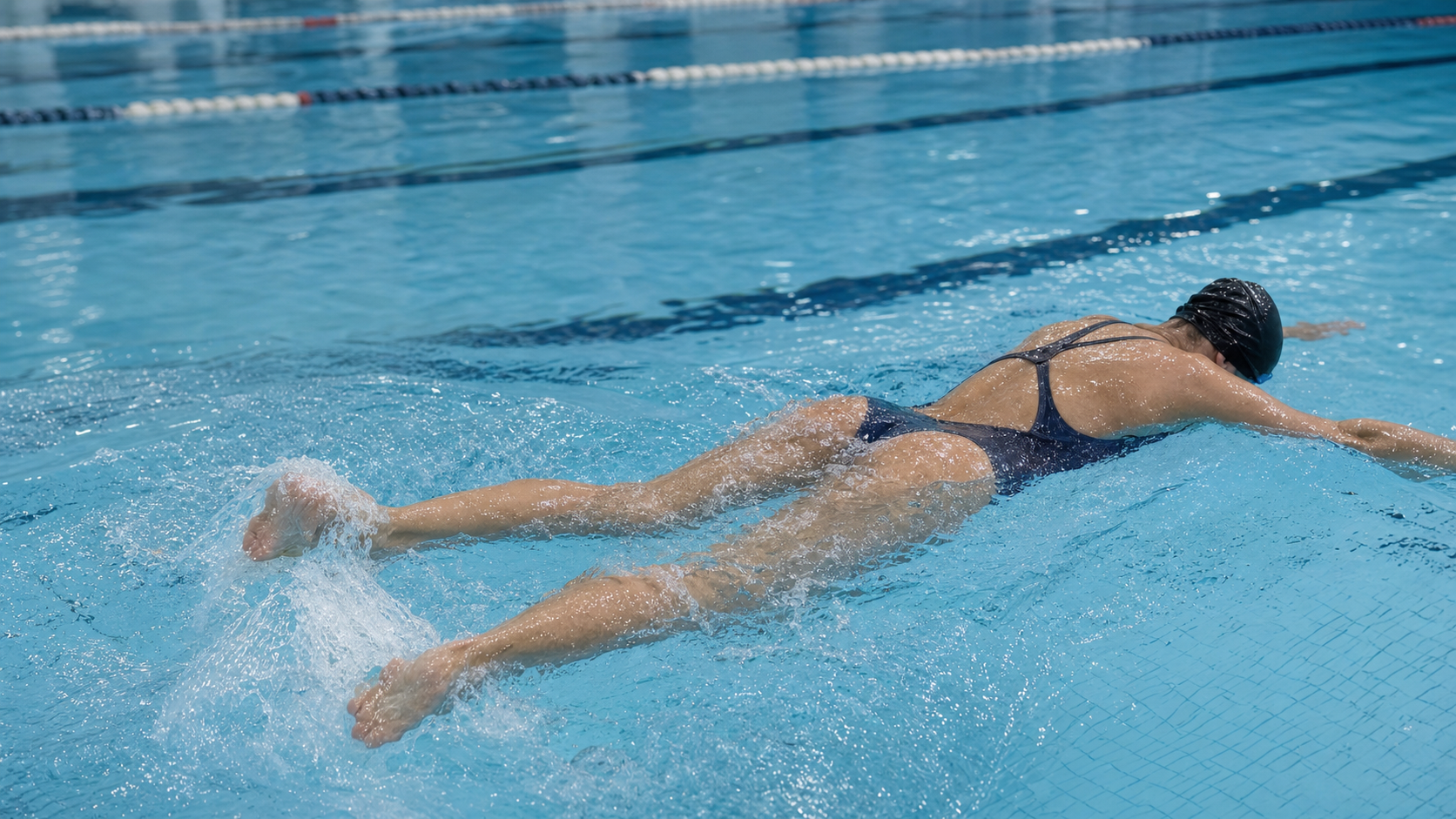
Breaststroke is typically the first stroke taught in swimming lessons in Taiwan, and it is also the most commonly used stroke in public pools. However, it is also the stroke most likely to injure the knees. “Swimmer’s Knee” is quite common among swimmers in Taiwan, and its root cause is often knee valgus (inward collapse) occurring during the breaststroke kick.
Two Key Phases of the Breaststroke Kick
The breaststroke kick can be divided into two phases — the “outsweep” and the “insweep” — which together form the distinctive “frog kick”:
Outsweep (Recovery & Catch)
The outsweep is the process of drawing the heels toward the hips (the recovery) while the knees spread outward and the ankles evert, preparing for the propulsive kick.
Key point: The width of the knee separation should roughly match shoulder width — it should not be excessive. Overly wide knee separation not only increases drag (the thighs become an obstacle in the water), but more importantly, it places enormous lateral shear stress on the knee joint during the subsequent insweep kick. This is the primary cause of swimmer’s knee.
Insweep (Kick & Glide)
The insweep is the main propulsive phase of breaststroke. Both feet sweep backward and outward (pushing the water backward and outward), then the legs come together behind the body, transitioning into a streamlined glide.
Key point: Ankle dorsiflexion (the “flexed foot” or “hooking” of the toes) is the source of propulsive power in breaststroke. The more flexible the ankle and the greater the dorsiflexion angle, the larger the surface area that can contact the water, and the stronger the propulsion. Once the kick is complete and the legs come together, the toes should naturally point inward so the soles of the feet face directly backward.
| Breaststroke Kick Phase | Knee Position | Ankle Action | Primary Muscles |
|---|---|---|---|
| Heel recovery | Folds backward | Relaxed | Biceps femoris (hamstrings) |
| Outsweep | Spreads to shoulder width | Dorsiflexion (foot hook) | Lower leg muscles |
| Kick propulsion | Sweeps inward together | Sustained dorsiflexion | Quadriceps, gluteus maximus |
| Glide | Extended and together | Toes turned inward | Core stabilization |
Core Principles of Knee Protection
Protecting the knees and maintaining propulsion power are not opposing goals. The following principles help achieve both at once:
Principle One: “Knees should not travel past the toes”
During heel recovery, the knees should bend backward rather than jutting forward. If the knees move significantly forward during recovery (past the position of the toes), this places unnecessary stress on the kneecap (patella).
Principle Two: “Let the hips drive the legs, not the knees twisting on their own”
Knee abduction (outward spreading) should originate from external rotation at the hip joint, not from the knee twisting independently. This subtle difference is hard to see from the outside, but it feels completely different: when done correctly, you feel the rotation coming from your hips; when done incorrectly, you feel torsional pressure in your knees.
Principle Three: “Control the speed of heel recovery”
A fast, forceful recovery motion (like cracking a whip) causes the knee joint to absorb impact at the end of the movement. Recovery should be a controlled, smooth motion.
Practical Tips
Practical training suggestions for swimmers in Taiwan:
- Poolside kick drills: Sit at the edge of the pool with your feet dangling in the water and slowly practice the full breaststroke kick cycle. Without the resistance of moving through water, you can better feel the correct knee position.
- Ball squeeze drill: Hold a small inflatable ball between your thighs and practice completing the kick using only the lower leg (below the knee), which strengthens the power generated by the lower leg.
- Kickboard timing drill: Using a kickboard, count how many kicks it takes to swim 50 meters of breaststroke kick. Reducing the number of kicks (by increasing the propulsion of each kick) often indicates improved technique.
- Feel the water resistance: Pause briefly before the recovery to confirm that your feet are properly dorsiflexed (hooked) before extending into the kick. “Feeling your soles pressing against the water” is the sensation of a correctly hooked foot.
Conclusion
Protecting your knees in breaststroke is not about “swimming less” — it’s about “doing the movement correctly.” When the hips drive external rotation of the legs, the knees maintain an appropriate width, and the ankles achieve full dorsiflexion, you’ll find that breaststroke can be both efficient and fast, with no knee discomfort at all. If you’ve experienced ongoing knee pain from swimming breaststroke, don’t simply push through it — find an experienced swimming coach to carefully review your leg technique. Usually, just a few coaching sessions are enough to identify and correct the underlying issue.
Related Reading
抖肩舞 台灣x日本交流版 (台灣 vs 前橋) 赤城山登山賽 coincidance
8 年前
CT 喇低賽) 武嶺牽車 才是王道 西進牽車四小時內秘訣 攝手位置 如何判斷 防抽筋小秘訣
7 年前
西進武嶺 免費訓練分析服務 Intervals | 練不夠還是練過頭?你哪一種類型選手?AI模型告訴你! | 備戰神器 | 公路車 訓練 | CT Yeh
4 年前
[教學] Premiere 影片 手震 修正 教學 防抖 單眼 影像 GoPro 穩定 Video Stabilization
8 年前
滑雪新手們慘摔學習全紀錄(請開字幕),滑雪好好玩 | Snowboard + Ski | 岩原 スキー場 | 滑雪APP使用 | GoPro Max
6 年前
一日北高常見問題大集合 | 攻略 | 路線 | 訓練 | 補給 | 自行車 單車 | 一日雙城 | 雙塔 | TWB北高360 | 屁股痛
6 年前
大禹嶺 到 武嶺牌樓 全程前後實況錄影 | 北進武嶺 | 東進武嶺 | KOM | 訓練台 | 坡度分析 | Taiwan KOM Last 10 km HARD | 公路車
6 年前
iPhone內建一秒變長腿🤣 車友必備#cycling
2 年前