Introduction
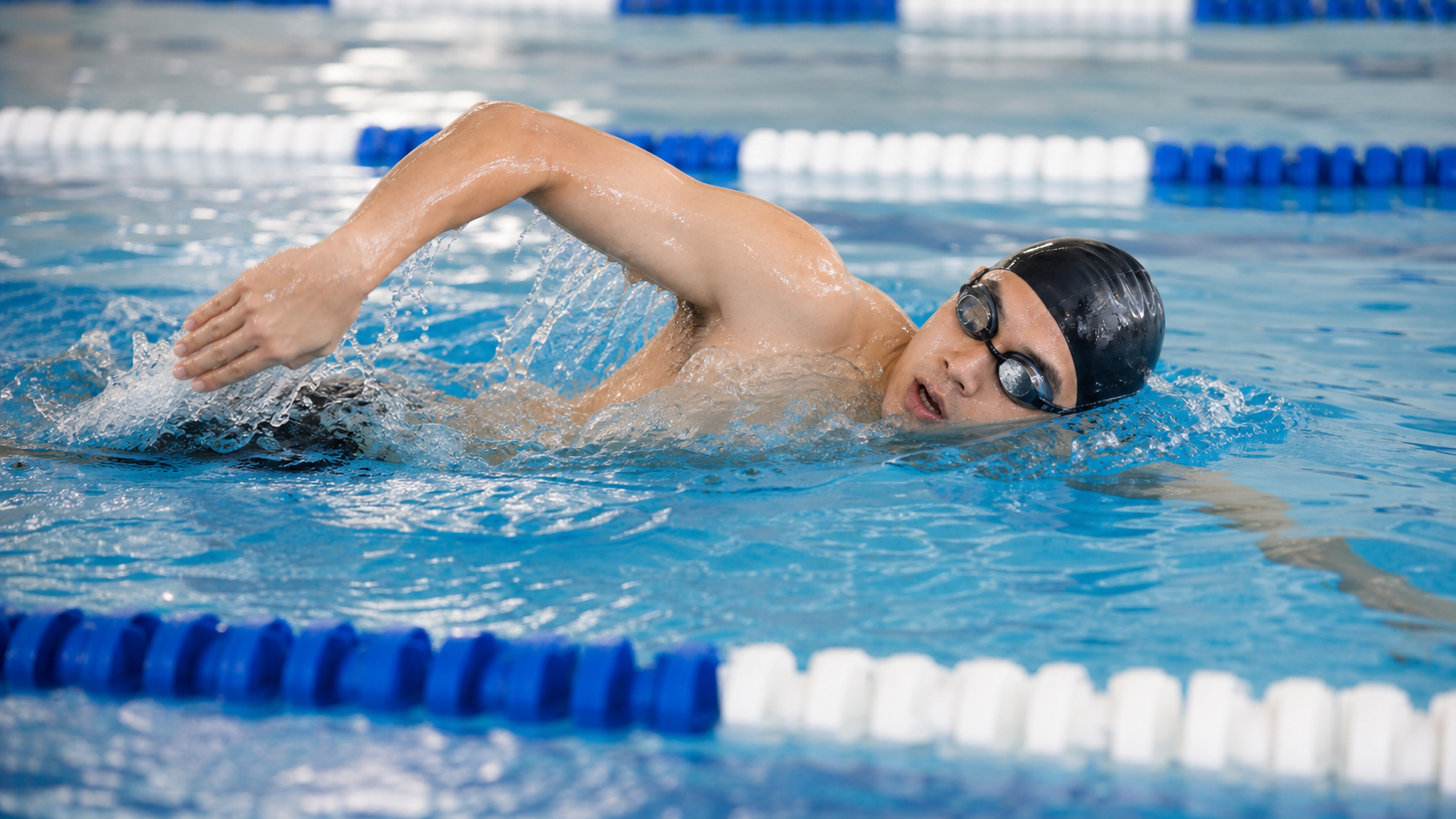
Walk into any public pool in Taiwan, and you’ll notice that most freestyle swimmers breathe to only one side—usually the side of their dominant hand. This “unilateral breathing” habit won’t cause major problems in the short term, but over time, it can quietly affect your technical balance, muscle development, and even become a limiting factor for speed in competition.
The Hidden Problems of Unilateral Breathing
Many swimmers don’t realize that breathing to the same side for years can lead to the following issues:
Asymmetric Stroke: To make room for the head to turn, the arm on the breathing side often crosses toward the midline on entry, causing a “cross-over entry,” while the arm on the non-breathing side may over-press downward (Crossover Pull). The two sides end up with completely different stroke patterns.
Neck and Shoulder Imbalance: Turning the head to only one side over a long period gradually creates differences in muscle tension between the two sides of the neck. In mild cases, it feels uncomfortable; in severe cases, it can lead to chronic neck pain.
Limited Vision: In open-water swimming or triathlon, swimmers who can only breathe to one side cannot flexibly observe both sides and are prone to drifting off course.
Physical Limitations: In long-distance swimming, unilateral breathing (usually every two strokes) results in a relatively high breathing frequency, which can cause hyperventilation at high intensity. Some swimmers switch to breathing every four strokes to avoid this, but that can lead to hypoxia. Bilateral breathing (every three strokes) provides a middle-ground breathing frequency while maintaining left-right balance.
When to Train Bilateral Breathing
Not every swimmer needs to learn bilateral breathing immediately. Here are indicators for determining the right timing:
| Swimmer’s Condition | Recommended Action |
|---|---|
| Beginner with unstable technique | Master unilateral breathing first; no rush to go bilateral |
| Can swim 500m or more with stable technique | Start practicing bilateral breathing |
| Preparing for triathlon or long-distance open water | Strongly recommended to master bilateral breathing |
| Has obvious stroke asymmetry issues | Should begin bilateral breathing training immediately |
| Competitive swimmer during race preparation | Keep dominant-side breathing; add bilateral training during post-race recovery |
How to Build a Bilateral Breathing Rhythm
The most common mistake when switching from unilateral to bilateral breathing is “forcing yourself to breathe every three strokes throughout the entire session,” which leads to giving up due to the feeling of hypoxia. The correct approach is gradual progression:
Phase 1: Non-Dominant Side Breathing Practice (2–4 weeks)
During part of your practice, force yourself to breathe only to the non-dominant side, even if the breathing motion feels clumsy and your body rocks significantly. Add 4–6 sets of 25m non-dominant side breathing in each session.
Phase 2: Mixed Breathing Rhythm (2–4 weeks)
Use the “5-3-5-3” pattern: swim 5 strokes and breathe to the left, then after breathing, swim 3 strokes and breathe to the right, then 5 strokes to the left again, and so on. This irregular rhythm allows the body to gradually adapt to breathing on both sides without experiencing hypoxia from continuous three-stroke breathing.
Phase 3: Fixed Three-Stroke Breathing (long-term maintenance)
Breathe every three strokes, alternating left and right. Once you get used to it, this rhythm feels quite natural, and the breathing motion becomes smoother.
Here is a comparison of common breathing patterns:
- Breathe every 2 strokes: High breathing frequency; suitable for short-distance sprints or recovery
- Breathe every 3 strokes (bilateral): Balanced and efficient; suitable for long distances
- Breathe every 4 strokes: Demands high cardiorespiratory endurance; suitable for advanced swimmers with high training volume
- Breathe every 6 strokes: Used only for special intensity training; generally not recommended
Practical Tips
The following auxiliary drills can accelerate the development of bilateral breathing technique:
- Catch-up drill with a pull buoy: Remove the interference of leg movements and focus on practicing the head rotation angle for the non-dominant side. The ideal head rotation angle for breathing is about 60–70 degrees (not 90 degrees—don’t turn the head fully sideways).
- Practice head turning in the shallow end: Stand in the shallow end of the pool and simulate the head rotation for breathing, confirming that the mouth clears the water sufficiently without over-lifting the head.
- Track your breathing rhythm: Record the number of bilateral breathing sets in each session in your training log, gradually increasing the proportion week by week.
Conclusion
Bilateral breathing is a technical habit that requires patience to build, but the rewards it brings are comprehensive and lasting: a symmetric stroke, balanced muscle development, stronger open-water adaptability, and a more flexible breathing strategy. For swimming enthusiasts in Taiwan, it is one of the most worthwhile investments of time for improving long-distance swimming performance.
Related Reading
- Improving Breathing Side in Swimming: A Progressive Plan for Bilateral Breathing Training
- Freestyle Breathing Technique: Training Methods and Race Applications for Bilateral Breathing
- How to Learn Bilateral Breathing in Freestyle: Methods, Pros and Cons
- Swimming Breathing Technique: Analysis of the Pros and Cons of Side Breathing and Bilateral Breathing
碟煞公路車 優缺點?換車一年半實際經驗分享 / 公路車 / CT Yeh
2 年前
一日北高/長距離團騎 常見問題補充篇 / 組團或跟團的眉角 / 壯車友容易被瘦車友慢性拉爆 / 原來屁股痛可能是這個原因...? / 風場配速法 / 公路車 / CT Yeh
2 年前
西進武嶺 免費訓練分析服務 Intervals | 練不夠還是練過頭?你哪一種類型選手?AI模型告訴你! | 備戰神器 | 公路車 訓練 | CT Yeh
4 年前
碟煞公路車 銑面器 !? 原來銑完差這麼多! 降低蹭碟機率! | TIME 公路車 保養小記錄 | CT Yeh
3 年前
#公路車 #Vo2Max #最大攝氧量 測驗 體驗 | 心肺測試
6 年前
一日北高前的高裝檢 | 北高 360 | 挑戰11小時的裝備 | 一日雙塔 | 補給
6 年前
一日北高前的西濱集訓 | 跟著11小時軍團 | 300W踩不動的大逆風 | 輪車破風差幾瓦?
6 年前
一日北高常見問題大集合 | 攻略 | 路線 | 訓練 | 補給 | 自行車 單車 | 一日雙城 | 雙塔 | TWB北高360 | 屁股痛
6 年前