Climbing Technique for Consecutive Corners: Acceleration Out of Turns and Braking Timing Into Turns
Introduction
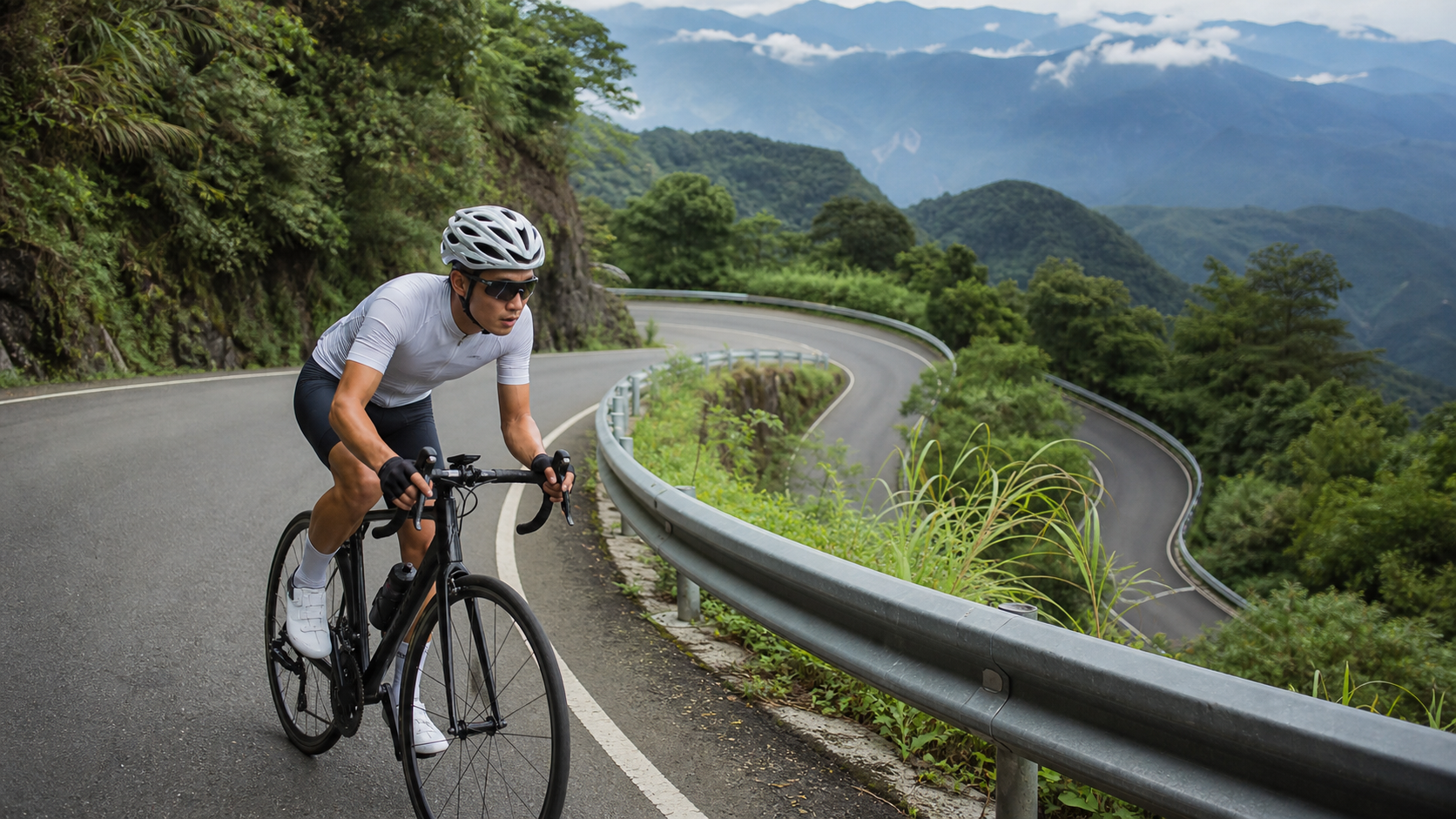
The hallmark of Taiwan’s mountain roads is a series of hairpin turns and winding, multi-corner sections—Yangmingshan’s Jingshan Road, the Liwu River Gorge before Wuling, and the Xiaoyi section of Wulai are practically “corner training grounds.” Many riders perform decently on straight climbs but visibly lose speed once they enter consecutive corners. The reason isn’t just technique; it’s also an imprecise grasp of cornering timing. This article will break down climbing corner technique in depth, helping you maintain rhythm, conserve energy, and even turn corners into overtaking opportunities.
Basic Mechanics of Climbing Corners
Cornering on a slope differs fundamentally from cornering on flat ground in several ways:
- Lower speed, less centrifugal force: Climbing speeds typically range from 10–20 km/h, far lower than on flat roads. This means the physical risk in the corner itself is lower, but the cost of braking and then re-accelerating is higher.
- Stopping pedaling costs more: On flat ground, pausing pedaling for a few seconds has little impact. On a slope, stopping for 2–3 seconds can cost 1–2 km/h in speed, and regaining that speed on an incline requires extra work.
- Lean angle matters more: At low speeds, the bike’s lean angle has a more pronounced effect on stability, so the timing of leaning the bike requires greater care.
Braking Timing Before Entering a Corner
The Principle of “Brake Early, Pedal Late”
The most important principle for climbing corners is: adjust your speed before entering the corner, rather than braking mid-corner. This sounds simple, but in practice, many riders still habitually slow down inside the turn, causing the following problems:
- Braking mid-corner interrupts the pedaling rhythm, abruptly cutting off cadence
- Front-wheel traction is divided (handling both steering and braking), reducing stability
- Inability to resume pedaling immediately at the exit, because the bike is still unstable right after the brakes are released
The correct approach:
- Begin progressive braking (primarily with the rear brake) 3–5 meters before the corner
- By the time you reach the apex, braking force should be fully released
- Resume pedaling immediately after entering the corner
How to Judge Entry Speed
The most common question from climbing beginners is: “How slow do I need to go to be safe?” There’s no fixed answer—it depends on corner curvature, road surface, tire grip, and individual skill. Recommended approach:
- Work backward from “being able to pedal at full effort immediately at the exit” to determine entry speed
- Practice repeatedly on the same route, fine-tuning entry speed each time to feel how stability changes at different speeds
- On wet roads, reduce entry speed by 30–40% compared to dry conditions
Key Techniques for Accelerating Out of Corners
Accelerating out of corners is the essence of climbing corner technique. Good exit acceleration lets you rebuild power immediately after passing the apex, turning each corner into a “recharge point” for your climbing rhythm.
Body Movements for Exit Acceleration
- Pedal in sync with the bike straightening up: As you feel the bike gradually return from a lean to upright, start applying power immediately—don’t wait until you’re fully upright to pedal.
- Initiate force with the outside pedal: In a corner, the outside pedal is typically at the bottom. Start pushing from the outside pedal at the exit, effectively transferring your center of gravity into the pedaling motion.
- Keep the upper body stable: When accelerating out of a corner, engage your core to avoid upper-body swaying (out-of-saddle rocking), allowing pedaling force to transfer directly to the rear wheel.
Rhythm Management for Consecutive Corners
| Corner Type | Entry Strategy | Exit Strategy | Rhythm Maintenance Focus |
|---|---|---|---|
| Gentle bend (large radius) | Barely any braking | Maintain cadence and accelerate | Don’t interrupt pedaling |
| Moderate corner | Light rear braking | Resume pedaling immediately at exit | Shift to an easier gear before braking |
| Hairpin (U-turn) | Slow down 5–8m in advance | Sprint for 3–5 seconds after the exit | Use the exit section to regain lost speed |
Special Scenario: Corners Where a Descent Meets a Climb
A common terrain feature on Taiwan’s mountain roads is a descent immediately followed by an uphill section with a corner in between. This is frequently seen on the Tianxiang section of Wuling and certain parts of Yangmingshan. The correct strategy:
- Make full use of momentum before entering the corner on the descent—don’t brake too early
- After the exit, use the remaining inertia to immediately switch to climbing pedaling mode
- This transition should be completed within 3–5 seconds, including: releasing the brakes → straightening the bike → starting to pedal → adjusting cadence
Practical Advice
- Repeatedly practice on a fixed route: Choose a route with 5–10 corners and train on it repeatedly, focusing on one technical point at a time (e.g., only entry timing this session, only exit acceleration next session).
- Video analysis: Ask a riding buddy to film you from the side as you navigate corners, then observe your braking points and exit pedaling timing.
- Avoid gripping the handlebar too tightly: Many riders tense up and grip the bars too hard when entering a corner, which actually hinders the bike’s natural leaning response. Keep your wrists relaxed when entering turns.
- Be especially conservative in the rain: On rainy days, fallen leaves, standing water, and painted road markings on mountain roads are particularly slippery. Reduce entry speed compared to normal, and any technique optimization should be carried out with safety as the top priority.
Conclusion
Progress in climbing corner technique is essentially the art of “reducing energy waste.” Every clean corner means one less brake application and one less burst of power spent re-accelerating. Accumulate dozens, then hundreds, of cornering repetitions on Taiwan’s mountain roads, and these technical details add up to the hidden margin that breaks through your climbing performance.
Related Reading
- Advanced Descending Technique: Body Control for High-Speed Cornering on Road Bikes
- Road Bike Descending Safety on Mountain Roads: Cornering Line Selection and Speed Control
- Descending Technique After Climbs: Safe Brake Control and Cornering Lines
- Bicycle Cornering Technique: A Progressive Guide from Safe and Slow to Fast and Smooth