Electronic Shifting In-Depth Review: Comparing Shimano Di2 vs SRAM eTap on Usability, Reliability, and Upgrade Cost
Introduction
The rise of electronic shifting is one of the most significant advances in bicycle drivetrain technology in recent years. Unlike mechanical shifting, which relies on cable tension to transmit shift commands, electronic shifting uses electrical signals to precisely control small motors — dramatically improving shift accuracy while enabling automated features such as semi-synchronized front shifting (automatically switching chainrings based on rear cassette position). Today’s two dominant electronic shifting systems are Shimano Di2 and SRAM eTap (AXS). This article compares them in depth across five dimensions: shift logic, reliability, battery management, cross-platform integration, and upgrade cost.
Shimano Di2: The Mature, Stable Pioneer of Electronic Shifting
Shimano launched its first-generation Di2 (Digital Integrated Intelligence) system in 2009, and it has since evolved into the 12-speed Dura-Ace R9200 Di2 and Ultegra R8150 Di2. Di2’s design philosophy carries forward Shimano’s consistent principle of “high reliability, low maintenance.”
Shift logic:
- Right shifter: small lever (inward) shifts to a smaller rear cog (easier), large lever (outward) shifts to a larger rear cog (harder)
- Left shifter: small lever (inward) shifts to the smaller chainring, large lever (outward) shifts to the larger chainring
- Supports “Multi-Shift”: holding the lever down lets you jump multiple gears in one continuous motion
- Synchronized Shifting: automatically switches the front chainring based on rear cassette position, reducing cross-chaining angles
Reliability and waterproofing:
Di2 uses a wired connection — components are linked by thin wires, with power distributed from the battery — giving the system a highly enclosed, sealed design. It carries an official IPX6 waterproof rating and performs well in rain or high-pressure washing. Long-term users report that Di2 connectors occasionally need cleaning to prevent poor contact, but overall failure rates are extremely low.
SRAM eTap AXS: A New-Generation Wireless Choice
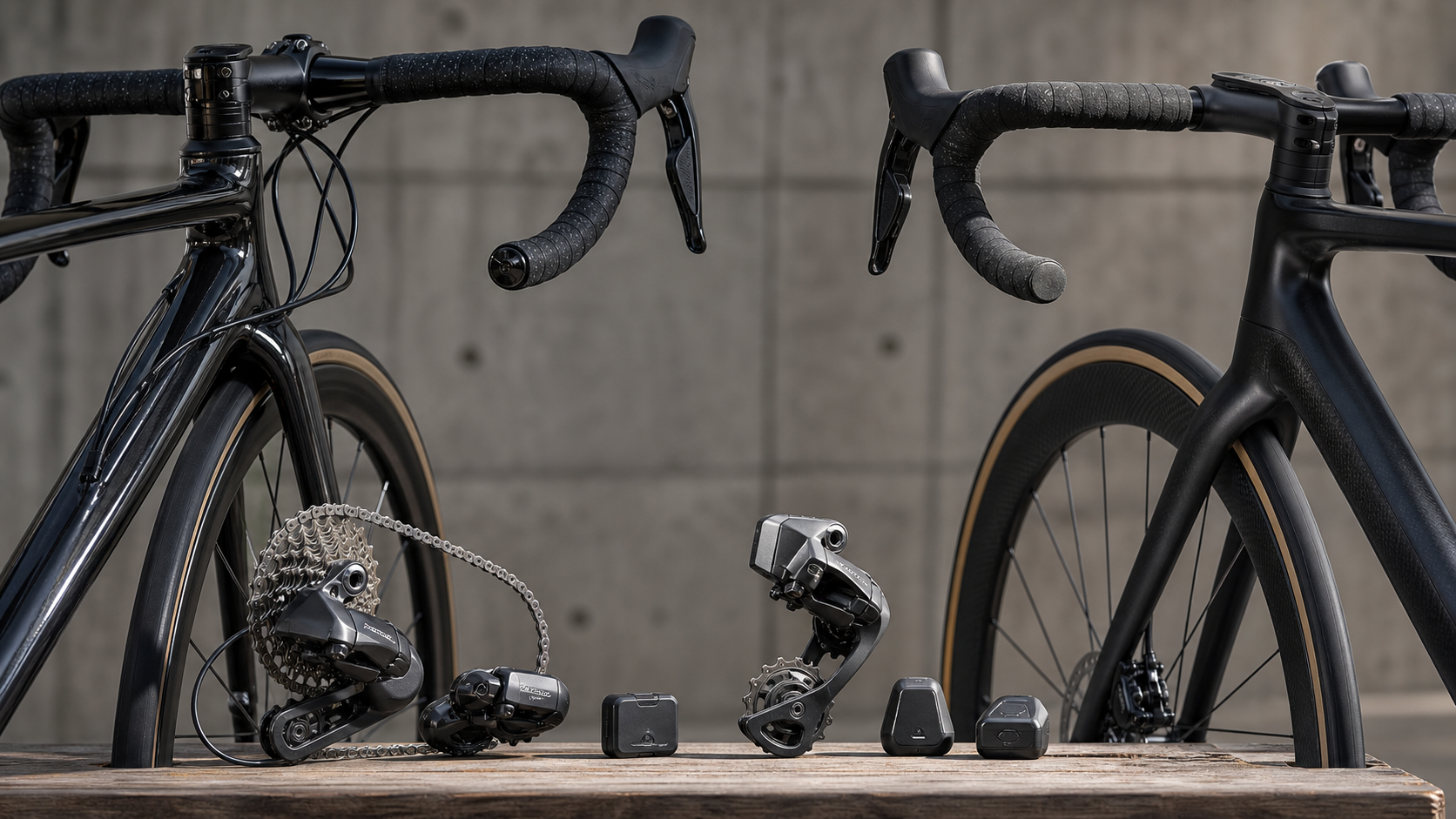
SRAM’s eTap AXS system is fully wireless — the rear derailleur, front derailleur, and shifters each carry their own rechargeable battery and communicate via SRAM’s proprietary AXS wireless protocol. It is currently the most widely deployed wireless shifting system.
Shift logic (the biggest difference from Di2):
- Right shifter (either button): shifts to a smaller rear cog (easier)
- Left shifter (either button): shifts to a larger rear cog (harder)
- Press both shifters simultaneously: switches the front chainring (big/small)
- This logic is completely different from both Di2 and mechanical shifting, requiring riders to build entirely new muscle memory
Wireless advantages:
- No rerouting of cables needed when switching frames, making installation extremely simple
- Wireless latency is extremely low (manufacturer-rated at under 2ms), essentially imperceptible in real-world use
- The SRAM AXS app lets you check the battery status of each component in real time
Key Comparison
| Comparison Item | Shimano Di2 (Ultegra) | SRAM eTap AXS (Force) |
|---|---|---|
| Shift speed | Extremely fast (under 0.1s) | Extremely fast (under 0.1s) |
| Connection type | Wired | Wireless |
| Battery design | Main battery + small auxiliary battery | Independent battery per component |
| Battery life | Approx. 1,000–1,500 km | Approx. 400–600 km per battery |
| Charging port | Dedicated SM-BCR2 charging cable | Standard USB-C port |
| Waterproof rating | IPX6 | IPX7 |
| Suggested retail price in Taiwan (groupset) | Approx. NT$35,000–45,000 | Approx. NT$40,000–55,000 |
Real-World Battery Management Experience
This is one of the areas where the two systems differ most in day-to-day use.
Di2 battery management:
The main battery (usually hidden inside the seatpost or down tube) lasts approximately 1,000–1,500 km per charge, meaning most riders only need to charge it every 2–3 months. The dedicated charger, while not a standard connector, is rarely forgotten since charging is so infrequent.
eTap AXS battery management:
eTap AXS uses multiple replaceable batteries — one for the rear derailleur, one for the front derailleur, and one each for the left and right shifters (four batteries total) — with each battery lasting approximately 400–600 km. USB-C charging is convenient thanks to its standard connector, but the downside is having to track the charge level of several batteries at once. If any single battery runs out, that component immediately stops working — a real risk on long rides, making it important to develop the habit of regularly checking battery levels in the AXS app.
It’s recommended to carry a spare battery. The official spare battery costs approximately NT$600–800 and is roughly the size of a cigarette lighter.
Garmin / Wahoo Integration
Both systems support ANT+ and Bluetooth protocols, allowing real-time gear ratio and front/rear derailleur position information to be displayed on a bike computer. Shimano handles setup customization through its E-tube Project software, while SRAM uses the AXS app — both let riders complete all configuration adjustments from a smartphone without any special tools.
Evaluating a Mechanical-to-Electronic Upgrade
Budget reference for upgrading from mechanical 11-speed to an electronic system:
- Components to replace: rear derailleur, front derailleur, left and right shifters, batteries (plus Di2’s wiring set)
- Ultegra Di2 component set (excluding wheels): approx. NT$35,000–45,000
- SRAM Force eTap AXS component set (excluding wheels): approx. NT$40,000–55,000
- Installation fee (typical bike shop): approx. NT$1,500–3,000
If your existing frame cannot route cables internally, Di2’s wiring may need to run externally — it’s worth confirming your frame’s cable routing design beforehand.
Practical Recommendations
- Di2 suits conservative riders: If you prefer a mature, stable system, don’t want to manage multiple batteries, and like traditional shifting logic, Di2 is the more natural choice.
- eTap suits riders who value upgrade flexibility: The wireless design means switching frames requires little to no rerouting, a major advantage for riders who frequently swap bikes or own multiple bikes.
- Try the shift logic before buying: eTap’s “press both shifters to change the front chainring” logic is completely different from Di2’s — it’s worth trying it hands-on at a shop to confirm you can adapt.
- Always carry a spare battery: If you ride eTap AXS, carrying a spare battery (about NT$600–800) is well worth the peace of mind.
- Start with Ultegra Di2 / Force eTap: For most riders, the performance difference between the flagship Dura-Ace Di2 and Red eTap is barely noticeable, and the mid-tier groupsets offer better value.
Conclusion
Both Shimano Di2 and SRAM eTap AXS are mature, reliable electronic shifting systems, and their shift accuracy and speed have both reached a level that’s nearly indistinguishable to the naked eye. Your final choice comes down to your preference for wired versus wireless, how comfortable you are with each system’s shift logic, and compatibility with your existing components. Whichever system you choose, electronic shifting will bring a level of precise, effortless shifting to your everyday rides that mechanical shifting simply can’t match.
Related Reading
- Complete Comparison of Bicycle Electronic Shifting Systems: Shimano Di2 vs SRAM eTap vs Campagnolo EPS
- Electronic Shifting Di2/eTap/EPS vs Mechanical Shifting: A Real-World Comparison
- Upgrading to Electronic Shifting: A Real-World Comparison of Di2 vs eTap AXS
- Getting Started with Electronic Shifting (Di2/eTap): Is It Worth Upgrading?
SRAM FORCE E1 首發!/ 改成短腿了 / 煞車升級有感嗎? / TIME ADH 變速大升級 / 公路車 / CT Yeh
1 年前
來都來了!改好改滿 / CS大導輪 + BB 可以省幾瓦? / 同場加映 TIME XPRO卡踏 / #公路車 #ceramicspeed / CT Yeh
1 年前
Wilier 盤爺車大升級! SRAM RED D1 升級到 RED E1 新版,爽度、重量有差嗎?/ 你以為只有改這樣嗎XD? / 鈔能力 / 公路車 / CT Yeh
1 年前
Garmin Edge 1050 旗艦車錶 全台首測!/ 環法冠軍指定 / 對比Edge 1040改進哪些? / 公路車 / CT Yeh
2 年前
單車胎壓觀察到的有趣現象,SRAM Quarq TyreWiz 2.0 無內胎胎壓計 / 裝了有哪些幫助? / Tubeless / 公路車 / CT Yeh
1 年前
2025 自行車錶排行榜 兩萬車友大數據 / Garmin Bryton 排名會大洗牌嗎? / 全新的碼表前身分析 /公路車 / CT Yeh
1 年前
首發 Garmin Edge 850 車錶 深入開箱!? / 公路車 / CT Yeh
10 個月前
#公路車 #Fitting 靠人工智慧APP 幫你調整單車
6 年前