Introduction
“Swimming doesn’t make you lose weight, and you’re even hungrier afterward.” This is the impression many people have of swimming for fat loss. There is some truth to this claim, but it is largely a misunderstanding. Swimming’s fat-loss effect is genuinely more complex than running’s, because water temperature, swimming speed, stroke choice, and in-water metabolic mechanisms all influence the final calorie expenditure. If you understand these variables, swimming can absolutely become an effective fat-loss tool.
Water Temperature: The Most Overlooked Fat-Loss Variable
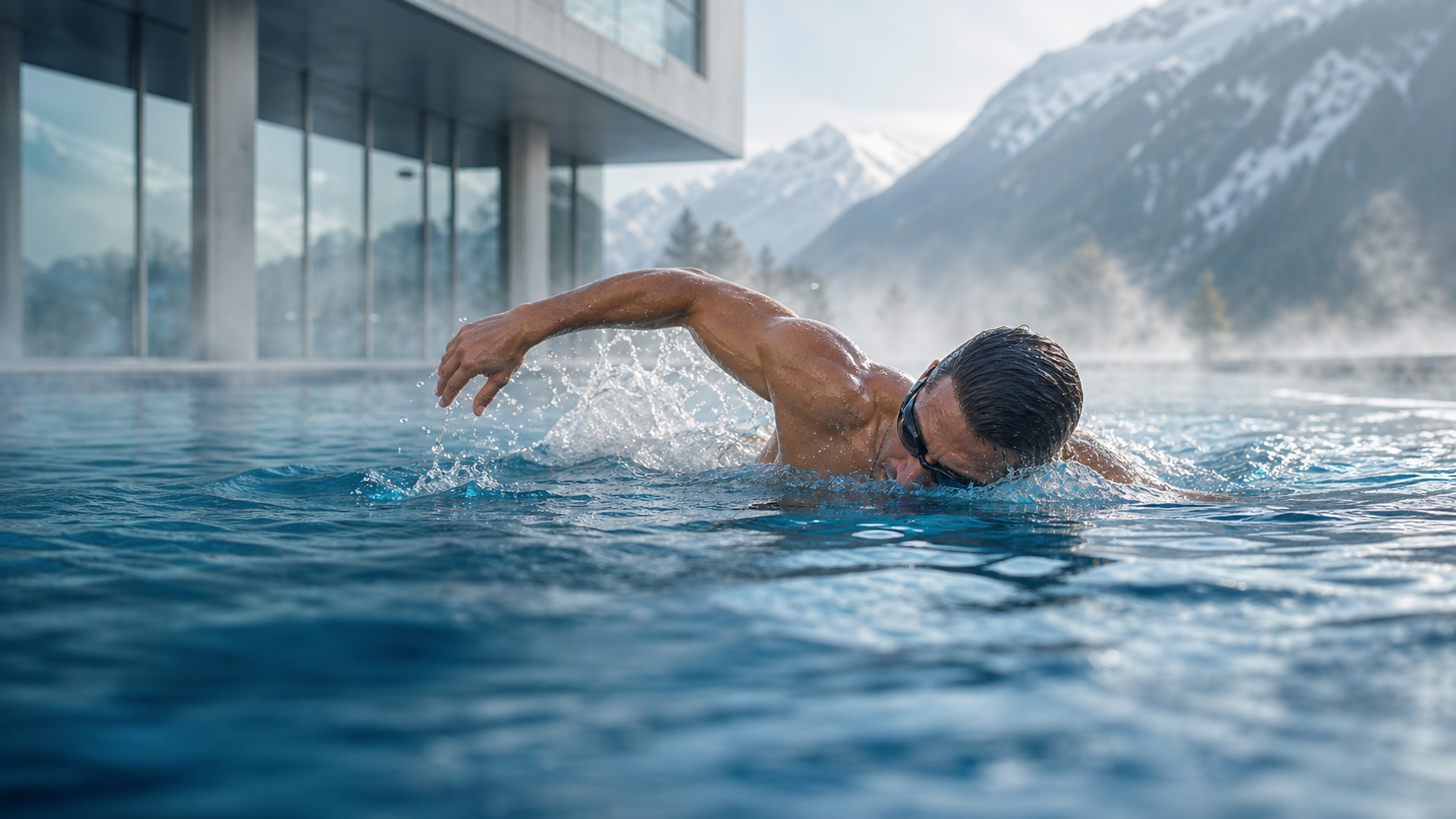
This is what makes swimming’s fat-loss effect unique. Water conducts heat more than 25 times better than air, and when you are submerged in water below body temperature, your body continuously loses heat through conduction. To maintain core temperature (around 37°C), brown adipose tissue and muscle accelerate their metabolism, burning more calories.
| Water Temperature | Extra Calorie Burn vs. a 28°C Pool | Notes |
|---|---|---|
| 24–26°C (Cool) | About +10–15% | Typical summer temperature of most public pools in Taiwan |
| 20–23°C (Cold) | About +20–30% | Winter outdoor pools or open-water swimming |
| Below 20°C (Icy) | Over +30% | Requires acclimation training; not recommended for beginners |
| 28–32°C (Warm) | Baseline | Standard for indoor heated pools |
One thing to note: while cold water burns more calories, it also strongly stimulates appetite. Studies show that after swimming in water below 20°C, subjects’ post-swim food intake averaged 44% higher than after swimming in warm water. This is one of the main reasons behind the feeling of being “even hungrier after swimming.” As a result, cold-water swimming needs to be paired with dietary control to actually achieve fat-loss results.
Calorie Burn Comparison Across Strokes
Stroke choice affects calorie burn far more than most people realize:
- Butterfly: The highest burn, about 14 kcal per minute (for a 70 kg adult), but it has a high technical barrier, and most people struggle to sustain it past 200 meters.
- Freestyle: The second-highest burn, about 11–13 kcal per minute. It’s the mainstream choice for long-distance swimming and offers the best balance between efficiency and intensity.
- Backstroke: A moderate burn, about 9–11 kcal per minute, and friendlier for beginners and those with back discomfort.
- Breaststroke: The lowest burn, about 8–10 kcal per minute, but the technique effectively trains the inner thighs and glutes.
In Taiwan’s public pools, most casual swimmers choose breaststroke. While it’s less efficient than freestyle, as long as it’s maintained for sufficient time and intensity, it still delivers a meaningful fat-loss effect.
Swimming’s “Afterburn Effect”
The phenomenon where the body continues consuming oxygen to restore physiological balance after aerobic exercise ends is called Excess Post-exercise Oxygen Consumption (EPOC), commonly known as the “afterburn effect.” Because swimming engages large muscle groups throughout the body, its EPOC effect is significant: after high-intensity interval swimming (swim HIIT), metabolic rate can remain elevated above resting levels for 2–3 hours, burning an estimated additional 50–200 kcal.
In addition, long-term swim training increases muscle mass, and muscle has a far higher basal metabolic rate than fat tissue — each kilogram of muscle burns about 13 kcal per day, while each kilogram of fat tissue burns only about 4.5 kcal. In other words, regular swimming doesn’t just burn calories during the workout — it also raises your fat-burning rate at rest.
Interval Swimming for Fat-Loss Efficiency
If fat loss is the primary goal, the following training approaches can maximize swimming’s fat-burning benefits:
- Swim HIIT: 25-meter sprints (all-out effort) plus 30 seconds rest, repeated for 10–12 rounds. This approach stimulates growth hormone release, a potent fat-mobilizing hormone.
- Pyramid training: 25m → 50m → 75m → 100m → 75m → 50m → 25m, with 30–45 seconds rest between segments. The total distance isn’t large, but the intensity swings widely, producing significant results.
- Long-distance moderate intensity: A continuous swim of 1,000–2,000 meters, keeping heart rate at 65–75% of maximum, suited for long-term fat loss driven primarily by aerobic metabolism.
Practical Tips
- Don’t blame swimming itself for post-swim hunger: Prepare healthy post-swim food in advance, such as boiled eggs, unsweetened soy milk, or bananas, to avoid overeating after your swim.
- Manage your expectations about water temperature: Indoor pools in Taiwan are typically 26–28°C, which is a reasonable environment for fat loss. There’s no need to deliberately seek out cold water — time spent in the water matters more than water temperature.
- Track progress, not just body weight: Swimming often builds muscle and burns fat at the same time, so body weight may stay flat in the short term even as body fat percentage drops. It’s better to judge progress using waist circumference, a body fat scale, or how your clothes fit.
- Swim at least 3–4 times per week: Each session should last 30 minutes or more to achieve significant metabolic benefits.
Conclusion
Swimming’s fat-loss effect is underestimated, largely because the appetite increase caused by water temperature misleads many people’s perception of their results. As long as it’s paired with reasonable dietary control, and you understand how water temperature, stroke choice, and training method affect calorie burn, swimming can absolutely become a highly efficient fat-loss exercise. Its advantage lies in being able to burn fat while protecting your joints, letting you lose weight without wearing down your body.
Related Reading
- Swimming and Weight Management: The Truth About Calorie Burn in Water Exercise
- Thermoregulation and Calorie Burn in Water: Why Does Swimming Burn More Energy?
- Water Temperature and Metabolism in Swimming: Calorie Burn and Core Temperature Regulation in Cold-Water Swimming
- The Truth About Weight Management Through Swimming: A Complete Breakdown of Calorie Burn Calculations and the Appetite Compensation Effect
靠單車減肥35公斤 心得分享與整理
7 年前
CT暗黑廚房) 車友必備 宇宙無敵鮮蚵湯 幫助訓練恢復 天然食補 好市多 超肥鮮蚵 破PR
7 年前
水金九不厭五分 10度寒流冷到不願停!feat. 卡卡 / 公路車 / CT Yeh
6 個月前
#公路車 #Vo2Max #最大攝氧量 測驗 體驗 | 心肺測試
6 年前
2016/05/13 單車 冷水坑下滑
10 年前
滑雪新手們慘摔學習全紀錄(請開字幕),滑雪好好玩 | Snowboard + Ski | 岩原 スキー場 | 滑雪APP使用 | GoPro Max
6 年前
2016/4/20 - 中社路 夜騎 半年甩肉14KG 後測
10 年前
大家都在開箱的...單車用藍芽對講耳機真的有幫助嗎? SENA BiKom 20 長距離旅遊 & 海鷗繞圈賽 實際體驗心得 / 公路車 / CT Yeh
9 個月前