Introduction
Sarcopenia — the quiet, gradual loss of muscle mass that comes with aging — doesn’t just make someone look frailer; it directly affects walking ability, balance, and metabolic function. Research shows that muscle mass begins declining slowly from age 30, accelerates after 40, and drops by roughly 6–10% per decade. For Taiwan’s growing elderly population, maintaining muscle mass is an urgent public health concern. Swimming, especially combined with water resistance training, offers a solution that’s both safe and effective.
The Physics of Water Resistance
Water offers over 800 times the resistance of air. This means that when you move your arms or legs through water, the resistance you encounter is far greater than the same movement would produce on land. Even more distinctive, water resistance has a property land-based resistance doesn’t: bidirectional resistance.
When you lift a dumbbell on land, gravity’s resistance only exists in the downward direction; release your grip and the resistance disappears. In water, no matter which direction you move, you meet resistance from the water. This means both the agonist and antagonist muscles get trained within the same movement — which is why water training is especially good for developing balanced muscle groups.
Training Effects of Swimming Strokes on Major Muscle Groups
| Stroke | Primary Muscles Trained | Special Significance for Anti-Aging |
|---|---|---|
| Freestyle | Latissimus dorsi, deltoids, core, quadriceps | Strengthens the upper back, counters age-related stooping |
| Backstroke | Abdominals, back extensors, hamstrings | Balances abs and back, prevents lower back pain |
| Breaststroke | Hip adductors, gluteus maximus, pectorals | Strengthens the adductor group, which is rarely trained otherwise |
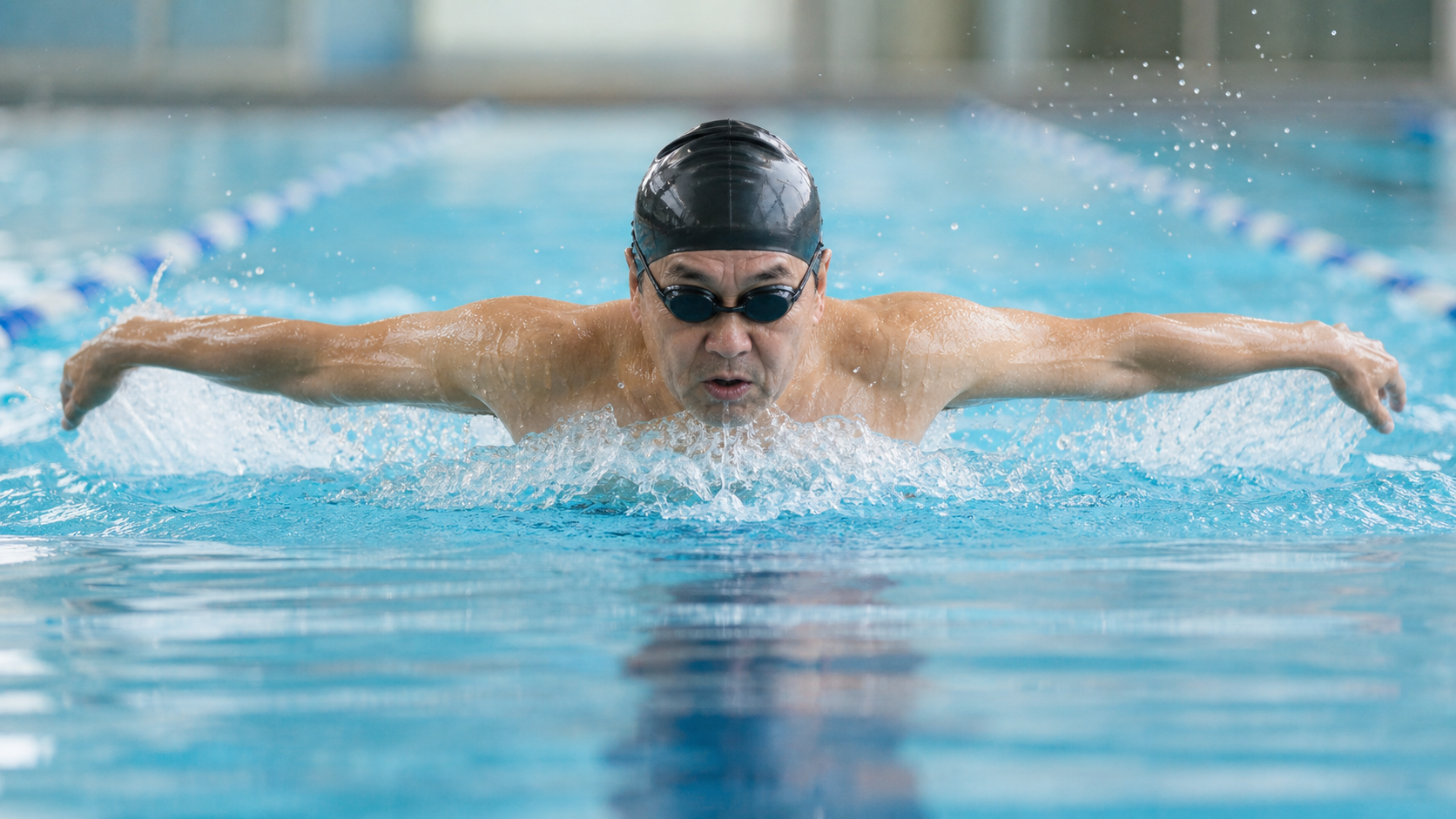
| Butterfly | Pectoralis major, latissimus dorsi, whole-core | Highest intensity, suited to advanced swimmers |
Combining full-body training across all four strokes, swimming can comprehensively cover the major muscle groups from neck to ankle — something rarely seen in most aerobic exercise.
Advanced Methods for Water Resistance Training
While standard swimming has some strength-building effect, adding water resistance equipment and specific movements makes it more effective at countering sarcopenia:
Aqua Noodle Training
- Underwater bicep curls: grip the noodle with both hands and push upward against the water’s buoyancy, training the triceps
- Underwater rowing: pull both arms backward through the water, strengthening the lats and rhomboids
- 15–20 reps per set, 3 sets, 45 seconds rest between sets
Water Stepping and Jumping
- High-knee running in place: rapid knee raises while standing in waist-deep water, training the core and quadriceps
- Water squats: squat down slowly and stand back up — water resistance makes the standing phase harder, strengthening glutes and legs
- Water side steps: move laterally, specifically training the gluteus medius (an important balance muscle and a common weak point in older adults)
Buoyancy-Assisted Strength Training
- Kickboard push-ups: press both hands down on a kickboard and mimic a push-up motion in the water, strengthening the chest and triceps
Comparing Muscle Benefits: Water Training vs. Land Training
Multiple studies have compared the strength gains from water resistance training against land-based resistance training, with these main findings:
- Among older adults (65+), water resistance training produces strength gains comparable to light land-based weight training, but with significantly lower risk of falls and injury.
- In a 10-week water resistance training program, participants’ lower-limb strength improved by an average of 15–25%, with significant improvements in walking speed and balance.
- For older adults who are overweight or have joint issues that prevent land-based resistance training, water training is often the only viable strength-training option.
Practical Recommendations
- 2–3 water resistance sessions per week: alternate with pure aerobic swimming — for example, Monday aerobic swimming, Wednesday water resistance training, Friday a mixed session.
- Pair with adequate protein intake: muscle synthesis needs sufficient raw material. Taiwan’s Ministry of Health and Welfare recommends 1.2–1.5 grams of protein per kilogram of body weight per day for adults 65 and older (versus the standard 0.8 g/kg for general adults).
- Take in protein within 30 minutes after swimming: during this “golden window,” muscles absorb protein most efficiently. A cup of unsweetened soy milk with a hard-boiled egg is a convenient option.
- Regularly assess your muscle mass: many pharmacies and gyms have body-composition scales that can measure muscle mass — checking every 1–2 months is a good way to confirm your training is working.
Conclusion
Aging can’t be stopped, but the rate of muscle loss can be controlled. Swimming combined with water resistance training is one of the safest and most comprehensive anti-aging exercise choices available today. For Taiwan’s growing population of middle-aged and older adults focused on healthy aging, a few pool sessions a week aren’t just exercise — they’re an investment in future mobility and quality of life.
You don’t need to wait until your knees give out to start swimming. Jump in the pool now, and build up a reserve of muscle capital for the person you’ll be thirty years from now.
Related Reading
靠單車減肥35公斤 心得分享與整理
7 年前
西進武嶺 免費訓練分析服務 Intervals | 練不夠還是練過頭?你哪一種類型選手?AI模型告訴你! | 備戰神器 | 公路車 訓練 | CT Yeh
4 年前
滑雪新手們慘摔學習全紀錄(請開字幕),滑雪好好玩 | Snowboard + Ski | 岩原 スキー場 | 滑雪APP使用 | GoPro Max
6 年前
[教學] Premiere 影片 手震 修正 教學 防抖 單眼 影像 GoPro 穩定 Video Stabilization
8 年前
水金九不厭五分 10度寒流冷到不願停!feat. 卡卡 / 公路車 / CT Yeh
6 個月前
CT暗黑廚房) 車友必備 宇宙無敵鮮蚵湯 幫助訓練恢復 天然食補 好市多 超肥鮮蚵 破PR
7 年前
實景訓練台) 彰化經典百K 高強度喵團 90分鐘 跟著一起練功 2019 Indoor workout Changhua Classic 100 Taiwan
7 年前
洗單車神器 吹水機! 實際洗車用用看 暴力洗鍊條大法 | 公路車 | CT Yeh
4 年前