Weather Strategies for Long-Distance Riding: Immediate Adjustments for Sudden Rain, Strong Winds, and High Heat
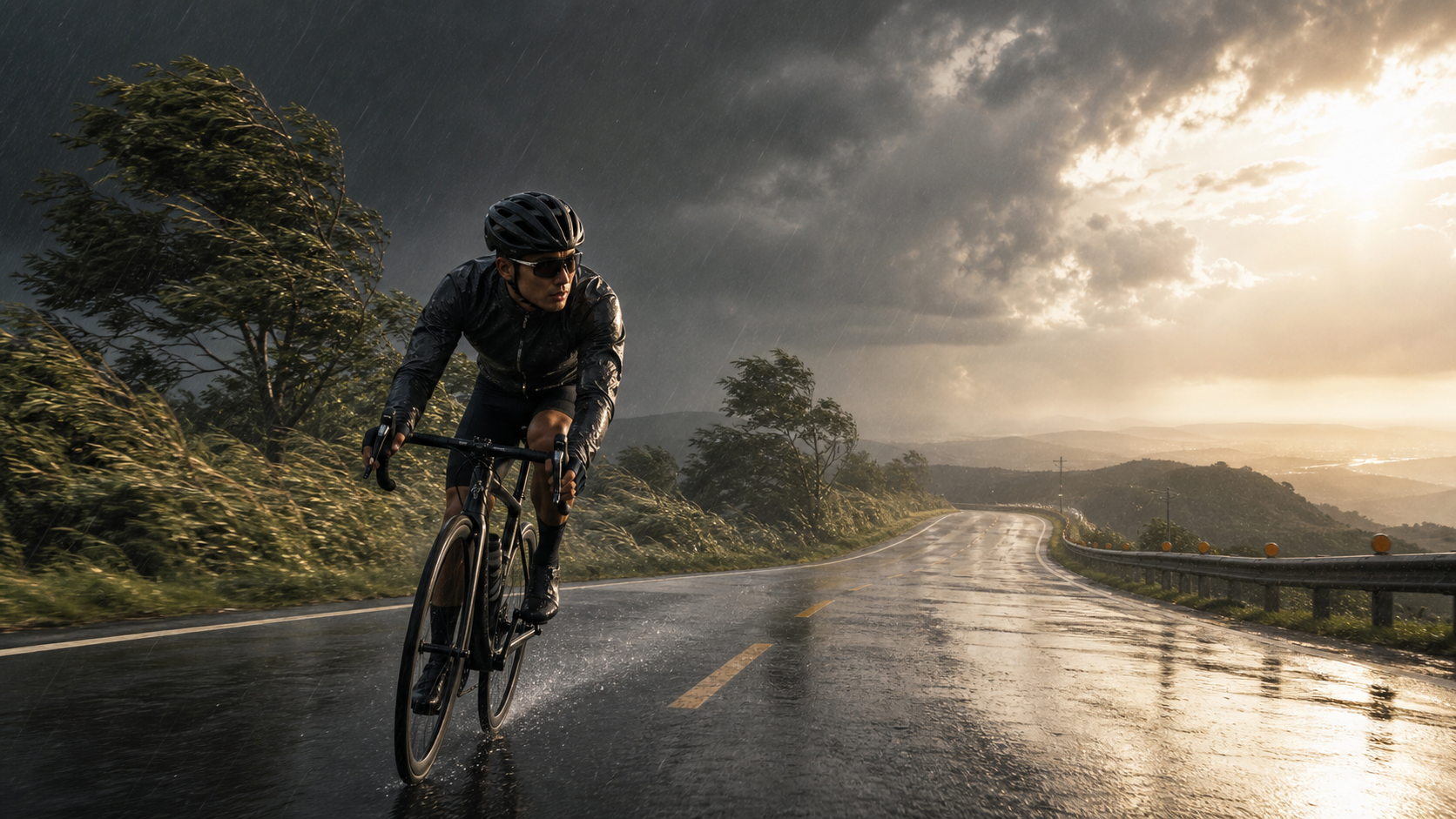
Introduction
Taiwan’s weather is highly changeable, especially in mountainous areas—sunny in the morning, but possibly thunderstorms by the afternoon. Long-distance riding spans long durations and vast regions, making it nearly impossible to have perfect weather for every segment. Learning to adjust your strategy under different weather conditions is an essential skill for long-distance riders and a key differentiator between those who are prepared and those who are not.
Responding to Sudden Rain
Convective rain in Taiwan’s summer comes and goes quickly, most frequently occurring between 2–5 PM. Rain affects long-distance riding in three main ways: reduced visibility, slippery road surfaces, and a drop in body temperature.
Immediate Action Checklist
- Slow down immediately: Braking distance on wet roads is 2–3 times longer than on dry roads; approach corners at more conservative speeds
- Avoid white lines and manhole covers: These are extremely slippery when wet and should be ridden around
- Put on a windproof and waterproof jacket: Even in brief rain, getting soaked causes body temperature to drop rapidly, especially dangerous on descents
- Seek shelter: If there is lightning and thunder, immediately find covered shelter (gas stations, bus stops); do not wait in open areas or under trees
- Check shifters: If using electronic shifting, confirm that connectors have not accumulated water and short-circuited
Rain Gear Recommendations
| Gear | Purpose | Weight |
|---|---|---|
| Lightweight windproof/waterproof jacket | Rain protection and insulation | 80–150g |
| Waterproof phone pouch or bike computer cover | Protect electronic devices | Negligible |
| Latex gloves (thin) | Maintain grip in the rain | 30–50g |
| Reflective vest | Increase visibility in the rain | 80–100g |
Responding to Strong Winds (Especially Crosswinds)
Certain sections of Taiwan (Provincial Highway 61 along the coast, Hengchun Peninsula) frequently experience strong crosswinds, and sudden gusts can cause riders to momentarily lose directional control.
Strong Wind Riding Techniques
- Lower your center of gravity: Bend your elbows and keep your body lower to reduce the surface area exposed to wind resistance
- Stabilize the handlebars: Grip the handlebars firmly with both hands, keeping elbows slightly bent to absorb impacts—do not lock them out
- Anticipate crosswinds: On sections sheltered by roadside buildings, expect sudden gusts when leaving the shelter
- Group formation: In crosswinds, the group can adopt an “echelon” formation to shelter each other from the wind
- Pace control: Don’t force power output into headwinds; accept a drop in speed and aim to maintain the same heart rate output
Wind Speed and Riding Strategy
- Wind speed < 20 km/h: Ride normally
- Wind speed 20–35 km/h: Reduce speed and avoid riding side-by-side
- Wind speed > 35 km/h: Consider changing the route or waiting; descents are especially dangerous
Responding to High Heat (Above 32°C)
During Taiwan’s summer riding season, temperatures exceeding 32°C are commonplace. High heat not only causes discomfort but also accelerates fluid and electrolyte loss, reduces cardiac output efficiency, and significantly impacts physical performance.
High Heat Riding Adjustment Strategies
- Proactively reduce power output: In high heat, the same heart rate corresponds to lower power output; do not force yourself to hit power targets
- Increase hydration frequency: Hydrate every 15 minutes instead of every 20–25 minutes
- Actively seek shaded sections: Shaded country roads are 5–8°C cooler than open highways
- Cool the neck: Pour cold water on your neck or apply an ice towel to rapidly lower core body temperature
- Avoid 12–3 PM: If possible, schedule the longest distance segments for early morning or evening
Tools for Weather Forecasting
Before departure, the following tools can be used to check the weather:
- Central Weather Administration App: Taiwan’s most accurate weather forecast, with hourly forecasts available
- Windy.com: Visualized maps for wind speed and rainfall forecasts; essential for mountain riding
- Rainfall Observation Stations (CWA website): Check real-time rainfall along your route
Practical Advice
- Do a detailed weather check the night before a long ride and prepare the appropriate gear
- A lightweight windproof jacket can be stuffed into a jersey pocket even on sunny days, just in case
- Inform your emergency contact of your weather response plan (e.g., if thunderstorms occur, you plan to wait at a certain location)
- The likelihood of afternoon lightning in Taiwan’s mountainous areas is high; if your route includes climbing sections, try to complete them before noon
Conclusion
Weather is the one variable in long-distance riding that is completely beyond your control, but your response to it can be entirely planned in advance. A lightweight rain jacket and a real-time weather app may be the difference between getting home safely and suffering through the elements. Accepting imperfect weather and setting out prepared is the true long-distance rider’s mindset.
Related Reading
- Weather Adaptation for Long-Distance Riding: Practical Strategies for Taiwan’s Summer Heat Waves and Southwesterly Winds
- Multi-Day Weather Strategies for Long-Distance Riding: Planning for Rides Lasting 3+ Days
- Cycling Weather Strategies: A Safe Riding Guide for Rain, Strong Winds, and High Heat
- Bikepacking Climate Response: Emergency Measures for Heavy Rain, Strong Winds, and Low Temperatures
單車 一日北高 ( 雙城 ) 肥宅雙人瘋狂行 紀錄片 REACTO
10 年前
#公路車 #Fitting 靠人工智慧APP 幫你調整單車
6 年前
一日北高前的西濱集訓 | 跟著11小時軍團 | 300W踩不動的大逆風 | 輪車破風差幾瓦?
6 年前
下雨天就是要改車 #ceramicspeed #bike
1 年前
一日北高/長距離團騎 常見問題補充篇 / 組團或跟團的眉角 / 壯車友容易被瘦車友慢性拉爆 / 原來屁股痛可能是這個原因...? / 風場配速法 / 公路車 / CT Yeh
2 年前
大武山後門26%歡樂陡坡!JJSC南台灣單車行Day2 / 被颱風追著跑 / 公路車 / CT Yeh
2 年前
JJSC南台灣單車走春三日行 DAY 1 / 強度 x 美食 x 節慶體驗 / 公路車 CT Yeh
5 個月前
彰化經典百K 多視角衝刺實錄 | 范老師高鐵 NEKO's Fun Eva | 公路車
5 年前