Long-Distance Riding Companion Communication: Group Hand Signals, Pace Coordination, and Supply Division
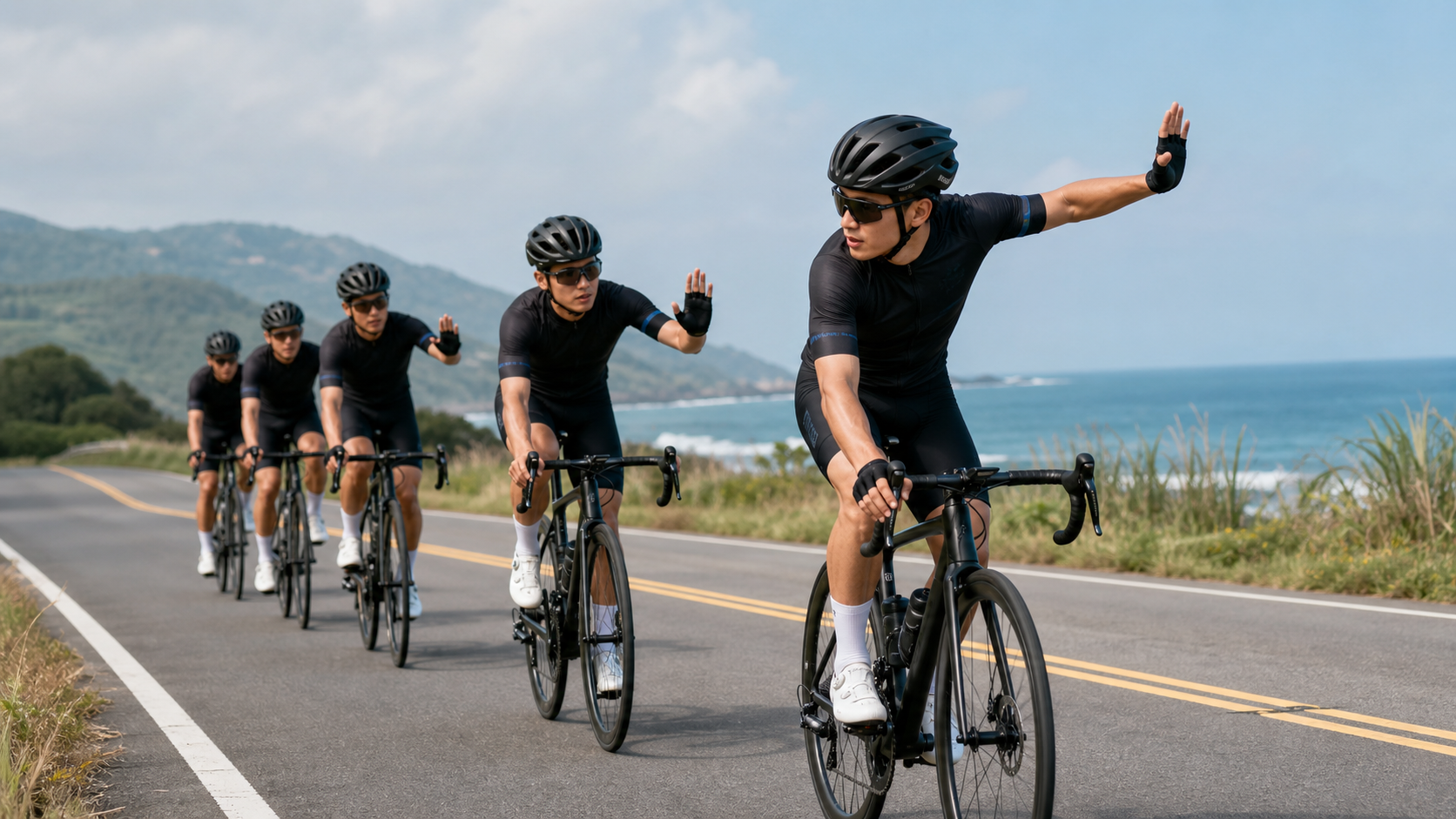
Introduction
Riding solo and riding in a group are completely different experiences. A well-coordinated group can save each rider 20–30% of their energy (through the drafting effect) and can also provide mutual support when mechanical issues or emergencies arise. However, group riding also comes with its own unique challenges: inconsistent speeds, differing supply needs, and dangerous actions caused by poor communication. This article provides a communication and coordination system for long-distance group riding.
Basic Hand Signal Language
Cycling hand signals are a universally recognized safety communication tool. Here are the most important signals for long-distance riding:
| Signal | Action | Meaning |
|---|---|---|
| Left/right arm extended horizontally outward | Arm perpendicular to the body | Turn left/right |
| Hand waving backward | Hand behind the waist | Obstacle behind, slow down |
| Palm pressing downward | Hand pressing down repeatedly | Slow down |
| Arm swinging upward | Forearm extended straight up | Entire group stops |
| Finger pointing down at the ground | Pointing at a specific spot | Obstacle on the road (pothole, gravel) |
| Fist held back | Fist behind the waist | Emergency stop |
| Patting the thigh | Patting repeatedly | Rotate the lead (take over the front) |
Important: All hand signals should be passed from the front to the back (the rider in front makes the signal, the rider behind repeats it), forming a relay chain to ensure the entire group receives the message.
Standard Verbal Communication Phrases
In addition to hand signals, verbal calls are also an important tool for group safety:
- “Car!”: A vehicle is approaching from behind, the entire group moves to the side
- “Hole!”: There is a pothole ahead
- “Left / Right!”: Turning left or right soon
- “Slow!”: Need to slow down ahead
- “Stop!”: Notifying the entire group that a supply stop is coming up
- “Pedestrian!”: Pedestrian ahead, need to go around
Calls should be clear and loud, passed from the front to the back in sequence. Each rider repeats the call and passes it on to the next.
Pace Coordination Strategies
Differences in fitness among group members are the most common source of friction in long-distance riding. Here are several ways to coordinate pace differences:
Paceline
Taking turns at the front is the most effective way to save overall energy:
- Standard rotation interval: each rider leads for 3–5 minutes (adjust based on wind speed and fitness)
- When rotating, the lead rider pulls aside to let the line move forward
- Less fit members can lead for just 1–2 minutes before rotating; equal time is not mandatory
Handling Pace Differences
- Discuss the day’s target pace before departure to ensure all members agree
- Stronger riders should wait for slower riders after climbs (don’t wait on descents—the speed difference is too dangerous)
- If the pace difference is too large, split into Group A/B and agree to meet at the supply stop
Streamlining Supply Division
Efficient supply division within the group can significantly reduce time spent at supply stops:
- Centralized supply purchasing: Before stopping, designate 1–2 riders to go into the store to shop while others perform mechanical checks and stretching
- Distributed tool carrying: Pumps, chain tools, etc. are carried separately by different members to reduce individual load
- Supply sharing: Confirm what food each person has brought before departure to facilitate sharing in an emergency
- Stop time control: Designate a timekeeper to ensure supply stops do not exceed 15 minutes
Group Response to Mechanical Issues
When someone has a mechanical issue (flat tire, broken chain, etc.), the group’s standard procedure:
- The entire group stops and moves to a safe spot on the side of the road
- Those with technical skills handle the mechanical issue while others replenish food/water or rest
- The most skilled member acts as the “mechanic”; others should not crowd around and interfere with the work
- After the repair is complete, give everyone 3–5 minutes to get ready, and confirm all members are prepared before departing
Practical Advice
- Hold a “pre-ride meeting” 30 minutes before departure to confirm the day’s route, supply points, and emergency contact information
- Every member should store the emergency contact numbers of all other members in their phone
- On unfamiliar sections, designate one member to handle GPS navigation while others follow, reducing distraction
- If a member feels unwell or wants to quit, don’t pressure them; one member can accompany them to drop out while the others continue
Conclusion
A good group culture is one of the best parts of long-distance riding. When everyone understands the meaning of the hand signals, is willing to coordinate pace, and contributes to supply division, the group becomes an organic whole, allowing everyone to ride farther, safer, and enjoy the journey more.
Related Reading
- Group Ride Hand Signals and Communication: The Language of Mutual Understanding for Safe Group Riding
- Cycling Hand Signals and Group Communication: Basic Safety Signal Standards for Riding in Taiwan
- Group Riding Safety: A Complete Guide to Hand Signals, Route, and Braking Cues
- Skills and Coordination in Group Riding: Principles of Hand Signal Communication, Following Distance, and Avoiding Chain-Reaction Crashes
[教學] Dashware 教學 如何製作有 速度 功率 心律的 騎車影片 Guages Video
8 年前
一日北高/長距離團騎 常見問題補充篇 / 組團或跟團的眉角 / 壯車友容易被瘦車友慢性拉爆 / 原來屁股痛可能是這個原因...? / 風場配速法 / 公路車 / CT Yeh
2 年前
大家都在開箱的...單車用藍芽對講耳機真的有幫助嗎? SENA BiKom 20 長距離旅遊 & 海鷗繞圈賽 實際體驗心得 / 公路車 / CT Yeh
9 個月前
單車 一日北高 ( 雙城 ) 肥宅雙人瘋狂行 紀錄片 REACTO
10 年前
CT 喇低賽) 武嶺牽車 才是王道 西進牽車四小時內秘訣 攝手位置 如何判斷 防抽筋小秘訣
7 年前
實錄) 車隊中 攝影師 是如何用感情拍片的呢? 單車 移動攝影 攝影師的視角 米粉坡 手持 DJI OSMO POCKET Ft. Team Neko
7 年前
多機位拍片神器 DJI Action 2 拍出速度張力感 | 類空拍機視角 4陣列麥克風超強降風噪 實測! | 公路車 | CT Yeh
3 年前
新屋團體繞圈賽 | 眾多菁英好手賽道奔馳 | 千瓦女子軍團 | 無敵交管狂獲好評 明年你一定不能錯過 | #公路車
5 年前