Introduction
Many long-distance riders spend a great deal of time planning routes and choosing gear, yet overlook two elements that most easily transform the riding experience: warm-up and cool-down. Without a warm-up, the body takes longer to get into gear, increasing the risk of going too hard early on; without a cool-down, muscles recover in a tightened state, making next-day soreness worse and raising the risk of injury. This article provides two ready-to-execute routines.
Why Do Long Rides Need a Warm-Up Even More?
Unlike short training rides, the early portion of a long ride often means setting off in the dark of early morning, when temperatures are lower, muscles are stiff, and the entire ride’s intensity needs to stay within Zone 2. Without a proper warm-up, riders are prone to:
- Abnormally high heart rate in the first 20–30km (the body hasn’t reached a steady state yet)
- Excessive cold-start stress on the knees and Achilles tendons
- Poor energy efficiency, burning through too much glycogen early on
The 20-Minute Pre-Ride Warm-Up Routine
This routine is performed before departure, requires little space, and can be done in a parking lot or at the roadside.
Dynamic Stretching (10 minutes)
Dynamic stretching (stretching while in motion) suits warm-ups better than static stretching because it simultaneously boosts blood flow and joint mobility:
| Movement | Sets | Purpose |
|---|---|---|
| Leg swings forward and back | 15 per leg | Hip joint mobility |
| Lateral lunges | 10 per leg | Warming up inner and outer thighs |
| Squats with torso twists | 10 | Activating glutes and core |
| Ankle rotations | 10 circles per foot | Warming up ankle joints, preventing Achilles strains |
| Torso rotations | 10 | Loosening the lumbar spine joints |
Light Riding Activation (10 minutes)
After finishing dynamic stretching, don’t immediately ride at your normal pace:
- First 5 minutes: Ride at a very easy Zone 1 intensity (heart rate around 50–55% of max)
- Next 3 minutes: Gradually build to the low end of Zone 2
- Final 2 minutes: Do 2–3 rounds of 20-second “fast cadence” (high rpm, low resistance) to activate the neuromuscular connection
This “low-intensity activation phase” ensures your cardiac output, muscle temperature, and energy metabolism systems are ready before you truly start riding.
The 15-Minute Post-Ride Cool-Down Routine
After reaching your destination, complete the cool-down within 15 minutes, while muscles are still warm, for the best results.
Static Stretching (10 minutes)
After a long ride, these areas need stretching the most:
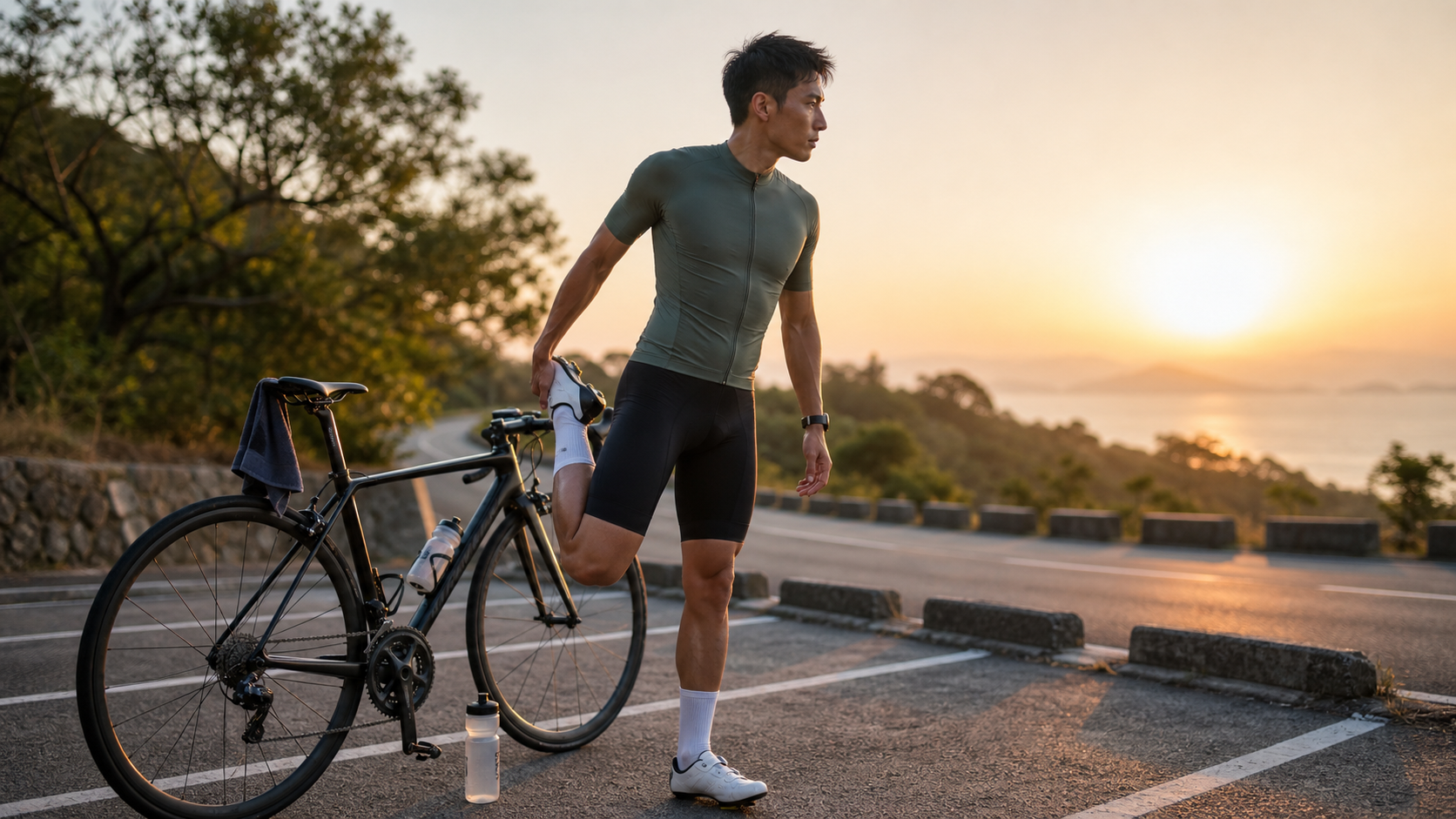
- Quadriceps (front of thighs): Standing, grab your ankle and bend it back, hold for 30–45 seconds, 2 times per leg
- Hamstrings (back of thighs): Sit on the ground with legs straight, lean forward, hold for 30–45 seconds
- Calves (gastrocnemius/soleus): Facing a wall in a lunge, back heel on the ground, hold for 30 seconds, then slightly bend the back knee for another 30 seconds
- Hip flexors (iliopsoas): Kneeling lunge, front leg bent 90 degrees, back knee on the ground, torso upright, hold for 30–45 seconds
- Shoulders, neck, and upper back: Interlace hands overhead to stretch, plus neck side tilts, each held for 20 seconds
Light Massage (5 minutes)
If you have a foam roller or massage ball:
- Roll the quadriceps and hamstrings for 1 minute each
- Roll each calf for 30 seconds
- Glutes (piriformis): Sit on the roller, slightly tilted, roll each side for 1 minute
If you don’t have a roller, gently grasp with your hands and press along the direction of the muscle fibers.
Immediate Refueling After the Cool-Down
Cool-down and refueling should happen together; don’t wait until all stretching is done to refuel:
- Within 15 minutes of stopping: Consume carbs + an electrolyte drink
- You can drink while doing static stretching
- If you feel noticeably fatigued, take protein (20–25g) immediately after stretching
Practical Tips
- Add the warm-up and cool-down to your pre-ride “checklist” and make them a habit for every ride
- After the cool-down, if conditions allow, apply a warm towel to your legs to speed up muscle relaxation
- If your legs still feel tight 2–4 hours after a long ride, do another light stretch
- If you have knee discomfort, pay extra attention to quadriceps activation during the warm-up (wall squats, 15 reps)
- If time is tight, the warm-up can be shortened to 10 minutes, but keep the first 20 minutes of the ride at Zone 1 intensity
Conclusion
Warm-up and cool-down may seem time-consuming, but each only takes 15–20 minutes, and in return you get better riding performance, faster recovery, and fewer injuries. In a 10-hour, 200km ride, investing 35 minutes in preparing and protecting your body is the most cost-effective use of time.
Related Reading
- The Right Way to Warm Up and Cool Down: The Key Step 90% of Riders Overlook
- Warm-Up and Cool-Down Before and After Riding: A 10-Minute Routine
- The Complete Guide to Dynamic Stretching Before Riding: The Perfect Warm-Up to Awaken Your Body
- Climbing Warm-Up Strategies: Activating Muscles and the Nervous System Before the Race
一日北高/長距離團騎 常見問題補充篇 / 組團或跟團的眉角 / 壯車友容易被瘦車友慢性拉爆 / 原來屁股痛可能是這個原因...? / 風場配速法 / 公路車 / CT Yeh
2 年前
FTL 與 SYB 車隊專訪 西進武嶺 實用攻略分享! 2小時 如何練?!你不知道的眉角!新手準備武嶺必看 EP1 | 實力派女車友 | 精華版 | 公路車 | CTYeh
4 年前
單車 一日北高 ( 雙城 ) 肥宅雙人瘋狂行 紀錄片 REACTO
10 年前
CT 喇低賽) 武嶺牽車 才是王道 西進牽車四小時內秘訣 攝手位置 如何判斷 防抽筋小秘訣
7 年前
Never Stop 西進武嶺 前後雙機 完整全程錄影 訓練台 實境
8 年前
2019 夏季KOM 5小 完賽心得 準備攻略 東進武嶺 夏季登山王之路 Taiwan KOM Challenge
7 年前
Live) 備戰2019彰化經典百K 賽前攻略 (已完賽請看新影片
7 年前
一日北高常見問題大集合 | 攻略 | 路線 | 訓練 | 補給 | 自行車 單車 | 一日雙城 | 雙塔 | TWB北高360 | 屁股痛
6 年前