Introduction
Two runners with identical fitness levels can differ by 5–10 minutes in marathon results due to differences in course strategy. Course strategy isn’t something only elite runners need to think about—for every recreational runner hoping to hit their target pace, it’s race-day wisdom that cannot be ignored.
This article breaks down every key element of the marathon course—the start, straights, curves, climbs, aid stations, and the final sprint—and provides concrete speed management strategies.
The Start: Positioning and the First 5K Strategy
The Importance of Corral Placement
Large marathon events (such as the Taipei Marathon and the Wan Jin Shi Marathon) typically start runners in corrals based on predicted finish time. Choosing the correct starting corral is crucial:
- Corral too far forward: You start too fast (carried away by the pack), burning energy prematurely
- Corral too far back: You need to weave through the crowd, expending extra energy and risking injury
- Best strategy: Choose a corral slightly faster than your predicted finish time (about 5–10 minutes), allowing you to maintain a smooth rhythm while still having room to move up
The Golden Rules of the First 5K
- The first kilometer after the gun will inevitably be crowded; accept the slow pace and don’t weave laterally to pass
- Keep your heart rate below 78% of your max HR (5–8% lower than your target pace heart rate)
- Let the “easy feeling” from adrenaline remind you: this early comfort is an illusion—hold back
Speed Management on Curves
Curves on road race courses are a source of speed loss many runners overlook:
The Tangent Running Principle
On any curve, running the full arc along the outside is far longer than taking the shortest route (the tangent). In a 42.195 km marathon, if you run entirely on the outside, your actual distance can reach 43–44 km; by running precise tangents, you can stay close to the standard distance.
- Rule: Take the shortest straight-line path through every curve (extending from the straight before the curve to the straight after it)
- In practice: Start moving inward 3–5 steps before the turn, then return to your usual line after the curve
- Estimated savings: Running precise tangents throughout the race can save an average of 100–300 meters of distance, translating to roughly 30–90 seconds
| Curve Type | Recommended Strategy | Cautions |
|---|---|---|
| 90-degree right-angle turn | Cut the inside, take the shortest route possible | Watch the surface material (slippery brick) |
| Wide sweeping curve | Follow the tangent along the middle of the course | Don’t block others’ lines |
| Consecutive S-curves | Find the overall shortest path for each section | Requires advance judgment; not every curve should be cut |
| Hairpin turn | Don’t force the shortest line; maintain steady speed | Safety first in high-density crowds |
Speed Management at Aid Stations
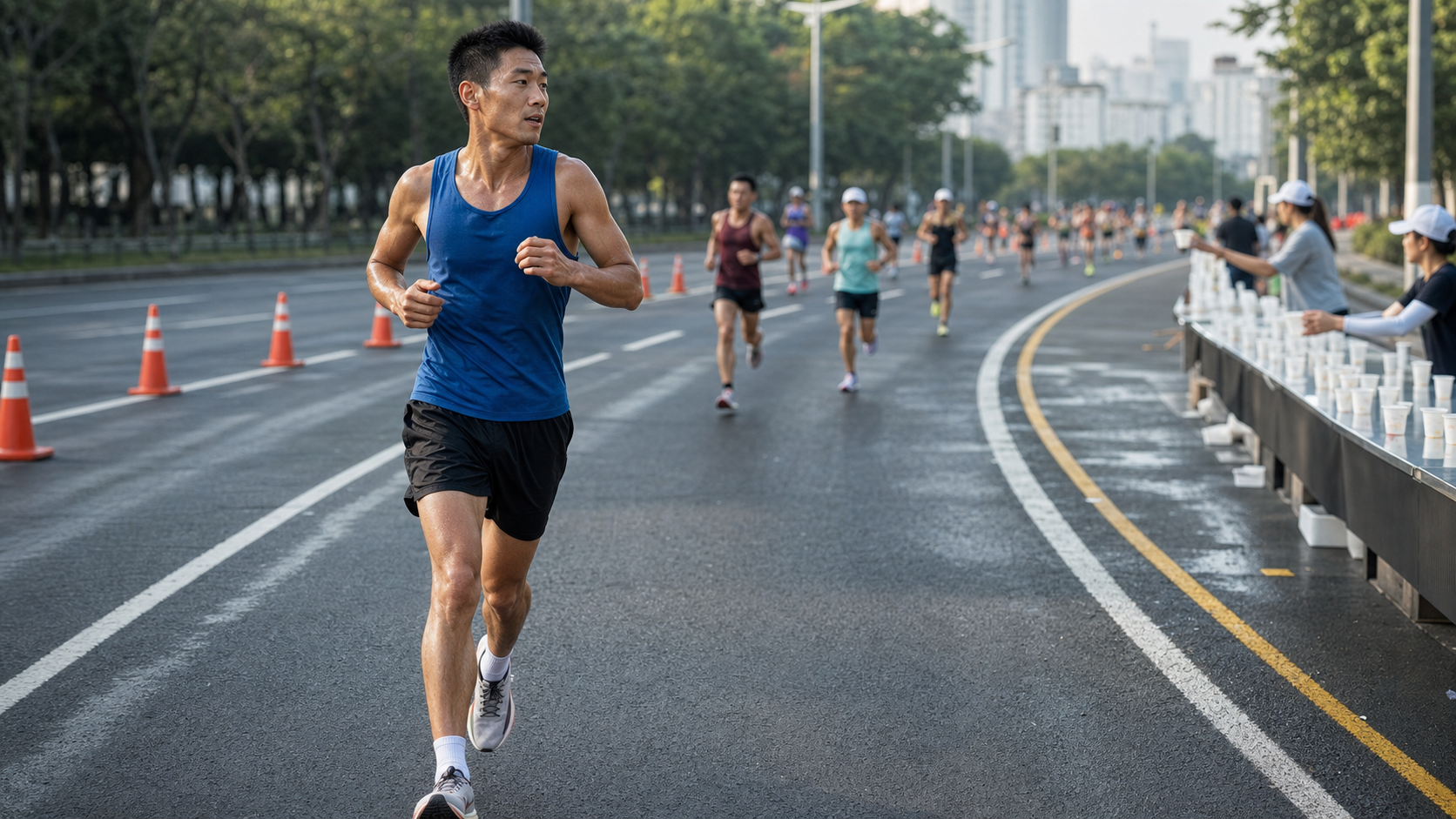
Aid stations are an unexpected black hole where many runners lose time:
The Ideal Aid Station Workflow
- Decide 50–100 meters in advance whether to take on supplies at this station (don’t decide when you arrive)
- Reach out toward the volunteer you’re targeting to signal (reducing hesitation time on both sides)
- Slow down, don’t stop: Ease to a 6:30–7:00/km pace to grab your drink, then keep jogging while you drink
- Quickly return to your target pace after drinking
- Take your energy gel 30 seconds before the aid station so you can wash it down with water from the station
Time Savings Calculation
- Coming to a full stop to drink: 15–30 seconds lost
- Walking while drinking: 8–15 seconds lost
- Jogging while drinking: 3–8 seconds lost
- With 10 aid stations over 42 km, saving 8 seconds per station = roughly 80 seconds saved over the entire race
Speed Management on Uphills and Downhills
- Uphills: Ease your GPS pace by 10–20 seconds/km, keep your heart rate steady, and don’t try to pass large numbers of runners on climbs (the cost is too high)
- Downhills: Don’t sprint at full speed; protect your quadriceps; let gravity accelerate you naturally, but don’t exceed your fastest pace from the first half by more than 5 seconds/km
- Recovery after hills: After the climb ends, give your body 30–60 seconds to adjust before returning to your target pace
Final 5K Sprint Strategy
- At 37 km, assess how much fuel remains in the tank: if you feel good, start picking up the pace by 5 seconds per kilometer
- At 40 km, you can allow your RPE to reach 8–9
- In the final kilometer, if you still have something left, you can push 10–20 seconds/km faster for the final sprint
- Never start sprinting before 37 km: The cost of accelerating too early is often blowing up at 39–40 km
Practical Tips
- Scout the course beforehand: Know where the curves, climbs, and aid stations are, and plan your pace for each segment in advance.
- Practice tangent running: Deliberately practice cutting curves during training so it becomes instinct on race day.
- Practice aid station drills: Practice drinking while running during long runs so you won’t stop out of nervousness on race day.
- Segment target pace card: Divide the race into segments, write the target pace for each on a card, and stick it on your arm for quick reference.
Conclusion
Course strategy is free speed. Fitness takes months of training to improve, but strategic wisdom only requires understanding and practice. Starting today, make every race a carefully managed speed experiment—your results will improve faster than you think.
Related Reading
- Road Race Starting Strategy: How Pacing in the First 10% of the Distance Affects Finish Time
- Corral Starts and Positioning Strategy for Road Races
- Marathon Race Day Strategy: Starting Pace, Aid Stations, and Picking It Up in the Second Half
- The Complete Marathon Pacing Guide: Precise Segment Plans from Sub-3 to Sub-6
西進武嶺 免費訓練分析服務 Intervals | 練不夠還是練過頭?你哪一種類型選手?AI模型告訴你! | 備戰神器 | 公路車 訓練 | CT Yeh
4 年前
CT 喇低賽) 武嶺牽車 才是王道 西進牽車四小時內秘訣 攝手位置 如何判斷 防抽筋小秘訣
7 年前
西進武嶺 自製新版AI配速表產生器 x 賽前攻略 抱佛腳! 沒有功率計也可以產生配速表嗎?有什麼其他眉角賽前要注意的呢? | 西進武嶺 / 東進武嶺 KOM 攻略 | 公路車 | CT Yeh
4 年前
一日北高/長距離團騎 常見問題補充篇 / 組團或跟團的眉角 / 壯車友容易被瘦車友慢性拉爆 / 原來屁股痛可能是這個原因...? / 風場配速法 / 公路車 / CT Yeh
2 年前
Live) 備戰2019彰化經典百K 賽前攻略 (已完賽請看新影片
7 年前
西進武嶺各路段 前8000名 大數據分析 配速攻略/功率/心律/推力比/維持率/踏頻/踏瓦比/牽車率 大公開 | 建大盃 NeverStop 可參考 | 公路車 | CT Yeh
5 年前
公路車 爬坡 破PR 紀錄 小技巧 分享
6 年前
戰略) Zwift Race 如何咬在第一集團 如何評估自己要開多少推力 (請開1.5倍速看)
7 年前