Introduction
There is a way of traveling that requires no suitcase, no pre-booked hotels, and no tour guide. All you need is a bicycle, a bag, and a heart willing to let the journey lead you. This is Bikepacking, the minimalist version of bicycle travel. On the island of Taiwan, this travel philosophy has uniquely favorable conditions for practice: round-island highways, mountain trails, and the eastern coastline—every road can become the stage for a story.
The Difference Between Bikepacking and Bicycle Touring
Traditional bicycle touring typically uses large racks and panniers, prioritizing maximum luggage space, making it suitable for long-distance trips carrying tents, cooking gear, and changes of clothes.
Bikepacking, on the other hand, is a concept that has risen over the past decade, emphasizing paring gear down to the bare minimum and using frame bags, handlebar bags, and stem bags—lightweight storage systems that hug the bike—for lower overall weight, better handling, and greater suitability for mountain roads and off-road terrain.
| Aspect | Traditional Bicycle Touring | Bikepacking Minimalist Travel |
|---|---|---|
| Luggage system | Rack + panniers (mainly rear rack) | Frame bag + handlebar bag + stem bag |
| Total luggage weight | Usually 10–20 kg | Target under 5 kg |
| Suitable terrain | Flat roads, paved roads | Paved roads, mountain trails, mixed terrain |
| Travel pace | More fixed, detailed planning | Highly flexible, improvise as you go |
| Cost | Mainly restaurants + accommodation | Wild camping or simple lodging |
Minimalist Gear List: What Do You Really Need?
The core question of minimalist travel is: “If I don’t bring this, what’s the worst-case scenario?” Usually the answer is “it won’t be a big problem,” and so that item can be cut.
Indispensable items (related to survival and safety):
- Helmet, front and rear lights
- Phone and charging cable (serves navigation, emergency contact, and recording functions)
- Basic repair tools: puncture repair kit, multi-tool wrench, quick link
- First-aid kit (band-aids, elastic bandage, pain relievers)
- Waterproof rain jacket (Taiwan’s weather is changeable; this is a must)
- Water bottles (at least two, as resupply points may be far apart)
Items to decide based on circumstances:
- Change of clothes (1–2 sets of quick-dry clothing is enough; hand-wash and dry the same day)
- Sleep system (if planning to camp: lightweight sleeping bag + egg-crate sleeping pad; can be omitted if staying in lodging every night)
- Cash (mountainous or remote areas may not have credit card payment terminals)
Items you can leave behind (usually useless even if brought):
- Multiple sets of clothing (one quick-dry set for changing is enough)
- Laptop (a phone can handle almost all tasks)
- Large amounts of spare food (Taiwan’s convenience stores are dense; no need to stockpile)
Routes in Taiwan Suitable for Minimalist Travel
Taiwan’s geographic characteristics make it an ideal island for Bikepacking: moderate size, dense road networks, easy resupply at convenience stores, diverse culture, and generally friendly locals.
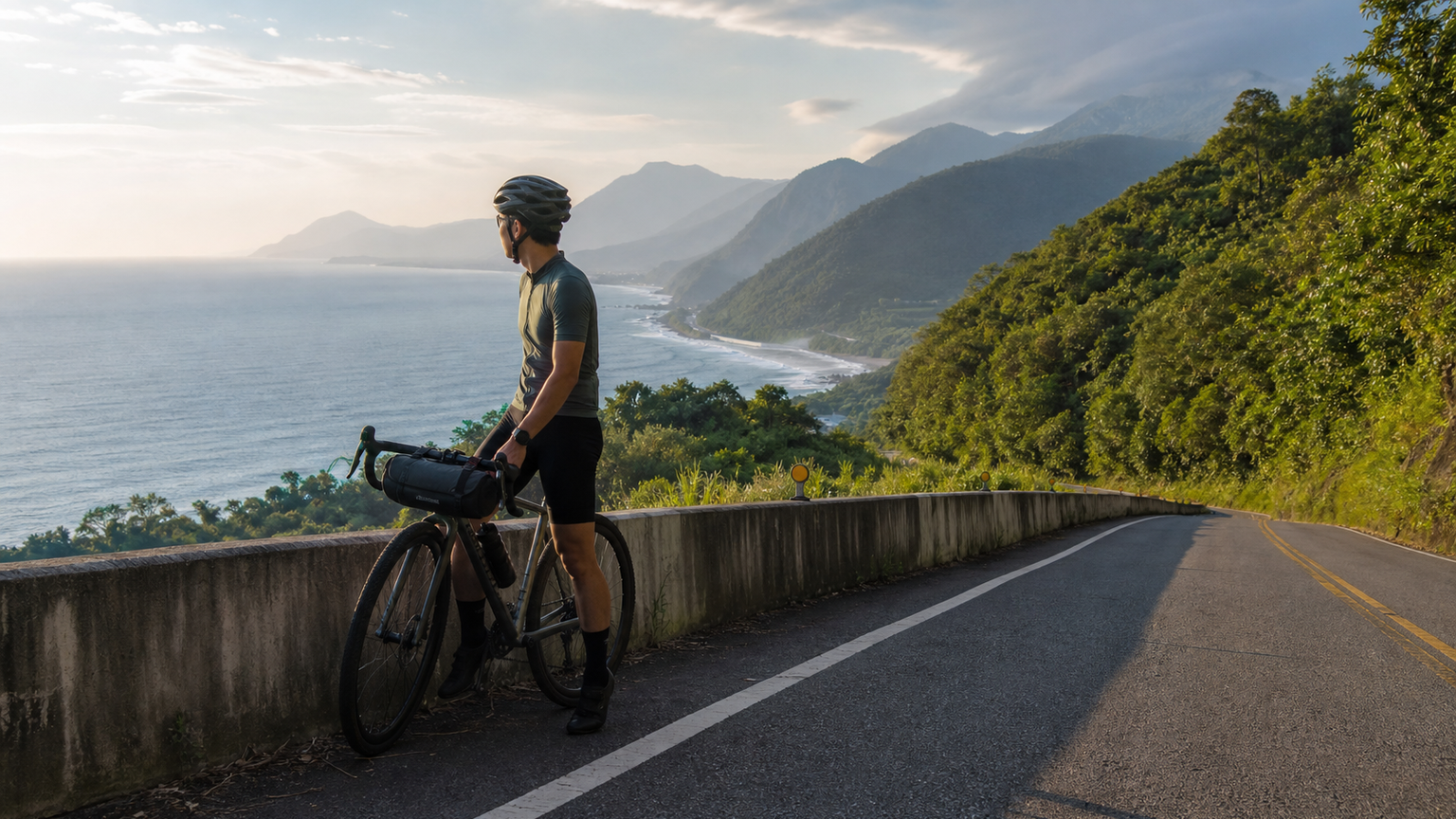
Eastern Coastline (Provincial Highway 9 + Provincial Highway 11): From Hualien to Taitung, riding along the Pacific Ocean—the sea on your right, the mountains on your left, and every turn revealing new scenery. Towns along the way make resupply easy, and you can choose to stay at homestays or backpacker hostels. The distance is about 160 km; riding at a leisurely pace over 3 days is the most enjoyable.
Beiyi Mountain Road + Northeast Coast: Starting from Taipei, crossing the Beiyi Highway, descending to Yilan, then returning to Taipei along the Northeast Coast—this is a two-day route that can be completed on a weekend, with moderate difficulty and rich scenery.
Pingtung Coast (Provincial Highway 26/Provincial Highway 1): Riding from Kaohsiung to Eluanbi, passing the road beside the Third Nuclear Power Plant along the Pacific coast to reach Taiwan’s southernmost point—this is a pilgrimage route for many travelers.
Practical Advice
- Don’t chase minimalism from the start: Bring a bit more on your first trip, trim down each time based on actual usage, and gradually find your own “minimum viable gear list”
- Prioritize investing in lightweight gear: Lightweight sleeping bags, titanium utensils, compression sacks—a one-time investment with long-term benefits
- Make good use of Taiwan’s convenience stores: The combined services at 7-Eleven and FamilyMart (ATM, hot food, hot water, charging) make traveling in Taiwan more convenient than anywhere else
- Tell your family your itinerary: Even if your plans are flexible, send a message every day to let them know you’re safe, so the trip is worry-free
- Mental preparation matters more than gear preparation: Plans can’t keep up with changes; learning to improvise is the true spirit of minimalist travel
Conclusion
The beauty of minimalist travel lies in the way it forces you to return to the essence of travel. When you have nothing extra to rely on, you begin to truly observe your surroundings, make decisions on instinct, and form genuine connections with strangers. The island of Taiwan, with its warmth and beauty, has always been waiting for travelers willing to set out with light luggage. Bring your bike, one bag, and go.
Related Reading
- Bicycle Touring Gear List: The Packing Philosophy of a One-Week Bikepacking Trip
- Packing for Bicycle Travel: Lightweight Techniques for a Grand Cycling Tour
- Bicycle Camping (Bikepacking) for Beginners: Lightweight Gear and Recommended Routes in Taiwan
- Introduction to Bicycle Camping: Bikepacking Gear List and Recommended Routes in Taiwan
單車 一日北高 ( 雙城 ) 肥宅雙人瘋狂行 紀錄片 REACTO
10 年前
靠單車減肥35公斤 心得分享與整理
7 年前
太平山單車員工旅遊 | 這樣玩CP值最高!| 公路車
5 年前
半日 小台灣 極限單車路線挑戰實錄
7 年前
日本自助單車旅,茨城絕景路線/ 新手也可以體驗 / 4K空拍絕景 / 機票省錢大法 / 單車友善旅館 / 國家級霞之浦180K自行車道 / feat. 緯緯 / CT Yeh
1 年前
風櫃嘴 | 全台最多大砲的單車路線 | 尋寶網攝影師告訴你怎麼擺拍起來才好看 | 熱門攝影地點巡禮
6 年前
多到選擇障礙... 換個單車把帶想一個小時 / BTP / 編織&軟木特有材質超吸睛! / 公路車 / CT Yeh
1 年前
南竿 單車 | 老婆公路車首航 | 偽出國體驗 | 4K 高畫質 | 綠色騎跡低碳輕旅遊 | #公路車
5 年前