Introduction
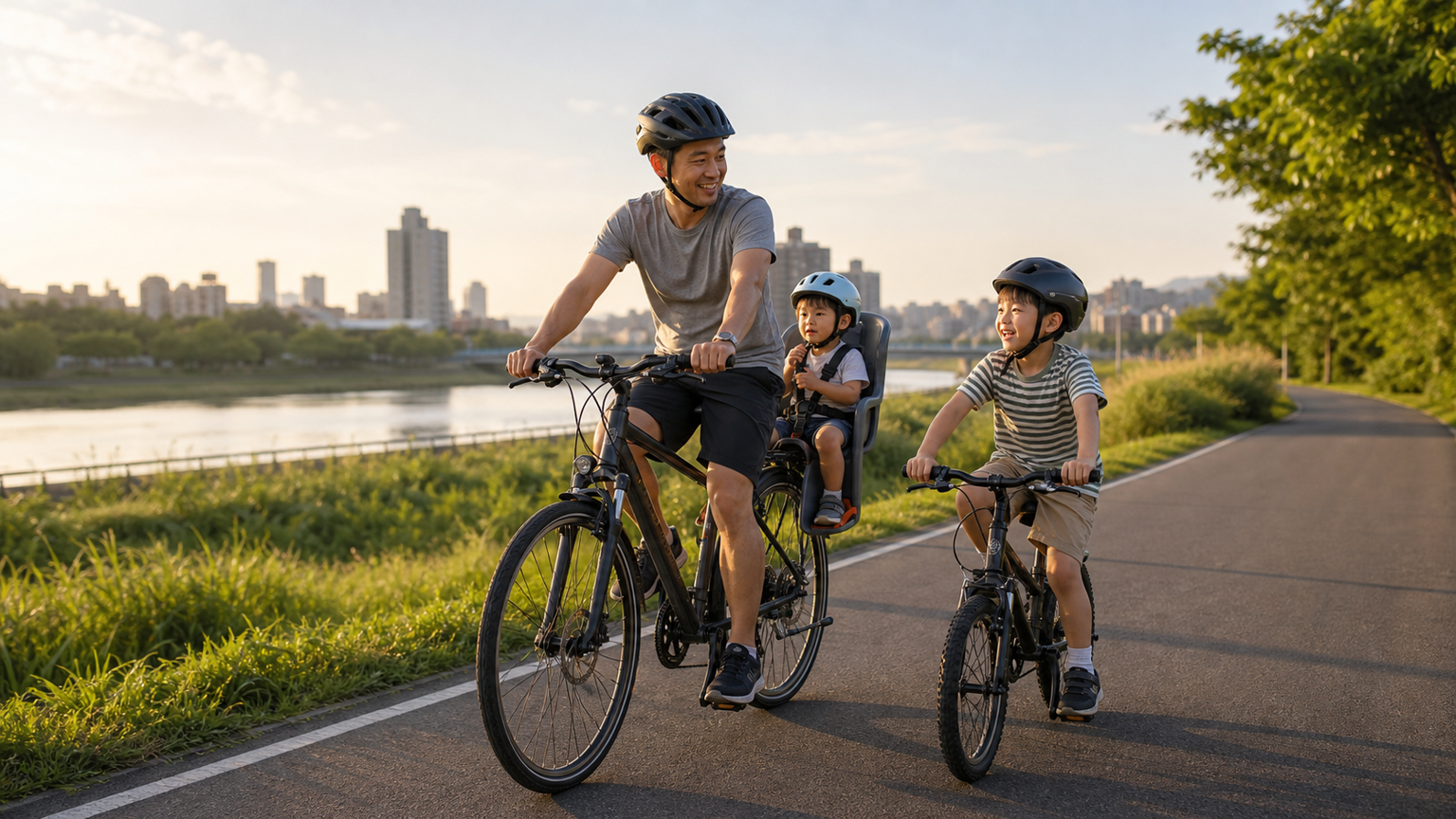
On weekend mornings at riverside parks, a familiar scene often unfolds: parents on bicycles while children either sit in a rear seat, curiously looking around, or pedal their own small bikes trying to keep up. There is an indescribable warmth to that image—a family moment in urban life that is becoming increasingly precious. Parent-child cycling is not just a form of exercise; it is a language of companionship, a way for families to create shared memories.
A Complete Guide to Child-Carrying Gear
Different ages call for different ways of riding together. Choosing the right equipment is the first step toward safe shared rides.
0-1 year old: Not recommended for riding along
Infants’ neck muscles are not yet fully developed and cannot withstand the vibration and swaying of a bike ride. Even with the highest-quality child seats or trailers, risks remain. This stage is not suitable for riding together.
1-3 years old: Rear-mounted child seat
A rear-mounted child seat is secured to the rear rack of an adult’s bike, with the child facing backward or forward, protected by a safety harness and foot guards. When choosing one, pay attention to the maximum weight capacity (usually 22 kg) and head support design. The downside is that the adult cannot directly observe the child while riding.
2-4 years old: Front-mounted child seat
Mounted on the adult bike’s top tube or head tube, the child faces forward, allowing the adult to interact directly and monitor the child’s condition in real time. The limitations are that it takes up more space, affects the adult’s riding posture, and typically has a lower weight capacity (about 15 kg).
2-5 years old: Bike trailer
An independent trailer hitched to the rear of an adult bike, capable of carrying 1-2 children, equipped with safety harnesses, a rain cover, and insect netting. Its advantages are high child safety, no impact on the adult’s riding, and it can double as a stroller; its disadvantages are its large size, inconvenient parking, and difficulty maneuvering on narrow paths.
4 years and up: Tagalong / Trailer bike
This is a half-bike attached to the adult’s rear axle, allowing the child to pedal (or not) while moving at the adult’s pace. It is an excellent tool for developing a child’s pedaling motion and bike balance.
5-6 years and up: Riding independently on a child’s bike
Once a child can ride independently, parent-child side-by-side riding can begin. In the early stages, choose a bike with training wheels; once balance is established, transition through a balance bike before moving to a pedal-equipped child’s bike.
| Age | Recommended Gear | Weight Limit | Key Advantage | Notes |
|---|---|---|---|---|
| 1-3 years | Rear-mounted child seat | Approx. 22 kg | Easy to install | Helmet is mandatory while riding |
| 2-4 years | Front-mounted child seat | Approx. 15 kg | Great parent-child interaction | Affects riding posture |
| 2-5 years | Bike trailer | Usually 2 children | Highest safety | Large size |
| 4-7 years | Tagalong | Approx. 30 kg | Develops pedaling feel | Requires practiced turning |
| 5 years and up | Child’s bike | No limit | Child’s independence | Speed must match the adult |
Safety Helmets: No Exceptions
Regardless of the carrying method used, a child’s helmet is absolutely essential. Choose products certified to EN1078, ASTM F1492, or equivalent safety standards, and ensure the helmet fits the head shape correctly with the straps adjusted properly (enough room for one finger under the chin).
Many parents worry their children won’t want to wear a helmet. The recommendation is to establish the helmet habit from a child’s very first ride, making it a natural pre-ride ritual rather than a rule enforced later.
Route Planning Principles for Parent-Child Rides
- Choose car-free or low-traffic dedicated paths: Riverside bike paths are the top choice for parent-child rides in Taiwan, fully separated from motor vehicles for the greatest safety
- Start with short distances: Children’s stamina is more limited than expected; keep initial rides to 3-5 km so kids finish with a sense of accomplishment rather than exhaustion
- Plan rest and refueling stops: Children need water and food more frequently than adults; make sure the route includes a place to stop every 1-2 km
- Avoid peak hours: Before 9 a.m. or after 4 p.m. on weekends, riverside paths are less crowded, making them better for a leisurely ride with kids
Practical Tips
- Follow the child’s pace: The goal of riding together is to enjoy the experience, not to cover distance—let the child set the rhythm for stopping and moving on
- Create rituals: Checking tire pressure together before departure, sharing ice cream after reaching the destination—these small rituals turn rides into unforgettable memories
- Take photos: Children grow up fast; photos taken during rides will feel especially precious years later
- Model traffic rules: Parent-child rides are the perfect opportunity to teach children traffic rules and safety awareness
Conclusion
The beauty of parent-child cycling lies not in mileage or speed, but in those moments of riding side by side—the proud look on a child’s face when they pedal a stretch on their own for the first time, the innocent wonder in their eyes when they stop to look at a butterfly, and the simple joy of sharing an energy bar together. These moments are a real connection that no electronic screen can ever provide.
Related Reading
- Riding with Kids: Gear and Route Recommendations for Family Cycling Trips
- Riding with Kids: The Complete Guide to Gear and Routes for Family Cycling Trips
- Family Cycling Trips: Safety Rules for Riding with Children
- Family Cycling Activities: A Guide to Safety Equipment and Route Selection for Riding with Kids
單車 一日北高 ( 雙城 ) 肥宅雙人瘋狂行 紀錄片 REACTO
10 年前
靠單車減肥35公斤 心得分享與整理
7 年前
#公路車 #Fitting 靠人工智慧APP 幫你調整單車
6 年前
#PUSHBIKE 原來這麼好玩! 小朋友 滑步車 初體驗 超可愛
6 年前
摔車後補裝備: 好市多新款單車安全帽& Specialized Romin 北高整路屁股都不痛的坐墊 | 一千元居然有MIPS | CT Yeh | 公路車
4 年前
單車賞雪 裝備準備及注意事項分享 | 公路車
5 年前
碟煞公路車 銑面器 !? 原來銑完差這麼多! 降低蹭碟機率! | TIME 公路車 保養小記錄 | CT Yeh
3 年前
再快都跟的上!? 單車跟隨攝影機之王 HOVERAir X1 PROMAX 全面實測 / 唯一!8K畫質&自行車專用模式和跟蹤信標&前後避障 / DJI Neo 可參考/ 公路車 / CT Yeh
1 年前