Introduction
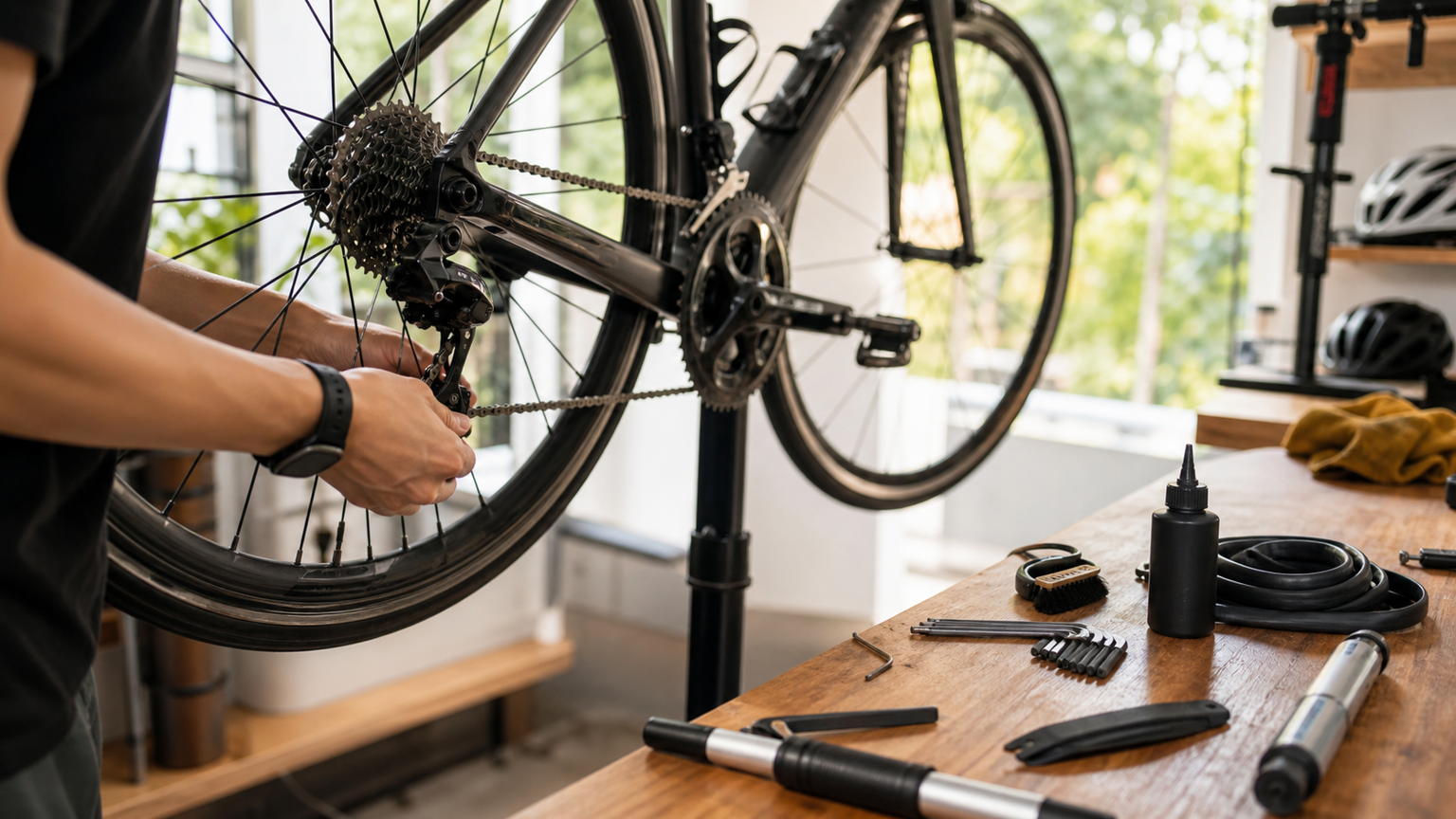
There is a particularly wonderful feeling: you take your bike apart, clean every component, reassemble it, and then ride out, feeling the renewed drivetrain working smoothly with every pedal stroke. That sense of accomplishment comes not just from the money saved on repair costs, but from a deep understanding of the machinery and a confirmation of your own abilities. Taiwan has a strong “do-it-yourself” culture, and the cycling maintenance world is no exception—from small repairs with basic tools to full bike overhauls, there is an entry point suited to every level of rider.
Starting with the Simplest: The Learning Ladder of Maintenance Skills
Bicycle maintenance skills can be built up step by step. There is no need to master everything at once—start with the most basic care, and as experience and confidence grow, gradually take on more complex projects.
Stage One: Cleaning and Lubrication (Anyone Can Do It)
Cleaning the chain and lubricating it is the most fundamental maintenance task. Every 200–300 km ridden, or after riding in the rain, the chain needs to be cleaned and re-lubricated. All you need is chain cleaner, chain lube, and an old toothbrush. The steps are simple, and the results are immediately visible.
Stage Two: Patching Tubes and Replacing Tires (Essential for Roadside Rescue)
This is a skill every rider should master, because a flat tire can happen anywhere. Tools needed: spare inner tube, patch kit, tire levers, and a pump. It is recommended to practice a few times at home first so your technique becomes smooth, and you won’t panic when you actually need to change a tire by the roadside.
Stage Three: Brake Adjustment (Most Critical for Safety)
After brake pads wear down or brake cables stretch, braking performance declines. Learning to adjust the brake system—including cable tension adjustment and brake pad alignment—is a vital skill that directly affects riding safety.
Stage Four: Drivetrain Adjustment
Derailleur adjustment is a challenge for many riders, but once you grasp the basic logic, it is not difficult. Adjusting the cable tension of the front and rear derailleurs and correcting the guide pulley position makes shifting precise and smooth.
Stage Five: Major Overhaul and Restoration (Advanced Challenge)
Replacing bearings, repainting the frame, and swapping out the entire drivetrain—this stage requires more tools and knowledge, but it also brings the greatest sense of accomplishment.
| Maintenance Task | Difficulty | Tools Needed | Recommended Learning Priority |
|---|---|---|---|
| Chain cleaning and lubrication | Low | Cleaner, lube, old toothbrush | First priority |
| Patching tubes and replacing tires | Low–Medium | Patch kit, pump | Second priority |
| Tire replacement | Medium | Tire levers | Third priority |
| Brake adjustment | Medium | Hex wrenches, screwdriver | Fourth priority |
| Derailleur adjustment | Medium–High | Hex wrenches, derailleur adjustment tools | Fifth priority |
| Bearing replacement | High | Bearing press tools, torque wrench | Depending on interest |
The Philosophy of Tool Investment
Investment in bicycle maintenance tools should be gradual. There is no need to buy every tool at the start—begin with the basic tools that solve the most common problems, then add more advanced tools as your skills improve.
Basic Tool Kit (Essential for Beginners):
- Multi-function hex wrench set (3mm, 4mm, 5mm, 6mm)
- Pump (with pressure gauge)
- Patch kit (inner tube, patch glue, tire levers)
- Chain lube and cleaner
- Small screwdriver set
Advanced Tools (Purchase as Needed):
- Chain tool (for replacing chains)
- Cassette removal tool
- Torque wrench (for protecting carbon fiber components)
- Workstand (makes maintenance more convenient)
The total cost of this tool set ranges from a few hundred to a few thousand NT$, and compared to the cost of each shop repair, it pays for itself after just a few DIY maintenance sessions.
Learning Resources
- YouTube tutorial videos: Search Chinese keywords such as “公路車維修” (road bike maintenance) or “補胎教學” (flat repair tutorial) for a wealth of high-quality instructional videos
- Observing at bike shops: Many shops welcome customers to watch the maintenance process and are usually happy to answer questions
- Rider community discussions: In Facebook rider groups, people are constantly sharing maintenance tips and problems they have encountered
- Official technical manuals: Major brands such as Shimano and SRAM publish technical documents that can be downloaded
Practical Advice
- Establish a regular maintenance routine: Do a basic clean and inspection once a month to nip problems in the bud
- Keep a maintenance log: Record the date of each service, parts replaced, and adjustments made to help track component lifespan
- Don’t be afraid to make mistakes: Mistakes are inevitable during maintenance, and most problems can be corrected—learning from errors is more effective than reading manuals
- Leave serious problems to the professionals: Until your skills are up to par, high-skill work such as disc rotor truing and frame welding should still be handled by a shop
Conclusion
Maintaining your bicycle yourself is a way of building a relationship with the machine. Each time you take it apart and clean it, you understand your bike a little deeper; each time you fix a problem, your confidence grows a little more. In Taiwan’s cycling culture, there are many veteran mechanics willing to pass on their knowledge, and countless riders sharing generously online. Get started—begin with the simplest chain cleaning. The satisfaction of riding after hands-on maintenance is something paying for a shop repair can never give you.
Related Reading
- The Culture of Bicycle Maintenance: The Sense of Accomplishment and Skill-Building of DIY Care
- Bicycle Maintenance for Beginners: The First Step to Changing Your Own Inner Tube
- Basic Home Bicycle Maintenance: Five Skills You Must Know
- Road Bike Maintenance Culture: The Trade-Off Between DIY Repair and Professional Shops
自助洗車場 洗單車 50元有找 清鍊條大法 居然還有小小兵
7 年前
碟煞公路車 銑面器 !? 原來銑完差這麼多! 降低蹭碟機率! | TIME 公路車 保養小記錄 | CT Yeh
3 年前
單車 一日北高 ( 雙城 ) 肥宅雙人瘋狂行 紀錄片 REACTO
10 年前
#公路車 #Fitting 靠人工智慧APP 幫你調整單車
6 年前
洗單車神器 吹水機! 實際洗車用用看 暴力洗鍊條大法 | 公路車 | CT Yeh
4 年前
洗完單車整隻手黑的解決妙招🤣 #bike
1 年前
摔車後補裝備: 好市多新款單車安全帽& Specialized Romin 北高整路屁股都不痛的坐墊 | 一千元居然有MIPS | CT Yeh | 公路車
4 年前
DJI Osmo Action 6 / 單車運動拍攝實用技巧 公路車 CT Yeh
7 個月前