The Slow-Living Philosophy of Cycling: A Riding Mindset That Ignores Speed and Savors the Journey
Introduction
KOM rankings on Strava, mileage challenges, power data—these are all part of modern cycling culture, but sometimes they make riding feel a bit heavy. How long has it been since you tucked your phone into your pocket, turned off all tracking, and simply pedaled, letting the road take you somewhere unknown? The slow-living philosophy of cycling is a gentle resistance to this over-datafied riding culture.
Reflections on Speed Culture
Taiwan’s road cycling culture has a strong competitive bent. Conversations among riders almost inevitably revolve around “What’s your average speed?” or “How many hours did it take you to get up Wuling?” This culture has its positive side—it provides clear goals, drives improvement, and creates a shared language for community interaction.
However, when speed becomes the only standard, cycling loses many of its possibilities. You start ignoring the wildflowers blooming by the roadside, you hesitate to stop and take photos in front of beautiful scenery for fear of losing power, and you feel frustrated because today’s pace “didn’t meet the target,” even though you genuinely enjoyed the entire ride.
The slow-living philosophy isn’t about telling you to ride slowly; it’s about freeing you from the single dimension of speed and letting cycling once again become a multi-dimensional sensory experience.
Practical Ways to Practice Slow Riding
Riding Without a Destination: Occasionally head out with no destination in mind, leaving the direction to your present-moment intuition. If turning right looks more interesting than turning left, turn right. If you’ve never taken this small road before, give it a try. Destination-free rides often lead to the most unexpected discoveries.
No-Strava Day: Once a month, schedule a “data-disconnected” ride—don’t open any tracking apps, and only bring your phone for map navigation. Without the comparison of data, your attention naturally returns to the immediate sensation of riding.
The Art of Stopping: Many riders have a rule that “stopping for more than X minutes means it’s not a complete ride.” Try breaking this self-imposed rule. Stop whenever you see something interesting, even if it means pausing for half an hour.
Follow the Food: Design your route around a snack or café you want to try, letting your taste buds rather than your mileage counter determine your riding direction.
| Slow-Living Riding Mode | Difference from Regular Riding | Experience Gained |
|---|---|---|
| Destination-free riding | No set endpoint or mileage | Sense of surprise, sense of exploration |
| Data-disconnected riding | No data recorded | Sense of liberation, sense of presence |
| Food-oriented riding | Aimed at restaurants/snack stands | Sense of pleasure, sense of everyday life |
| Slow photography riding | Photography as the main activity | Aesthetic appreciation, documentary value |
| Silent meditative riding | No music, no chatting | Sense of introspection, mind-body unity |
The Psychological Benefits of the Slow-Living Philosophy
From a psychological perspective, “slow riding” is actually a practice of mindfulness. When you let go of your fixation on speed, your attention returns to direct sensations: the temperature of the wind on your face, the texture of the road beneath your tires, the sound of roosters crowing from a distant village on the mountain road.
This shift in perception helps reduce anxiety and enhance well-being. In a highly stressful work life, cycling becomes a true way to “recharge,” rather than another occasion for performance evaluation.
- Riding without regard for speed is friendlier to beginners, lowering the psychological barrier to entry
- Slow riding aids in observing and improving technical details, such as pedaling posture and weight distribution
- The body’s perception is more acute at slower speeds, helping to detect fatigue or discomfort signals early
The Best Routes in Taiwan for Slow Riding
Taiwan has many routes particularly suited to the slow-living philosophy. These routes don’t chase difficulty; instead, they excel in scenery, culture, or natural atmosphere:
- Danlan Historic Trail Cycling Route: Passing through tea plantations and old houses in northern Taiwan, offering both a sense of history and nature
- The Area Around Luye Highlands in Taitung: During hot air balloon season (July–August), slow riding along the valley farm roads is picturesque
- Country Lanes of Changhua County: The agricultural landscape of Taiwan’s central plains, ideal for stress-free exploration
- The Yuanshan to Sanxing Section in Yilan: Scallion fields, farmhouses, and unspoiled countryside without tourists—an ideal place for slow riding
Practical Advice
- Regularly Schedule “Slow Ride Days”: In your training plan, schedule a slow ride with no speed or mileage goals every two to three weeks
- Bring a Paper Map: Don’t rely on phone navigation; try finding your way the traditional way to make the journey more tangible
- Ride Slowly with a Companion: Find a riding buddy who also doesn’t care about speed, chat while riding, and let conversation become part of the ride
- Accept the Result of “Not Riding Far”: The mileage on a slow ride day might only be half of your usual distance, and that’s completely fine
Conclusion
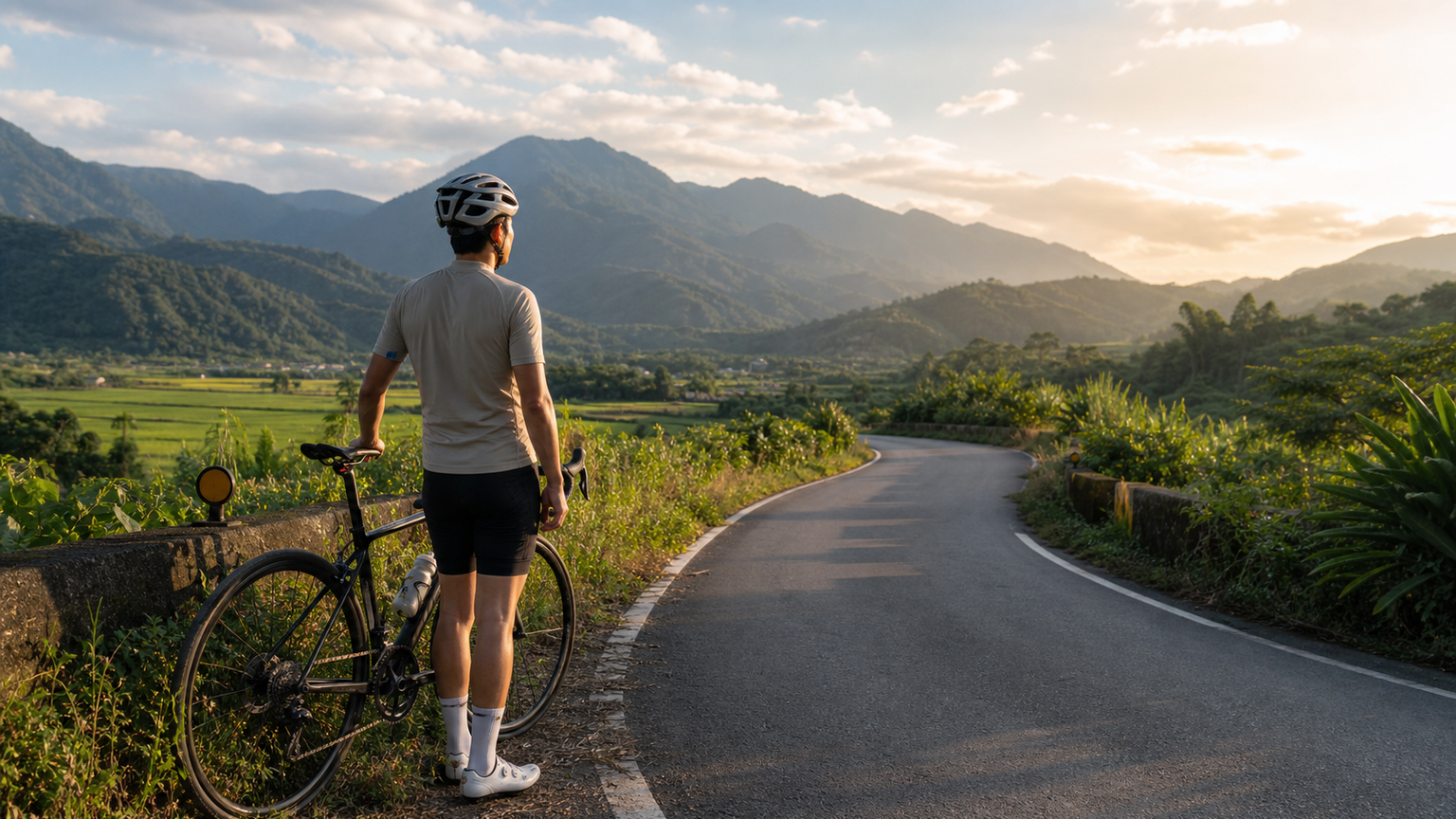
The deepest joy of cycling often lies not in the fastest KOM, but in some ordinary afternoon when you unknowingly ride to a place you’ve never been, buy a cup of aiyu jelly from an old grandmother’s roadside stall, sit down and gaze at the distant mountains, completely losing track of time. In moments like that, speed is entirely irrelevant. Give yourself back the right to be “slow,” and let cycling once again become something to enjoy, not something to perform.
Related Reading
- The Slow-Jogging Philosophy of Running: A Lifestyle of Not Chasing Speed and Enjoying the Process
- The Joyful Philosophy of Cycling Training: Why Enjoying the Process Matters More Than Chasing Results
- How Cycling Changes Lives: Taiwanese Riders Share How Bikes Transformed Their Habits and Mindsets
- The Social Impact of Cycling: How Bike Culture Has Reduced Transport Carbon Emissions in European Cities
CT 喇低賽) 單車 比賽總是沒照片? 攝影師的觀點大公開 姿勢就是力量! 請加速1.25倍收看
7 年前
靠單車減肥35公斤 心得分享與整理
7 年前
#公路車 #Fitting 靠人工智慧APP 幫你調整單車
6 年前
單車 一日北高 ( 雙城 ) 肥宅雙人瘋狂行 紀錄片 REACTO
10 年前
大禹嶺 到 武嶺牌樓 全程前後實況錄影 | 北進武嶺 | 東進武嶺 | KOM | 訓練台 | 坡度分析 | Taiwan KOM Last 10 km HARD | 公路車
6 年前
公路車 爬坡 破PR 紀錄 小技巧 分享
6 年前
4K 東眼山 x 水蜜桃冰沙 百人單車約騎! 操完再吃冰 多爽快
7 年前
再快都跟的上!? 單車跟隨攝影機之王 HOVERAir X1 PROMAX 全面實測 / 唯一!8K畫質&自行車專用模式和跟蹤信標&前後避障 / DJI Neo 可參考/ 公路車 / CT Yeh
1 年前