Introduction
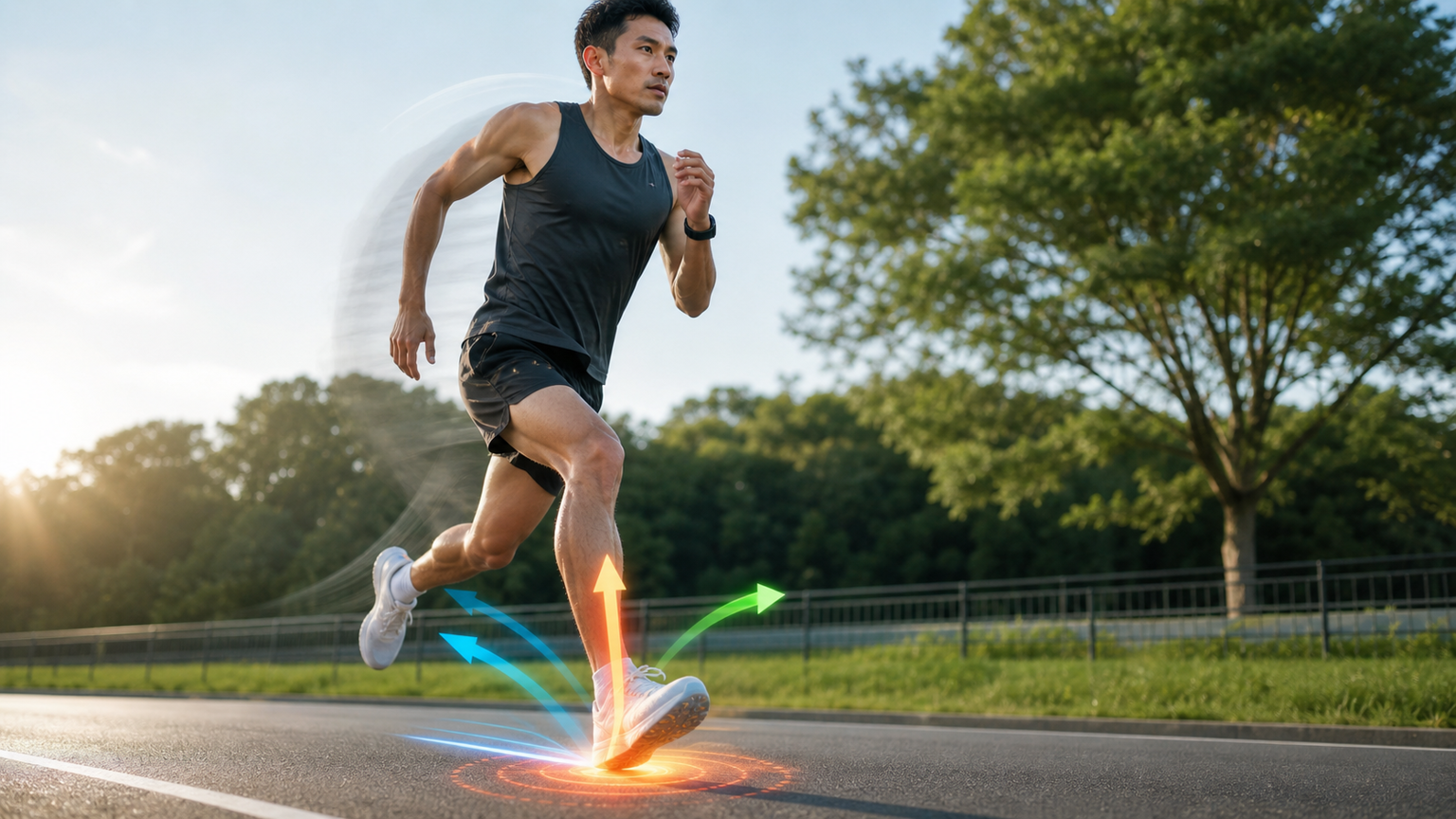
Every time your foot lands, the ground pushes back with a force equal in magnitude and opposite in direction — this is Ground Reaction Force (GRF). This force doesn’t just determine the impact load of your running; it directly reflects your running efficiency. Efficient runners generate maximum propulsive force with minimal braking force, while inefficient runners “fight against their own momentum” with every stride.
The Three Components of Ground Reaction Force
Using a force plate, the three directional components of running GRF can be measured:
| Component | Direction | Function | Ideal Characteristics |
|---|---|---|---|
| Vertical Force (Fz) | Up/Down | Support body weight, absorb impact | Low impact peak, small vertical oscillation |
| Anterior-Posterior Force (Fy) | Forward/Backward | Braking (landing) → Propulsion (push-off) | Small braking impulse, large propulsive impulse |
| Medial-Lateral Force (Fx) | Sideways | Lateral balance | Symmetrical, low lateral sway |
The peak vertical GRF during normal running is roughly 2-3 times body weight, with about 150-170 foot strikes per kilometer. The cumulative impact load over a single run is substantial, which is precisely why the principle of gradual progression is so important.
Braking Force: The Efficiency Killer
The most important thing to optimize in running is the ratio of anterior-posterior force:
- Braking Force (negative Fy): Generated when the foot lands in front of the center of mass, decelerating the body. Every step’s braking impulse is a “waste” of momentum that must be recovered in the following propulsion phase
- Propulsive Force (positive Fy): At the moment of push-off, the body exerts force backward against the ground, generating a forward reaction force
Characteristics of efficient runners:
- Foot strike occurs close to (or directly under) the center of mass, resulting in small braking force
- Moderate knee flexion at landing (not locked out), acting as a “shock absorber” to cushion impact
- Full push-off during the propulsive phase, generating a large propulsive impulse
Research shows that elite runners’ braking impulse is roughly 30-50% of body weight per step, while recreational runners can reach 70-100% — a difference that is directly reflected in running efficiency.
Key Running Mechanics Indicators
1. Vertical Oscillation
The up-and-down displacement of the center of mass during each stride. High oscillation means energy is being wasted on “bouncing” rather than moving forward. Elite runners have a vertical oscillation of about 6-8 cm, while recreational runners can reach 10-12 cm.
Ways to improve:
- Increase cadence (shortening the time per step naturally reduces vertical oscillation)
- Practice “light-footed running” (imagine you’re running over infrared-triggered landmines and trying not to set them off)
2. Foot Strike Pattern
- Heel Strike (HS): The heel lands first, producing the greatest braking force. This is the natural pattern for most runners
- Midfoot Strike (MF): The middle of the foot lands first, producing less braking force
- Forefoot Strike (FF): The forefoot lands first, producing the least braking force, but placing greater load on the Achilles tendon and calf muscles
Important note: no single foot strike pattern is inherently superior. Changing your foot strike pattern requires months of gradual adaptation. For most runners, increasing cadence often naturally improves foot strike pattern, and is safer than forcibly training a forefoot strike.
3. The Golden Combination of Stride Length and Cadence
- Running speed = Cadence × Stride length
- At the same speed, a cadence that is too low (stride length too large) is usually accompanied by higher braking force and vertical oscillation
- Research generally recommends increasing cadence by 5-10 steps/minute above your current level, which can effectively reduce impact load
Self-Assessment Methods for Running Mechanics
You don’t need a lab force plate — Taiwanese runners can use:
- Watch cadence function: Track your cadence during regular training, aiming for 170-180 steps/minute
- Side-view video: Film your running from the side with your phone and observe the relative position of your foot and knee at landing
- Listen to your footstrike sound: A louder footstrike sound usually indicates greater braking force
- Sense of vertical bounce: Focus on the intention of moving “forward” rather than “upward” while running
Practical Recommendations
- Cadence is the easiest mechanical indicator to improve: Practice with a metronome 1-2 times per week, aiming to raise your cadence to 175 steps/minute
- Keep your gaze level, 10-15 meters ahead: Looking down shifts your center of mass backward, increasing braking force
- Let arm swing drive your cadence: Swing your arms forward with a relaxed motion (not sideways), which helps naturally increase cadence and forward propulsion
- Downhill running technique training: Ground reaction forces are greater when running downhill, making it a stress test for your mechanical technique — focus on shortening stride length and increasing cadence
Conclusion
Ground reaction force is the objective language of running efficiency. Understanding mechanical indicators like braking force, propulsive force, and vertical oscillation allows you to evolve from “running by feel” to “running by understanding.” Through cadence adjustments and optimizing your foot strike position, every step can be converted more effectively into forward momentum — letting you run faster and farther with the same amount of energy.
Related Reading
- Ground Reaction Force and the Energy Return Science of Carbon-Plated Shoes
- Running Biomechanics Analysis: The Scientific Basis of an Efficient Running Posture
- Ground Reaction Force at Foot Strike: A Quantitative Study of Load Distribution in Heel Strike vs. Forefoot Strike
- Runners’ Landing Mechanics: Technical Training and Measurement Methods for Reducing Impact Force
RAMP FTP Test 直播 究竟能撐到幾瓦 訓練台 Gravat Zwift
6 年前
西進武嶺 8000名單車友數據分析 PART1 | 從新手到高手數量/瓦數/推力比/FTP推力比/功率計使用率 大解析 | 公路車 | CTYeh
5 年前
#公路車 #Fitting 靠人工智慧APP 幫你調整單車
6 年前
西進武嶺 免費訓練分析服務 Intervals | 練不夠還是練過頭?你哪一種類型選手?AI模型告訴你! | 備戰神器 | 公路車 訓練 | CT Yeh
4 年前
戰略) Zwift Race 如何咬在第一集團 如何評估自己要開多少推力 (請開1.5倍速看)
7 年前
Fitting訓練兩用功率車 ! Thinkrider ST900 完整實測!/ 坡度升降 / 鄰居測試/ smart bike/公路車/ CT Yeh
2 年前
單車AI教練!全新 ChatGPT4o 幫你分析訓練成果!排武嶺課表,分析騎車姿勢! 太神了! / 公路車 / CT Yeh / feat. 緯緯
2 年前
單車高張力拍攝神器 Antigravity A1 全景空拍機! / CT Yeh
30 天前