Complete Analysis of Professional Cycling Team Tactics: Formations, Drafting Effect, and the Final Sprint Launch
Introduction
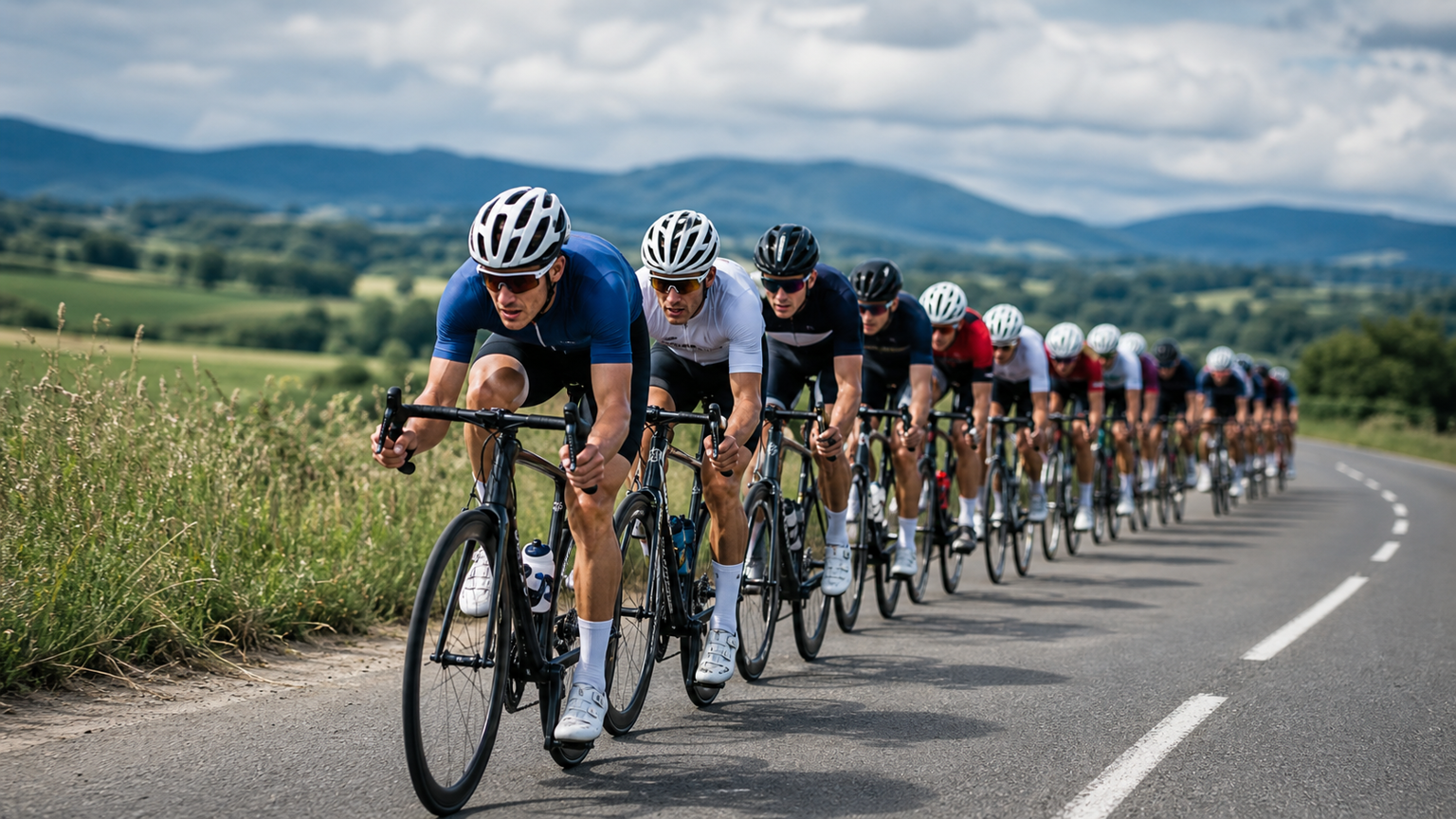
First-time viewers of professional road cycling races often see only a large group of riders densely packed together, wondering why they don’t spread out and ride individually. In reality, that dense “Peloton” is itself a refined science. Air resistance, formation combinations, psychological games — the group tactics of professional cycling are a perfect fusion of physics, sports science, and human intelligence.
The Drafting Effect: Why Ride Behind Others
Aerodynamics is the physical foundation of group tactics. Research shows that riding at the rear of a stable group, compared to riding solo, can save 25 to 40% of energy expenditure (depending on speed and position). This principle is known as “Drafting” or colloquially as the “Slipstream Effect”.
The riders at the front slice through the air, creating a low-pressure vortex zone behind them, and riders behind are almost “sucked along,” with drag significantly reduced. This is why on flat stages, the entire group can maintain high speed continuously while most riders remain relatively comfortable — because only the few at the very front are truly “working.”
| Position | Relative Wind Drag Comparison |
|---|---|
| Riding solo at the front of the group | 100% (full drag) |
| 2nd to 3rd row position in the group | Approximately 60-70% |
| Middle position in the group | Approximately 40-50% |
| Rear half of the group | Approximately 30-40% |
| Directly behind a single rider | Approximately 65-75% |
Crosswind Formations: When Side Winds Become a Weapon
When strong crosswinds appear on race day, flat stages transform into a different kind of battlefield. Smart teams use crosswinds to create Echelons:
- In strong crosswinds, the entire group cannot maintain a normal linear formation and must ride diagonally to gain mutual wind protection.
- The width of the diagonal line is limited; the road can only accommodate a certain number of riders in sheltered positions.
- Once the echelon is full, riders behind are exposed to the full force of the crosswind, their energy expenditure skyrockets, and the group naturally splits into front and rear clusters.
- Strong teams use this mechanism to create time gaps on flat stages, even dropping rival team leaders into the rear group and costing them significant time.
The Breakaway Game
Almost every stage sees riders attempting to form a Breakaway to escape the main group. This process itself is an art:
- Selection of breakaway riders: The main group (especially general classification rivals) does not want opposing riders in the breakaway, but at the same time does not want to expend too much energy chasing.
- The balance point of the game: Usually after a breakaway successfully escapes, the main group controls the gap (neither letting the escapees get too far nor deliberately chasing), only reeling them in during the final tens of kilometers.
- The shelf life of escapees: Most breakaways on flat stages are caught within the final 20 to 30 kilometers; breakaways on mountain stages have a higher success rate.
The Final Art: The Lead-Out Train and Launch Process
The final few kilometers of a flat stage are a meticulously choreographed Lead-Out Train:
- 5 to 6 kilometers from the finish: The team’s Domestiques begin to organize at the front of the group, lining up single-file to set the pace and push rivals to the rear.
- 3 to 4 kilometers from the finish: The first “bullet” Domestique sprints at full effort to drive the pace, then peels off exhausted.
- 1 to 2 kilometers from the finish: The second “bullet” Domestique takes over, pushing the speed even higher.
- 400 to 600 meters from the finish: The final Domestique (usually the strongest of the entire train) delivers one last acceleration, “launching” the sprinter.
- Final 200 to 300 meters: The sprinter breaks free and delivers the true explosive sprint, reaching speeds of 70 to 75 km/h or more.
The timing, rhythm control, and positioning throughout the entire process require countless hours of training and cultivated chemistry. One mistake can undo the entire carefully planned train.
Practical Advice
Understanding the tactics makes watching races more enjoyable:
- In the final 10 kilometers of a flat stage, watch which team’s riders begin organizing at the front of the group — this signals their sprinter is about to be activated.
- On crosswind days, pay special attention to whether the group begins riding in an echelon; this is often accompanied by dramatic splits in the group.
- In the final 5 kilometers of a mountain stage, note how many Domestiques remain with the team leader at the front of the group; the moment these riders “fall off” is often a precursor to the final attack.
Conclusion
The tactical world of professional cycling is a multidimensional game combining physics, physiology, and psychology. From every positional choice within the group to the launch timing in the final few hundred meters, every second is a blend of precise calculation and instinct. Next time you watch a race, try not to focus only on the sprint at the front — pull your perspective back: the movement of the entire group is the most beautiful dance of this sport.
Related Reading
- Road Cycling Peloton Riding: Complete Guide to Position Selection and Energy-Saving Strategies
- Team Rotation and Windbreaking Tactics: Why Drafting Saves Energy, the Principles of Formation, and Etiquette and Safety for Amateur Group Rides
- The Science of Cycling Collective Tactics: A Quantitative Aerodynamic Study of Team Drafting
- Road Bike Group Riding Techniques: Safe and Energy-Efficient Rotation Skills
「悲情男車友」創作單曲 爆笑MV / 公路車 / CT Yeh / 4K劇情版
7 個月前
鉅齒紋輪組!? ControlTech MEG-T50 EVO 碳纖維幅條輪組/ 功率對比實驗 / 公路車 / CT Yeh
2 年前
風櫃嘴 | 全台最多大砲的單車路線 | 尋寶網攝影師告訴你怎麼擺拍起來才好看 | 熱門攝影地點巡禮
6 年前
2025 海鷗團體繞圈賽 / 前八強賽事精華!/ 環台賽等級拍攝 / 國手菁英隊伍較勁 / CT Yeh #公路車
8 個月前
CT 喇低賽) 單車 比賽總是沒照片? 攝影師的觀點大公開 姿勢就是力量! 請加速1.25倍收看
7 年前
戰略) Zwift Race 如何咬在第一集團 如何評估自己要開多少推力 (請開1.5倍速看)
7 年前
風櫃嘴時間 預測西進武嶺時間?13000名車友統計數據分析告訴你 !
5 年前
多機位拍片神器 DJI Action 2 拍出速度張力感 | 類空拍機視角 4陣列麥克風超強降風噪 實測! | 公路車 | CT Yeh
3 年前