Introduction
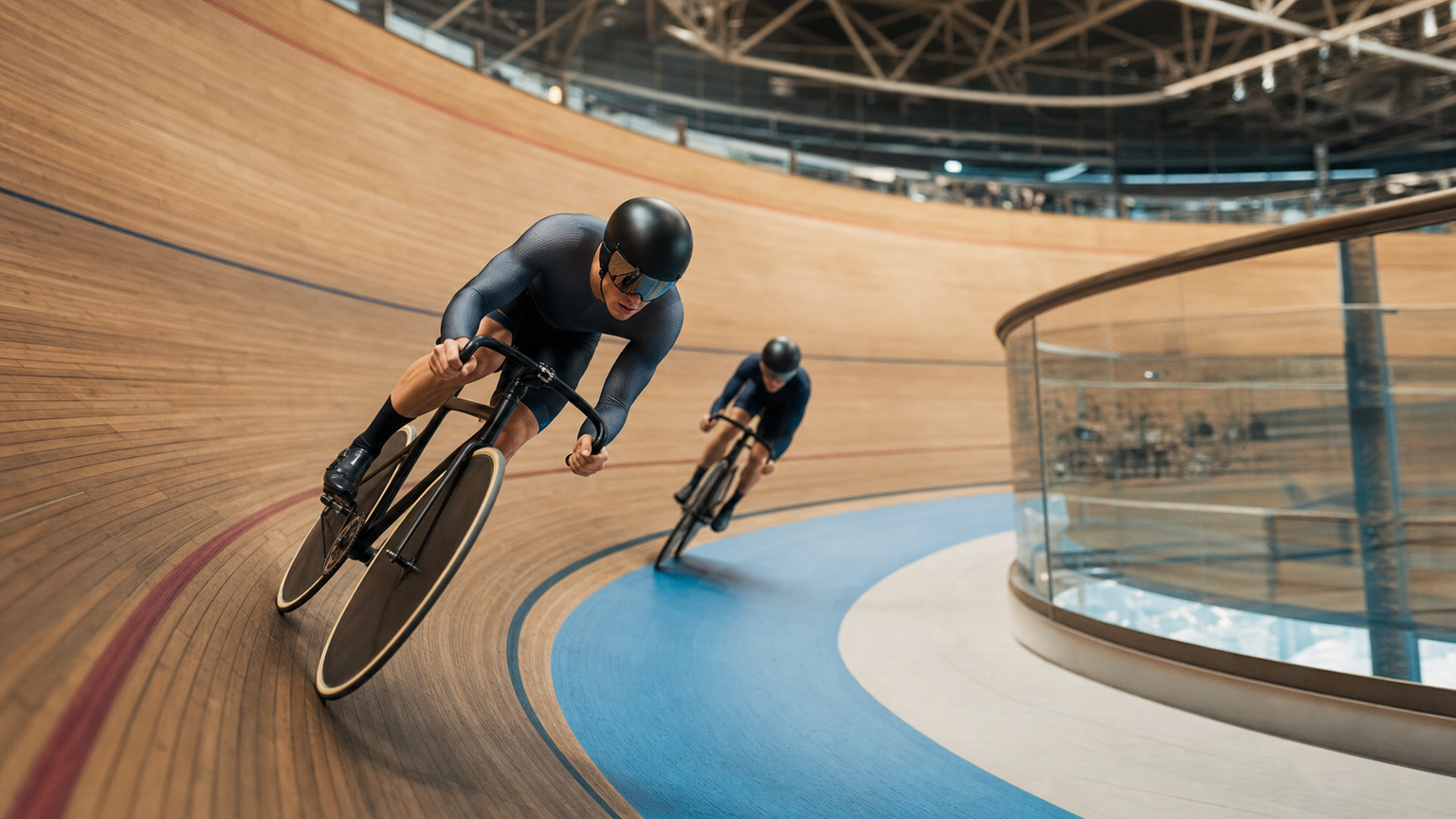
If road cycling is the marathon of the sport, then Track Cycling is the sprint on a 400-meter athletics track—pure, explosive, and breathtaking. On that oval, wooden, banked track, riders on steel-frame bikes with fixed gears (no freewheeling) use every muscle in their bodies to defy the laws of physics. Track racing is the discipline in cycling that comes closest to the absolute limits of human speed.
The Engineering Marvel of the Wooden Track
A track cycling venue is called a Velodrome, and its core is the wooden oval track. The design of the track is a masterpiece of engineering:
- Oval Design: The standard international track is 250 meters long (200-meter short tracks also exist), with semicircular turns at each end connected by straight sections.
- Banked Curves: The outer edge of the turns is significantly higher than the inner edge, with the banking ranging from about 12 to 13 degrees on the straights to as much as 42 to 45 degrees at the steepest point of the turns.
- The Physics of Banking: When riders corner at high speed, the inclined track provides the centripetal force that counteracts centrifugal force, allowing them to navigate the bends at speed without being flung outward.
- Choice of Wood: Top-tier tracks use specific hardwoods (such as Siberian pine or Afzelia), whose grain and hardness offer optimal rolling resistance characteristics.
| Track Specifications | Standard International Track |
|---|---|
| Total Length | 250 meters (most common) |
| Track Width | Approximately 7 to 8 meters |
| Banking on Straights | Approximately 12 to 13 degrees |
| Maximum Banking on Turns | Approximately 42 to 45 degrees |
| Common Wood | Hardwood, primarily Siberian pine |
Major Racing Events
Track cycling features a diverse range of events, each with different physical and tactical demands:
- Individual Pursuit: Riders start on opposite sides of the track, chasing each other or racing against the clock, focusing on endurance and pace management.
- Team Pursuit: Four riders per team; often one of the most anticipated Olympic events, testing overall pacing and formation maintenance.
- Sprint: A head-to-head duel between two riders, usually timed only over the final 200 meters, filled with psychological gamesmanship.
- Keirin: Originating from Japanese lottery-based bicycle racing, riders sprint freely after a motorized pace bike pulls off, carrying high risk of crashes and demanding explosive power.
- Omnium: A points-based combination of multiple events, testing all-around ability.
- Madison: A two-rider relay format where strategic lap gains earn points; the pace is fast and the tactics complex.
The Limits of Speed: How Fast Can Humans Go
Track cycling can reach astonishing speeds under special conditions:
- Men’s 200-meter flying start world record: Close to 82 to 85 km/h (set at a high-altitude track)
- Women’s 200-meter flying start world record: Close to 75 to 78 km/h
- 1-kilometer time trial (Men): Approximately 55 to 58 seconds
- Individual pursuit (Men’s 4 km): Under approximately 4 minutes
Factors influencing track speed include:
- Altitude: At high elevations (such as Bolivia or Mexico City), the thinner air reduces aerodynamic drag, so speed records are often set at high-altitude venues.
- Temperature: An appropriate indoor temperature lowers air density, which also aids in achieving higher speeds.
- Equipment: Monocoque carbon fiber frames, deep-section carbon wheels, and seamless skinsuits can shave off fractions of a second.
The Unique Design of Track Bikes
The racing machines used in track cycling are vastly different from road bikes:
- Fixed Gear: No freewheel mechanism; the pedals are directly linked to the rear wheel, so stopping pedaling slows the bike, and coasting is impossible.
- No Brakes: Standard track racing does not allow manual brakes; deceleration relies entirely on backpedaling resistance.
- Aerodynamic Frames: Extreme emphasis on aerodynamics, with tube profiles typically shaped for streamlined airflow.
- Precise Gear Ratio Calculations: Before each race, riders and technicians calculate the optimal gear ratio based on track length and the rider’s physical condition.
Practical Advice
If you are interested in track cycling:
- The Olympics are the best time to watch track events, with the men’s team pursuit and the keirin being the most thrilling competitions.
- Taiwan has several velodromes, some of which offer introductory courses open to the public, where you can experience the feel of riding a fixed-gear bike.
- Understanding the “Keirin rules” can help you appreciate Japanese cycling culture; Japanese professional keirin is the world’s largest lottery-based bicycle racing system.
Conclusion
On that 45-degree banked wooden slope, riders challenge the laws of physics with their legs. Track cycling has no hills, no scenery—only a pure duel of speed and willpower. In the moment the timing board flashes that number, what you witness is humanity’s most beautiful struggle at the very edge of speed.
Related Reading
3D 列印車褲墊 / 舒適改善? / 無痕 x 分區壓縮 / ATK & Decider系列 / JE22黑科技 / #公路車 #CTYEH
11 個月前
2023自行車展!與環台賽選手一同表演賽 / 全自動AI Fitting?/ TIME新車發表/神秘充電桌等 精華分享 VLOG | CT Yeh | 公路車
3 年前
高雄綠園道鐵路自行車道 / 外地人能輕鬆駕馭 還是整路崩潰? / 2025 全線開通 春節實地探索一次!(附GPS連結)/ 公路車 / CT Yeh
1 年前
2024 春季KOM 賽事精華版 / 太魯閣 / 貓捉老鼠精彩追擊 / 錄影剪輯版 / 東進武嶺 / 公路車 (請開啟字幕)
2 年前
司馬庫斯 | 單車員工旅遊 | 比武嶺還接近上帝的路 | 2021 全面實況 路況解析 | 空拍 櫻花炸開超濃密 | 財伯觀光果園 | CT Yeh
5 年前
單車實況) 車測中心高速賽道 96 彰化讚 挑戰組一圈實錄 | ARTC
6 年前
2024 如來神掌 百人約騎挑戰!feat. 秘境單車社團 / 神人們太可怕 / 全程錄影 x 完整坡度解析 / 公路車 / CT Yeh
2 年前
大禹嶺 到 武嶺牌樓 全程前後實況錄影 | 北進武嶺 | 東進武嶺 | KOM | 訓練台 | 坡度分析 | Taiwan KOM Last 10 km HARD | 公路車
6 年前