The Future of Cycling Technology: A New Era of Aero Development, Power Meter Evolution, and AI Training Assistants
Introduction
When Marco Pantani flew through the Dolomites on an aluminum frame at the end of the twentieth century, few could have foreseen the technological landscape of today’s professional cycling: nano-scale carbon fiber frames, multi-axis power meters, real-time aerodynamic simulation, AI-generated personalized training plans… Modern professional cycling has become a high-tech, knowledge-intensive competitive sport. And these technologies are rapidly filtering down into the everyday rides of every amateur cyclist.
Aerodynamics: A Speed Race Measured in Millimeters
Air resistance is the greatest source of drag at high speeds, accounting for 80 to 90% of total resistance. Therefore, for top professional teams, every design detail is a battle against aerodynamic drag:
- Frame tube shaping: Modern high-end frames have evolved from round tubing to precisely calculated airfoil sections, offering the lowest wind resistance at specific angles of attack.
- Integrated components: Integrating handlebars, head tubes, cables, and bottle cages into the frame’s silhouette eliminates turbulence caused by protruding parts.
- Aerodynamic design of helmets and skinsuits: Top riders’ skinsuits use specially textured fabrics that actively influence the boundary layer airflow, reducing separation drag.
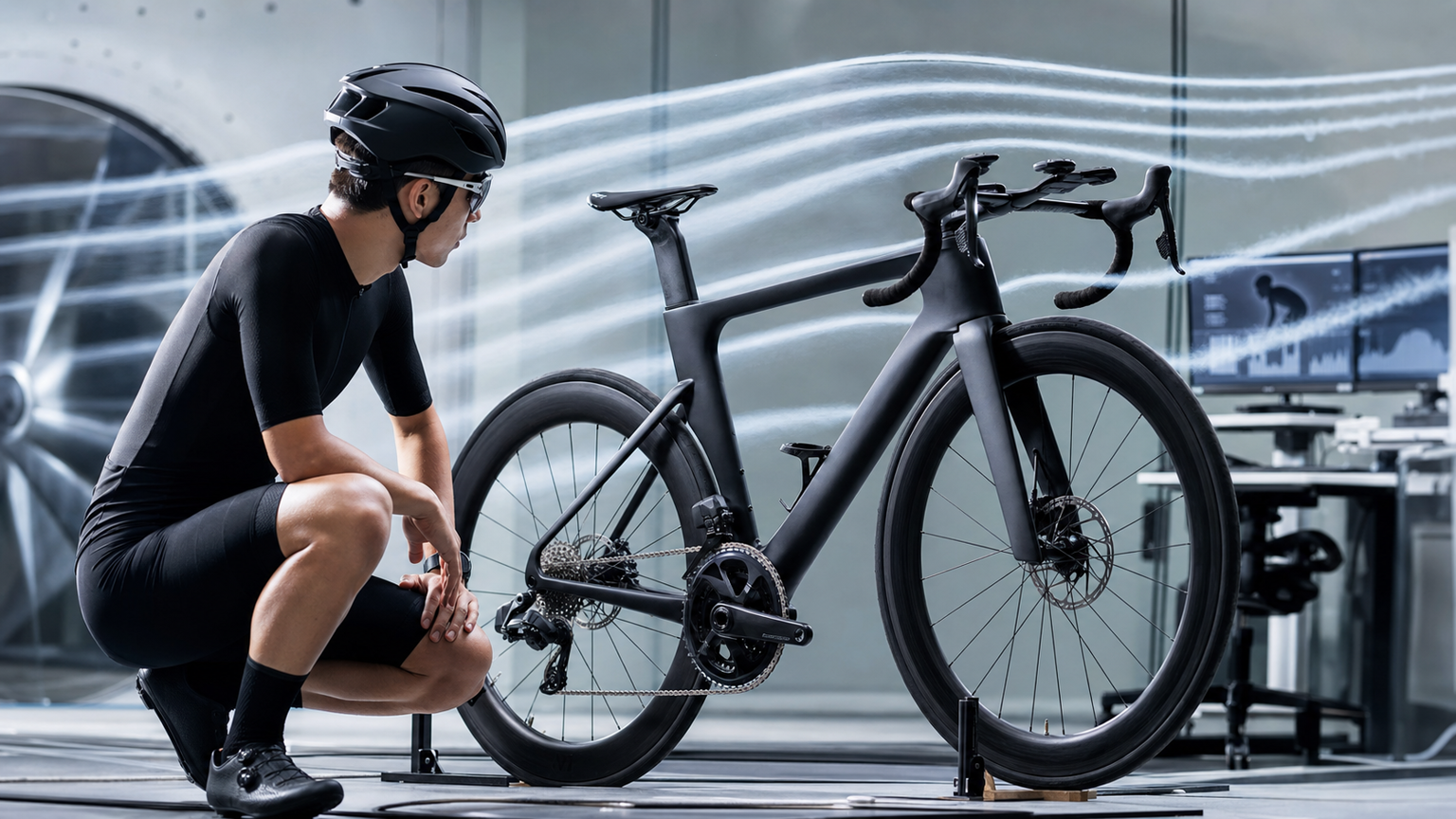
- Wind tunnel testing: Professional teams conduct extensive wind tunnel testing to find the optimal riding position and component combinations.
In recent years, the widespread application of CFD (Computational Fluid Dynamics) simulation software has emerged, allowing engineers to simulate thousands of design variations on computers before wind tunnel testing, dramatically shortening development cycles.
| Aerodynamic Technology Application | Effect Description | Suitable Scenarios |
|---|---|---|
| Airfoil frames | Reduces frontal wind resistance | Time trials, flat stages |
| Deep-section rims | Reduces rim turbulence | Time trials, sprints |
| Aero helmets | Reduces head wind resistance | Time trials |
| Integrated cockpits | Eliminates gap turbulence | Time trials, high-speed sections |
Power Meters: From Luxury Item to Standard Equipment
The power meter is one of the most important tools in modern cycling training. It measures the rider’s power output (in watts) in real time, shifting training from subjective feeling to objective data.
The evolution of power meters:
- 1990s: SRM launched early power meters based on the crank, but they were expensive (equivalent to several thousand US dollars) and used only by professional teams.
- 2010s: Brands like Stages and 4iiii introduced single-sided crank arm power meters, significantly lowering costs and beginning to spread into the amateur market.
- Recent years: Pedal-based power meters (such as Garmin Rally and Favero Assioma) have made installation more convenient; hub-based and chainring-based power meters have also matured.
Training applications of power meters:
- FTP (Functional Threshold Power) testing: Measures the maximum power a rider can sustain for one hour, serving as the baseline value for developing training plans.
- Training zone classification: Based on FTP percentages, training is divided into seven zones from Z1 (active recovery) to Z7 (neuromuscular power), with each zone corresponding to different physiological adaptation goals.
- Power management during racing: In mountain stages and time trials, riders set target power ranges to avoid blowing up in the latter part of the race from excessive output.
AI Training Assistants: Personalized to Every Pedal Stroke
Artificial intelligence is profoundly changing how training plans are designed:
- Adaptive training plans: Represented by Wahoo’s SYSTM and TrainingPeaks’ PMC (Performance Management Chart), these platforms automatically adjust subsequent workouts based on data from each session. When your performance declines due to fatigue or illness, the system automatically lowers intensity.
- Fatigue status monitoring: Combining heart rate variability (HRV), resting heart rate, and sleep data, AI can more accurately determine the optimal time to train, preventing overtraining.
- Race strategy simulation: By inputting route maps and personal power data, AI can simulate optimal pacing strategies, telling you how much power to output on each climb.
- Position analysis: Combining video recognition technology, some emerging platforms can analyze riding position and provide improvement suggestions.
The Current State of Technology Adoption Among Taiwanese Cyclists
The impact of these technologies on Taiwanese amateur cyclists is also increasingly significant:
- The proliferation of power meters has led more Taiwanese cyclists to adopt structured training.
- The localization of platforms such as Strava, Garmin Connect, and Wahoo RGT has lowered the barrier to data analysis.
- Local cycling communities are placing greater emphasis on sharing and discussing training data, and a culture of scientific training is gradually taking shape.
Practical Recommendations
If you want to start using technology to improve your riding performance, you can begin with these steps:
- First, purchase a cycling computer (such as Garmin or Wahoo) to record basic data (speed, heart rate, elevation gain).
- A power meter is the next investment; pedal-based power meters offer the best value for money as an entry-level choice within budget constraints.
- Use Zwift or TrainingPeaks for indoor training during winter, combining fun with structured training.
- Perform an FTP test every three to six months to track your improvement curve.
Conclusion
The advancement of cycling technology has never belonged exclusively to professional athletes. Every technology validated at the highest level of racing will eventually filter into the daily lives of every commuter, weekend warrior, and amateur rider. In the future, an AI coach may understand your body better than any human coach, and the bike you ride every day is quietly becoming smarter as well. Driven forward by both technology and human will, the story of cycling is far from over.
Related Reading
- The Future of Cycling Technology: AI Coaches, Smart Components, and the Riding Revolution of the Next Decade
- The Technology Revolution in Cycling Events: Applications of Wind Tunnel Testing, AI Tactical Analysis, and Real-Time Power Monitoring
- The Aerodynamics of Cycling: The Science of Wind Resistance Optimization from Helmets to Riding Position
- Technological Support for Professional Cycling Teams: Applications of Power Meters and Aerodynamic Analysis
單車AI教練!全新 ChatGPT4o 幫你分析訓練成果!排武嶺課表,分析騎車姿勢! 太神了! / 公路車 / CT Yeh / feat. 緯緯
2 年前
#公路車 #Fitting 靠人工智慧APP 幫你調整單車
6 年前
3D 列印車褲墊 / 舒適改善? / 無痕 x 分區壓縮 / ATK & Decider系列 / JE22黑科技 / #公路車 #CTYEH
11 個月前
2022台北國際自行車展 訓練台 試騎心得大全 差點腿軟走出! 元宇宙武嶺!| Garmin Tacx Oreka Xpedo Wahoo | 公路車 | CT Yeh
4 年前
再快都跟的上!? 單車跟隨攝影機之王 HOVERAir X1 PROMAX 全面實測 / 唯一!8K畫質&自行車專用模式和跟蹤信標&前後避障 / DJI Neo 可參考/ 公路車 / CT Yeh
1 年前
2023自行車展!與環台賽選手一同表演賽 / 全自動AI Fitting?/ TIME新車發表/神秘充電桌等 精華分享 VLOG | CT Yeh | 公路車
3 年前
2023時代騎輪節一分鐘預告💪 #cycling #公路車 #feiyutech
2 年前
2026 車錶排行榜!誰是最多車友正在使用?練家子最愛哪款?🏆 (2萬名車友數據) / 公路車 / CT Yeh
5 個月前