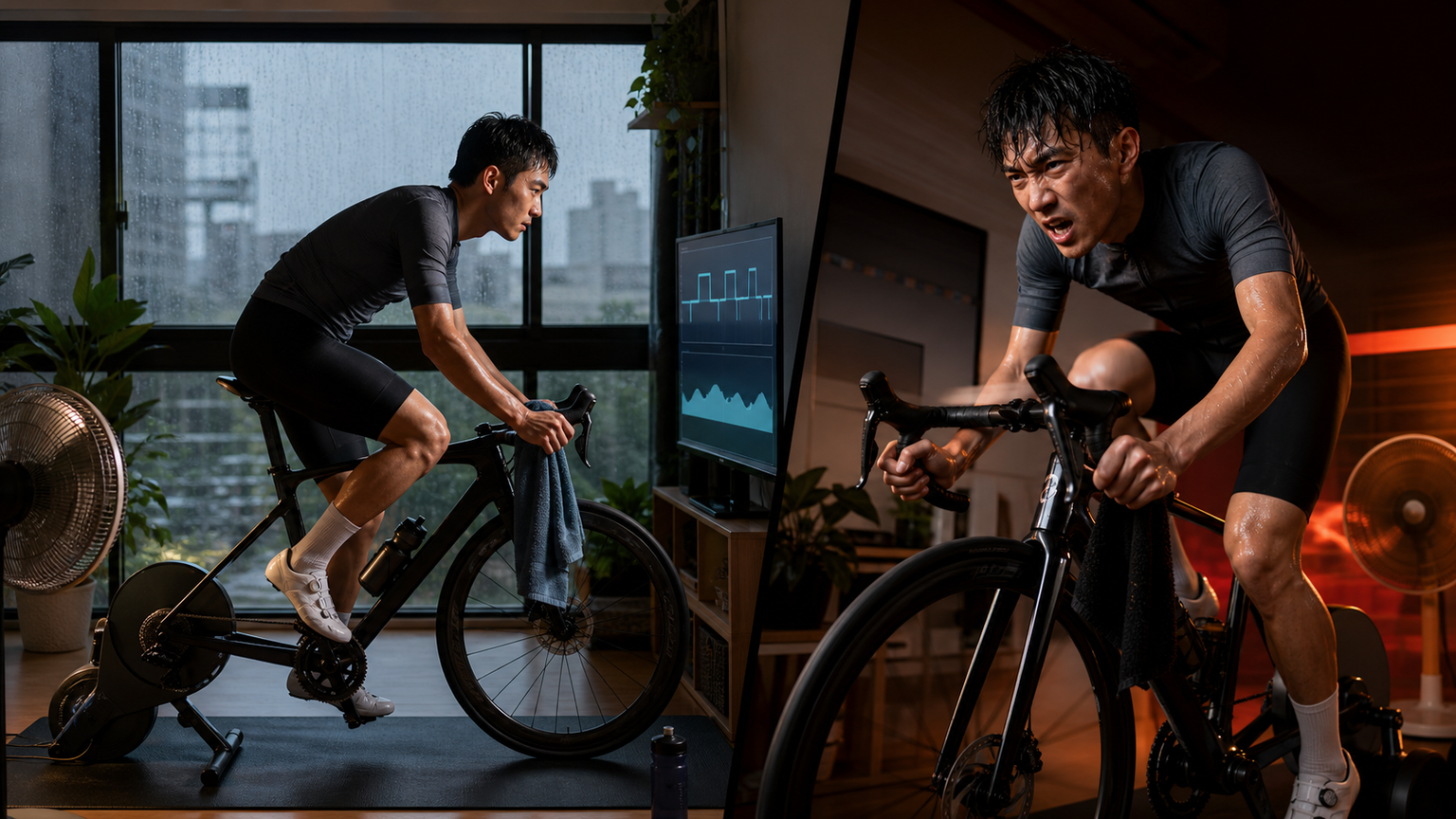
Introduction
In Taiwan, the adoption rate of indoor trainers has been climbing year after year, especially during typhoon season, plum rain season, or on days with poor air quality. Smart trainers (such as the Wahoo KICKR, Tacx NEO, and Elite Zumo) have become essential tools for many cyclists to maintain training quality. Modern smart trainers typically offer two main control modes: ERG mode (automatic power control) and resistance mode (simulated gradient or manual resistance). The difference between these two modes is not merely a technical setting—it directly impacts the physiological benefits and psychological challenges of training.
ERG Mode: A Precise, High-Efficiency Tool
The core mechanism of ERG (Ergometer) mode is: the trainer automatically adjusts resistance based on your target power input, ensuring that regardless of cadence, your actual power output remains at the target value.
Advantages of ERG mode:
- Precise intensity: A target power of 250W is exactly 250W, unaffected by cadence fluctuations, providing highly consistent training stimulus
- Mental relief: No need to “manage” resistance; you can focus on breathing rhythm and bodily sensations
- Ideal for structured workouts: ERG excels in training that demands high power precision, such as lactate threshold workouts and VO2max intervals
Limitations of ERG mode:
- Cadence trap (ERG mode death spiral): If cadence drops, the trainer increases resistance to maintain power, making it harder for the rider to pedal, creating a vicious cycle that eventually leads to stopping. This is especially dangerous in the later intervals of high-intensity sessions
- Insufficient neuromuscular stimulation: ERG mode “smooths out” natural fluctuations in cadence and torque, providing weaker stress stimulus to the neuromuscular system
- Cannot simulate acceleration: Sprint training is characterized by explosive acceleration; ERG mode’s resistance response has a delay and cannot truly replicate the dynamic feel of sprinting
Resistance Mode: A Training Choice Closer to Real Riding
In resistance mode, the trainer simulates a specific gradient or sets a fixed resistance level, and power output depends entirely on the rider’s cadence choice—this is completely consistent with the logic of outdoor riding.
Advantages of resistance mode:
- More realistic neuromuscular stimulation: The explosive feel of starting from a big gear and the acceleration of sprints are more closely replicated in resistance mode
- Natural torque rhythm: Riders can freely adjust cadence and train cadence strategies (high cadence vs. high torque)
- Suitable for sprint and strength training: Neuromuscular power intervals and climbing strength pedaling should prioritize resistance mode
Limitations of resistance mode:
- Unstable intensity: Riders must actively manage cadence; even slight distraction can cause power to drift
- Learning curve: A deeper understanding of your own power output characteristics is required to effectively execute structured workouts
Workout Pairing Recommendations for Both Modes
| Workout Type | Recommended Mode | Reason |
|---|---|---|
| Lactate threshold (Tempo/Sweet Spot) | ERG preferred | Requires long-duration steady power; ERG reduces the burden of manual management |
| VO2max intervals (4×4 minutes) | ERG, but lower power by 10% as buffer | Prevents death spiral in later intervals; allows slight cadence fluctuation |
| Sprint training (10-second sprints) | Resistance mode | ERG’s resistance response is delayed and cannot simulate real sprint acceleration |
| Climbing strength pedaling (60 rpm high torque) | Resistance mode with high resistance | Trains muscular strength characteristics; precise power control not required |
| Recovery workouts | ERG at low power | Ensures intensity stays below aerobic base level |
| Zwift/simulated routes | Resistance/gradient simulation mode | Real-time terrain response increases engagement |
Advanced Applications of Smart Trainers
Modern smart trainers paired with platforms such as Zwift, TrainerRoad, and Rouvy can further optimize the training experience:
- TrainerRoad: Centered on ERG mode, highly efficient for executing structured workouts; ideal for goal-oriented power training
- Zwift: Combines gradient simulation with community racing; ideal for boosting training motivation and executing virtual group workouts
- Rouvy: Real route videos paired with gradient simulation; ideal for preparing for specific race courses
Practical Recommendations
- When performing high-intensity intervals in ERG mode, maintaining a steady cadence of 85–95 rpm is the most effective strategy for avoiding the “death spiral”
- Schedule 1–2 “free ride” workouts in resistance mode each month to maintain diverse neuromuscular stimulation
- Indoor temperatures in Taiwan are high during summer; when training in ERG mode, adding a fan for cooling is recommended, as high indoor temperatures can spike heart rate by 10–20 bpm at the same power output
- Regular trainer calibration (spindown calibration) ensures accurate power data; it is recommended to perform this before each week of use
Conclusion
ERG mode and resistance mode each have their optimal application scenarios—it is not a matter of one being superior to the other. Understanding the logic behind both modes and selecting the right mode for the right workout is what truly allows a smart trainer to leverage its technological advantages. For indoor cyclists in Taiwan, making good use of the trainer’s different modes, supplemented by scientific workout design, allows you to maintain high-quality interval training benefits even during the plum rain season or the scorching summer heat.
Related Reading
- ERG Mode on Indoor Trainers: Analysis of Pros and Cons of Automatic Resistance Adjustment Training
- Climbing Simulation on Indoor Trainers: Applications of ERG Mode vs. Slope Mode for Climbing Training
- Power Training on Indoor Trainers: Proper Use of ERG Mode and Common Pitfalls
- ERG Mode vs SIM Mode: A Decision Tree for the Two Modes of Smart Trainers
邁金 T500 訓練台開箱!有下坡輔助、路感模擬、不用插電、直驅電機 !兩萬級距頂規享受新選擇!/ 公路車 / 室內訓練 / CT Yeh
1 年前
訓練台體驗) 2019台北自行車展 三大家 訓練台體驗 Tacx Neo Flux 2 Xepdo Apx Wahoo Kickr
7 年前
RAMP FTP Test 直播 究竟能撐到幾瓦 訓練台 Gravat Zwift
6 年前
西進武嶺 免費訓練分析服務 Intervals | 練不夠還是練過頭?你哪一種類型選手?AI模型告訴你! | 備戰神器 | 公路車 訓練 | CT Yeh
4 年前
Fitting訓練兩用功率車 ! Thinkrider ST900 完整實測!/ 坡度升降 / 鄰居測試/ smart bike/公路車/ CT Yeh
2 年前
Stages功率計 和 智騎 X7 Pro 訓練檯同時騎兩個 Rouvy 角色會一起進終點嗎?最後來點數據分析 | 公路車
5 年前
元宇宙單車運動!智騎 X7 Pro 智能訓練台 ThinkRider 居家線上練功
5 年前
ThinkRider 智騎 XXPRO 訓練台,高階機種功能 只要 1/3價格!? 實測功率對比、噪音實測 / 公路車 / CT Yeh
1 年前