Carbon Plate Running Shoe Review: The Actual Performance Benefits of Thick-Soled Carbon Plates on Marathon Results
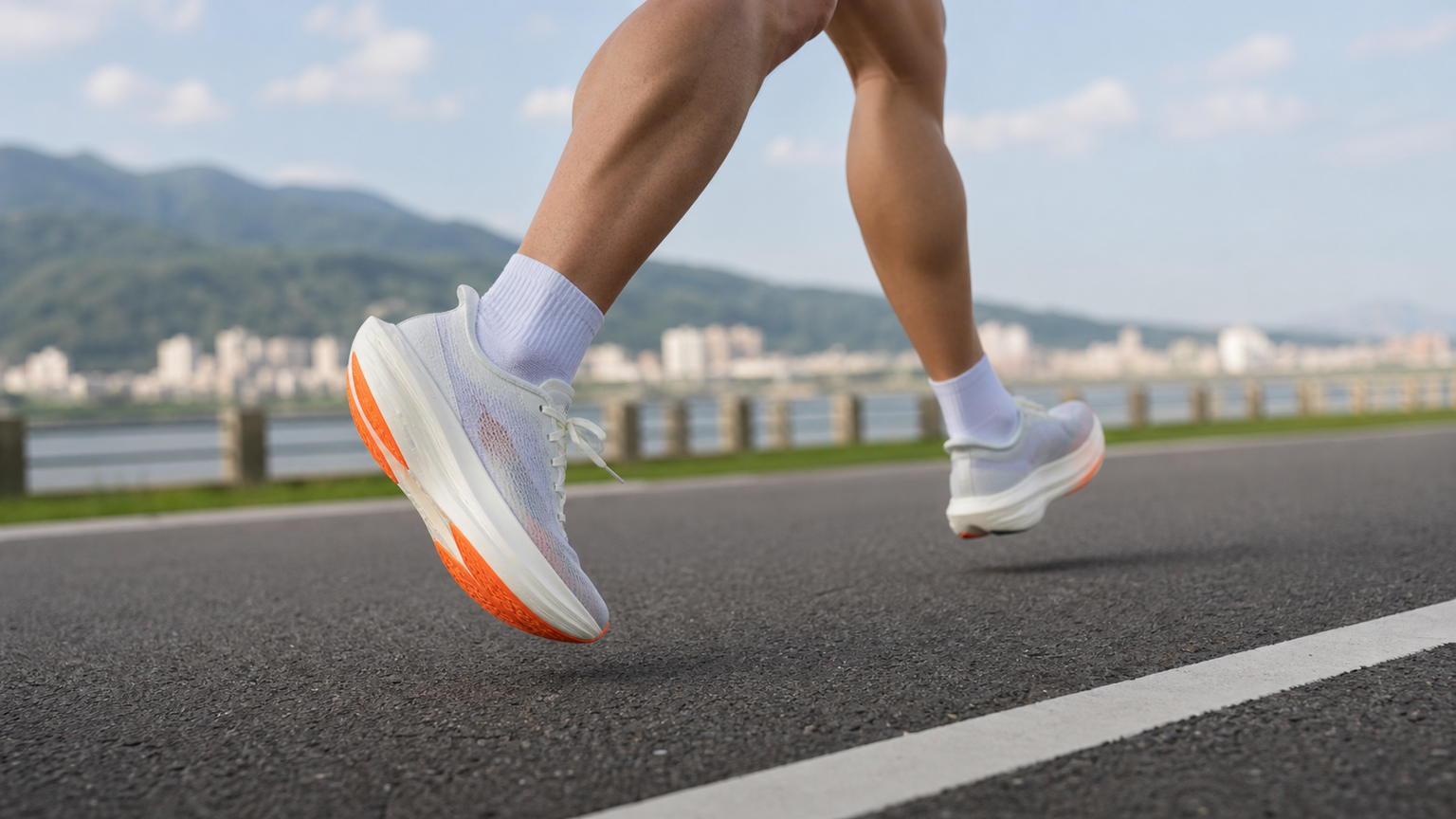
Introduction
When the Nike Vaporfly 4% debuted in 2017, it immediately sparked a technological revolution in the marathon world. Since then, major brands have successively launched racing shoes equipped with carbon plates, including the Adidas Adizero Adios Pro, ASICS Metaspeed Sky, HOKA Carbon X, and others. The term “carbon plate running shoes” has become the hottest topic of discussion among runners, but can these shoes, which typically cost anywhere from NT$5,000 to over NT$10,000, really make every runner faster?
The Biomechanical Principles of Carbon Plates
The core technology of carbon plate running shoes lies in the synergistic effect of three elements:
- Full-length carbon fiber plate: Sandwiched within an ultra-thick foam midsole, the carbon plate converts ground reaction forces into propulsion, reducing energy loss at the ankle joint.
- PEBA supercritical foamed foam: Compared to traditional EVA, energy return improves by approximately 20–30%, “giving back” more energy to the runner with every step.
- Rocker-style outsole design: Combined with the forward-leaning geometry of the thick sole, it allows the body’s center of gravity to roll forward naturally, reducing the heel-braking effect.
How Much Actual Performance Improvement Is There?
Based on a comprehensive analysis of multiple peer-reviewed studies:
| Study Source | Subjects | Average Running Economy Improvement | Equivalent Performance Gain |
|---|---|---|---|
| Journal of Sports Sciences (2019) | Elite male and female runners | Approximately 4% | Saves about 1–2 minutes in a 10K |
| European Journal of Sport Science (2020) | Recreational runners | Approximately 2–3% | Saves about 5–8 minutes in a marathon |
| Sports Medicine (2021) | Runners of mixed levels | 1–5% (high individual variation) | Varies by individual |
Key finding: The magnitude of performance improvement is proportional to the runner’s own speed. Elite runners (marathon time under 3 hours) benefit the most significantly; slower beginner runners (finish time over 5 hours) may actually see some of the advantage offset by the shoe weight (some carbon plate shoes exceed 250g).
Potential Risks of Carbon Plate Running Shoes
Carbon plate running shoes are not without drawbacks. Here are the points runners need to watch out for:
- Increased risk of ankle injuries: Some studies indicate that carbon plates alter a runner’s gait pattern, increasing the load on the Achilles tendon, which is especially noticeable for runners not yet adapted to thick soles.
- Poor training durability: Most carbon plate racing shoes are designed with a lifespan of only 300–500 km, making them unsuitable as daily training shoes.
- Adaptation period required: It is recommended to do 2–3 short adaptation runs before wearing new carbon plate shoes, allowing the body to get used to the entirely new gait mechanics.
- Cost considerations: Mainstream carbon plate racing shoes retail in Taiwan for approximately NT$6,000–12,000, and they wear out relatively quickly.
Practical Recommendations
Which runners are best suited for carbon plate running shoes?
- Runners targeting a finish time within 4 hours, with a consistent monthly mileage (at least 100 km/month)
- For use on race day when aiming for a PB (personal best), rather than for daily training
- Runners with normal or high arches, who feel the propulsive effect of the carbon plate more distinctly
Buying recommendations for runners in Taiwan:
- Budget under NT$6,000: Consider high-energy-return non-carbon plate shoes such as the Nike Pegasus 41 or ASICS Gel-Nimbus
- Budget of NT$6,000–9,000: Semi-racing models such as the HOKA Mach 6 or Adidas Supernova Rise
- Budget above NT$9,000: Nike Alphafly 3, Adidas Adizero Adios Pro 4, ASICS Metaspeed Edge Paris
Conclusion
Carbon plate running shoes can indeed deliver measurable performance improvements, but the “magnitude” varies from person to person. Given Taiwan’s hot and humid summer climate, runners wearing carbon plate shoes should pay special attention to ventilation and hydration. It is recommended that runners first establish a solid training foundation, then treat carbon plate shoes as a “secret weapon for race day” rather than a shortcut to compensate for insufficient training. Technology can assist performance, but it cannot replace a solid accumulation of mileage.
Related Reading
- Are Carbon Plate Running Shoes Worth Buying? An In-Depth Benefit Analysis for Everyday Runners
- Running Shoe Sole Thickness and Running Economy: The Science Behind Carbon Plate Shoes
- Carbon Plate Running Shoes: Who Should Wear Them? When to Wear Them? Understanding the Real Benefits of Carbon Plates at a Glance
- The Biomechanics of Carbon Plate Shoes: A Scientific Explanation of How Resilient Feedback Affects Running Efficiency
Unaas X50 全碳纖幅條輪 數據實測對比PK | Lun Hyper 的高階版 | 板輪爬坡也可以很厲害? ! 武嶺2小時大師一起親測! CP值超高 | 公路車 | CT Yeh
4 年前
Nepest NOVA 碳條輪組:輕量、空力、舒適一次滿足!/ 公路車 / CT Yeh
7 個月前
再快都跟的上!? 單車跟隨攝影機之王 HOVERAir X1 PROMAX 全面實測 / 唯一!8K畫質&自行車專用模式和跟蹤信標&前後避障 / DJI Neo 可參考/ 公路車 / CT Yeh
1 年前
#公路車 #Fitting 靠人工智慧APP 幫你調整單車
6 年前
單車 重低音 藍芽喇叭 音質實測 SoundBot SB525 Real Sound Test
8 年前
全台首發!邁金P715踏板功率計!市場價格撼動者再出招 / 功率對比實測 / FAVERO ASSIOMA 可參考! / 公路車 / CT Yeh
1 年前
Garmin Edge 540/840 Solar 台灣首發開箱!完整車錶功能 道路實測 / ClimbPro 爬坡提示超級牛 / 強大續航實測 / 公路車 / CT Yeh
3 年前
大家都在開箱的...單車用藍芽對講耳機真的有幫助嗎? SENA BiKom 20 長距離旅遊 & 海鷗繞圈賽 實際體驗心得 / 公路車 / CT Yeh
9 個月前