Introduction
“Why does my knee start hurting after just 5 kilometers?” “Why are my calves tight and sore the day after a run?” The answer to these questions often lies in a mismatch between a runner’s foot arch and their shoe choice. One common mistake among Taiwanese runners is picking shoes purely based on brand reputation or looks, while completely ignoring their own arch height and gait pattern.
Understanding Your Foot Type
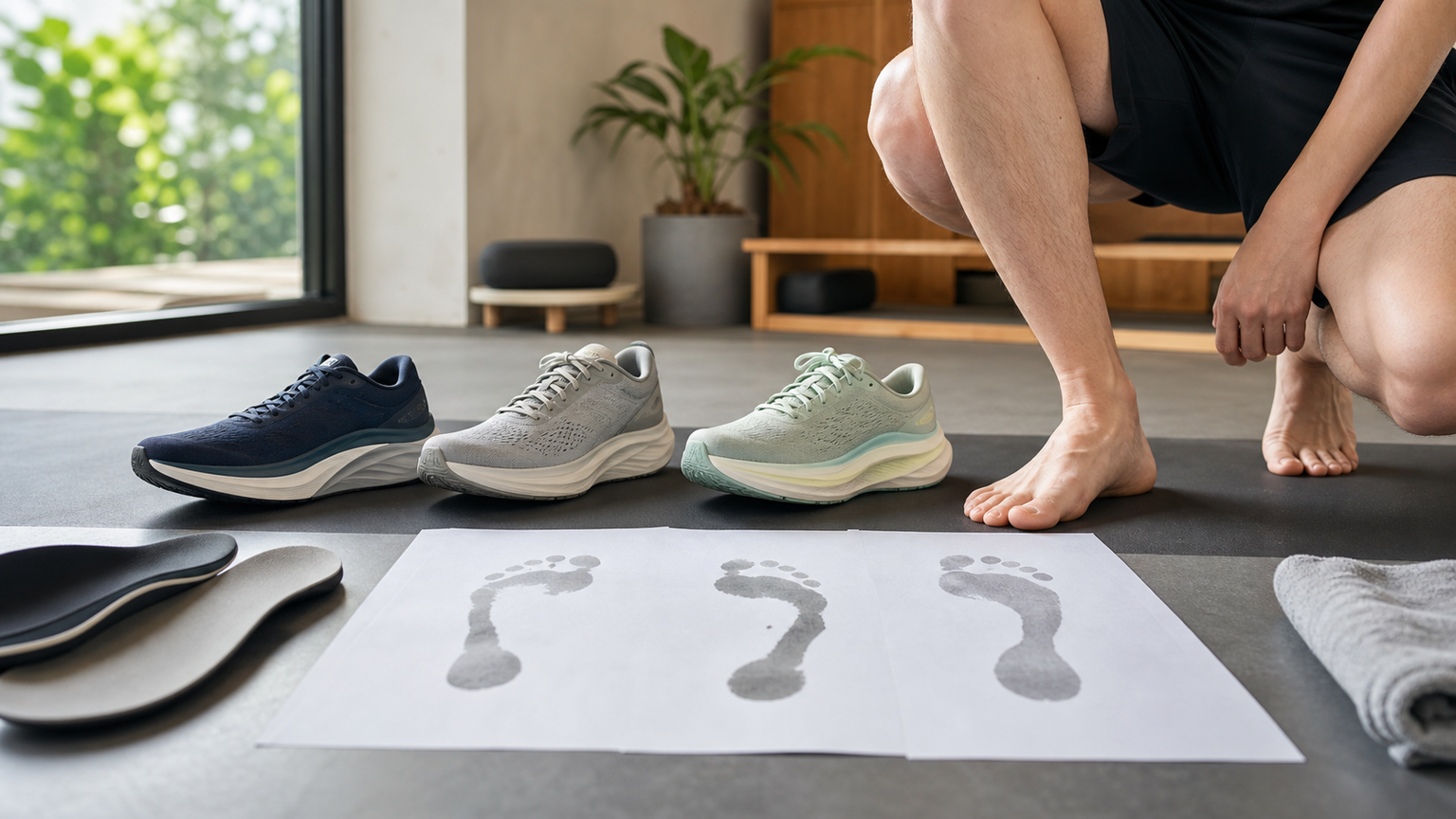
You can get a rough read on your arch height with the “wet footprint test”: wet both feet, step onto cardboard or a flat surface, and observe the shape of the footprint.
| Foot Type | Footprint Characteristics | Key Biomechanical Traits |
|---|---|---|
| Flat Feet (Low Arch) | Nearly a full footprint, arch barely visible | Overpronation — the ankle collapses inward |
| Normal Arch | A clear curved gap in the middle of the footprint | Mild pronation, close to a neutral gait |
| High Arch | A very narrow or even broken gap in the middle | Supination — impact force concentrated on the outer edge of the foot |
Shoe Strategy for Flat-Footed Runners
Because flat-footed runners lack sufficient arch support, the ankle tends to tilt excessively inward on landing. Over time this can lead to: medial knee pain (“runner’s knee”), tibial stress fractures, and plantar fasciitis.
Recommended shoe type: Support (Motion Control / Stability)
- Key features: reinforced medial heel support, dual-density midsole (firmer on the medial side), straighter shoe last
- Popular picks in Taiwan:
- ASICS GT-2000 / Kayano series
- Brooks Adrenaline GTS
- New Balance 860 series
- Saucony Guide series
Things to watch for:
- Avoid overly soft “cushioned” shoes, which can actually worsen overpronation
- Pair with arch supports (such as Superfeet Green or custom orthotics) for further improvement
Shoe Strategy for Normal-Arch Runners
Runners with a normal arch have a gait close to neutral, giving them the widest range of shoe options — the main considerations become personal preference and use case.
Recommended shoe type: Neutral Cushioning
- Key features: even cushioning, lightweight construction, streamlined last
- Example picks:
- Nike Pegasus series (all-around daily trainer)
- Saucony Ride / Triumph series
- HOKA Clifton series
- Brooks Ghost series
Shoe Strategy for High-Arch Runners
High-arch runners have a stiffer arch with naturally weaker shock absorption. Impact force on landing concentrates at the heel and forefoot, which can easily lead to: IT band syndrome, metatarsal stress fractures, and heel pain.
Recommended shoe type: Neutral with Maximum Cushioning
- Key features: thicker, softer midsole, curved last, minimal control structures (so as not to fight the foot’s natural supination motion)
- Recommended picks:
- HOKA Bondi series (maximum cushioning, thick sole)
- Brooks Glycerin series
- New Balance Fresh Foam 1080 series
Other Shoe-Buying Factors
Beyond foot type, the following factors matter just as much:
- Foot width: Taiwanese runners tend to have slightly wider feet than Western averages — when trying shoes on, make sure the forefoot isn’t cramped (look for 2E or 4E wide-fit versions)
- Running terrain: choose a well-cushioned road shoe for asphalt; switch to trail shoes for mountain paths
- Toe room: toes push forward inside the shoe while running, so leave about a finger’s width (1–1.5 cm) of space at the front
- Best time to try shoes on: in the evening, when your feet are slightly swollen and closer to their state during a long run
Practical Tips
- Consider visiting a specialty running store for a “gait analysis” — many offer free treadmill assessments
- If you have plantar fasciitis or a history of recurring injuries, consult a podiatrist or physical therapist; custom orthotics may be more effective than switching shoes
- Whenever you switch to a new pair of running shoes, gradually increase your mileage in them so your body can adapt to the different cushioning characteristics
Conclusion
The best running shoe isn’t the most expensive one — it’s the one that fits you best. Understanding your own foot type is one of the most worthwhile investments you can make on your running journey. The right shoe makes running more efficient and significantly lowers your injury risk, turning every run into something to enjoy rather than endure.
Related Reading
- Running Insoles and Arch Support: How to Choose the Right Insole for You
- Running Shoe Buying Guide: Arch Type, Cushioning Needs, and Mileage Lifespan
- Flat Feet vs. High Arches: Different Effects on Running and Cycling, and General Principles for Insole Adjustment
- The Science of Buying Running Shoes: Foot Type Analysis, Cushioning Needs, and Who Carbon-Plated Shoes Are For
單車 一日北高 ( 雙城 ) 肥宅雙人瘋狂行 紀錄片 REACTO
10 年前
#公路車 #Fitting 靠人工智慧APP 幫你調整單車
6 年前
一日北高/長距離團騎 常見問題補充篇 / 組團或跟團的眉角 / 壯車友容易被瘦車友慢性拉爆 / 原來屁股痛可能是這個原因...? / 風場配速法 / 公路車 / CT Yeh
2 年前
一日北高常見問題大集合 | 攻略 | 路線 | 訓練 | 補給 | 自行車 單車 | 一日雙城 | 雙塔 | TWB北高360 | 屁股痛
6 年前
再快都跟的上!? 單車跟隨攝影機之王 HOVERAir X1 PROMAX 全面實測 / 唯一!8K畫質&自行車專用模式和跟蹤信標&前後避障 / DJI Neo 可參考/ 公路車 / CT Yeh
1 年前
下次拍照前要查清楚啦🤣 #cycling
7 個月前
2025 自行車錶排行榜 兩萬車友大數據 / Garmin Bryton 排名會大洗牌嗎? / 全新的碼表前身分析 /公路車 / CT Yeh
1 年前
多到選擇障礙... 換個單車把帶想一個小時 / BTP / 編織&軟木特有材質超吸睛! / 公路車 / CT Yeh
1 年前