Road Running Functional Apparel Buying Guide: Washing Tips and Lifespan Management for Moisture-Wicking Fabrics
Introduction
Running weather in Taiwan is mostly hot and humid. A good moisture-wicking running shirt is not just about comfort—it’s an important safeguard against heatstroke and skin chafing. However, many runners invest thousands of dollars in high-performance running apparel, only to see it lose its sweat-wicking function within a few months due to improper washing and care. Understanding how functional fabrics work and how to maintain them is the only way to get the most value out of every dollar spent on running gear.
How Moisture-Wicking Fabrics Work
Moisture-wicking fabrics operate through two main mechanisms:
- Capillary action (physical sweat wicking): Using micro-channels between fibers to pull sweat from the skin’s surface to the outer layer of the garment for evaporation. Polyester is the most common material.
- Chemical treatment (DWR water-repellent coating): A waterproofing chemical is applied to the fiber surface, causing sweat to bead up and drain away quickly.
Common Fabric Comparison:
| Fabric Type | Moisture-Wicking & Quick-Dry | Odor Resistance | Weight | Cost |
|---|---|---|---|---|
| Polyester | Excellent | Average | Light | Low |
| Merino Wool | Good | Excellent | Medium | High |
| Bamboo Charcoal Fiber | Good | Good | Medium | Medium |
| Pure Cotton | Poor (absorbs but doesn’t wick) | Good | Heavy | Low |
| Lycra/Spandex Blend | Good | Average | Light | Medium |
Main Causes of Reduced Functional Garment Lifespan
Here are common “functional garment killers”:
- Washing in hot water (above 40°C): High temperatures damage the DWR water-repellent coating, rapidly degrading performance.
- Using fabric softener: Softener molecules coat the fiber surface, clogging capillary channels and significantly reducing sweat-wicking ability.
- Using chlorine bleach: Polyester fibers break down when exposed to chlorine bleach, severely shortening garment lifespan.
- High-heat dryer drying: Hot air causes fibers to shrink and deform, reducing both elasticity and performance.
- Washing with cotton garments: Lint from cotton attaches to functional fabrics, clogging sweat-wicking channels.
Correct Washing and Care Steps
Recommended post-run routine:
- Take the garment off promptly after running: Avoid prolonged sweat contact with fibers, which causes lingering odors.
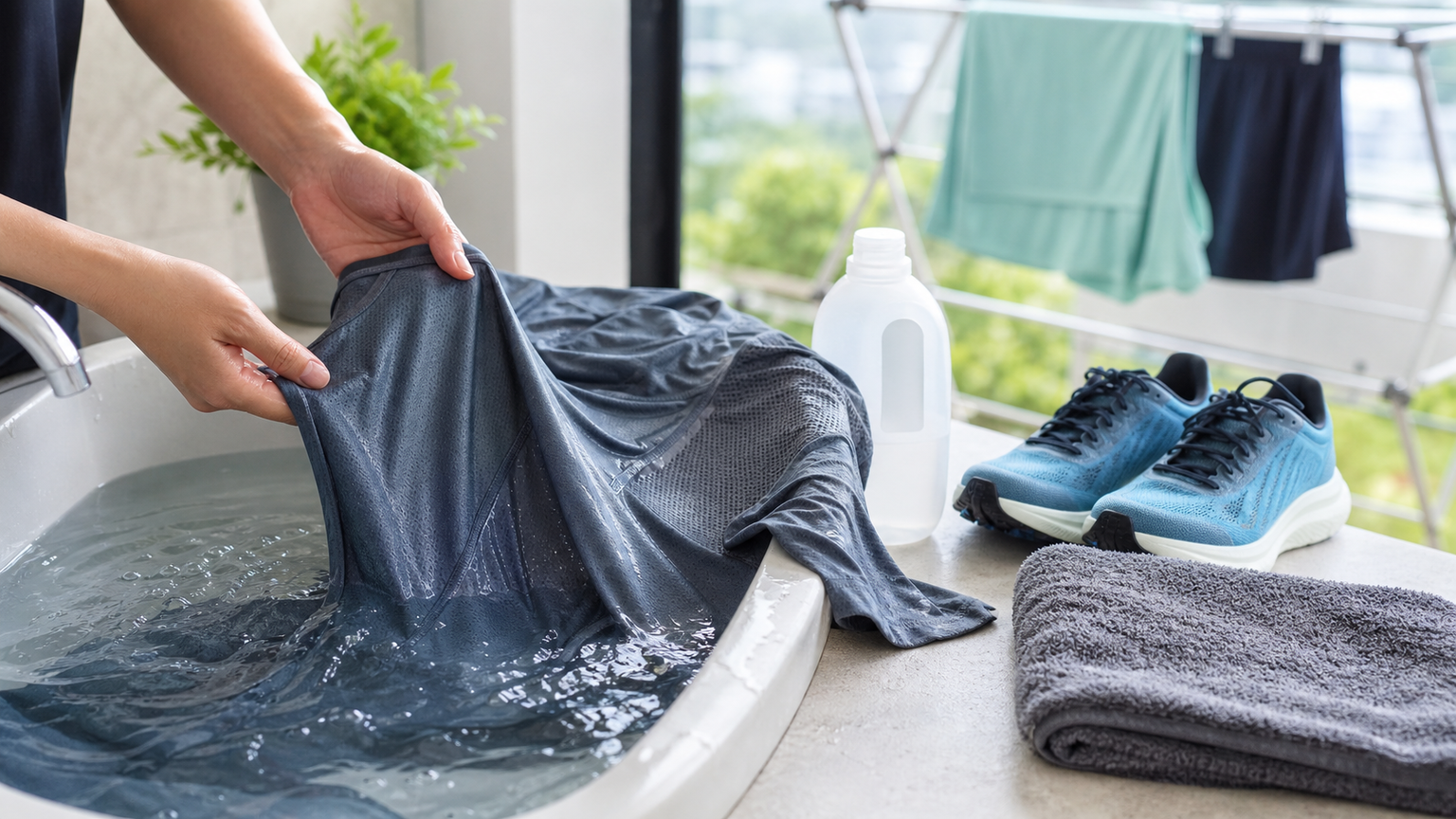
- Hand wash or machine wash (delicate cycle) in cold or lukewarm water (30–40°C).
- Use a neutral sports-apparel-specific detergent (e.g., Nikwax Tech Wash).
- Absolutely avoid: Fabric softener, dryer, bleach.
- Air dry naturally, avoiding direct sunlight (prolonged UV exposure accelerates fiber aging).
How to Restore DWR Water-Repellent Function:
When the garment no longer forms water beads on the surface after washing, but the fibers themselves are still intact, use a low-temperature iron (steam mode) or tumble dry on low heat for 10 minutes. The heat energy can reactivate the water-repellent molecules in the DWR coating.
Odor-Resistance Maintenance
Under Taiwan’s climate, lingering odors in athletic wear are a common annoyance. Solutions:
- Merino Wool: Naturally antibacterial, less prone to developing odors, ideal for travel and business-trip running.
- Vinegar soak: Soak in white vinegar and water (1:4 ratio) for 30 minutes to neutralize ammonia compounds produced by bacteria breaking down sweat.
- Sunlight sterilization: Moderate sun exposure (not prolonged) provides natural antibacterial effects.
- Avoid sealed storage: Functional garments must be completely dry before storing. Damp storage is the main cause of odor growth.
Expected Garment Lifespan and Replacement Timing
- Standard polyester running shirts: 2–3 years with proper care (approximately 200–300 washes).
- High-performance racing singlets: More sensitive to performance degradation; sweat-wicking typically declines after 1–2 years.
- Replacement signals: Odor persists after washing, sweat lingers on the body while wearing, fabric feels stiff and loses elasticity.
Practical Tips
- Establish a “running shirt rotation system”: Own 3–4 running shirts and rotate them to extend each garment’s lifespan.
- Prioritize breathability in Taiwan’s summer: Choose running shirts with honeycomb mesh structures or large cutout designs.
- Reflective strips or high-visibility designs: Taiwan has many night runners; safety features deserve priority consideration.
- Budget NT$600–1,200: Nike Dri-FIT and Adidas Aeroready daily training models already offer solid performance.
- Budget NT$1,500 and above: Brands like Craft, Salomon, and On Running offer superior sweat-wicking and odor-resistant designs.
Conclusion
The value of functional apparel lies in “maintaining performance over the long term,” not just the feel at the moment of purchase. As long as Taiwanese runners establish proper washing habits—low-temperature washing, no fabric softener, and air-drying before storage—every functional running shirt can become a reliable companion for years. The money saved from washing mistakes is enough to buy another great running shirt.
Related Reading
- Running Apparel Buying Guide: Functional Choices in Moisture-Wicking, UPF Rating, and Reflective Strips
- Running Shirt Buying Guide: Sweat-Wicking Fabrics, Cut Design, and the Best Choices for Taiwan Summers
- Running Singlets and Sweat-Wicking Shirts: How to Choose the Most Comfortable Top Layer for Running
- In-Depth Running Sock Selection Guide: A Comprehensive Comparison of Materials, Thickness, and Waterproofing
洗單車神器 吹水機! 實際洗車用用看 暴力洗鍊條大法 | 公路車 | CT Yeh
4 年前
3D 列印車褲墊 / 舒適改善? / 無痕 x 分區壓縮 / ATK & Decider系列 / JE22黑科技 / #公路車 #CTYEH
11 個月前
#公路車 #Fitting 靠人工智慧APP 幫你調整單車
6 年前
自助洗車場 洗單車 50元有找 清鍊條大法 居然還有小小兵
7 年前
CT暗黑廚房) 車友必備 宇宙無敵鮮蚵湯 幫助訓練恢復 天然食補 好市多 超肥鮮蚵 破PR
7 年前
多機位拍片神器 DJI Action 2 拍出速度張力感 | 類空拍機視角 4陣列麥克風超強降風噪 實測! | 公路車 | CT Yeh
3 年前
鉅齒紋輪組!? ControlTech MEG-T50 EVO 碳纖維幅條輪組/ 功率對比實驗 / 公路車 / CT Yeh
2 年前
Lun HYPER 第三代 D45碳幅條輪組 功率對比實測 / 鈦合金行星齒輪,中高階的製造水準 / 公路車 / CT Yeh
1 年前