Trail Running Headlamp Buying Guide: A Complete Comparison of Lumens and Battery Life for Night and Morning Runs
Introduction
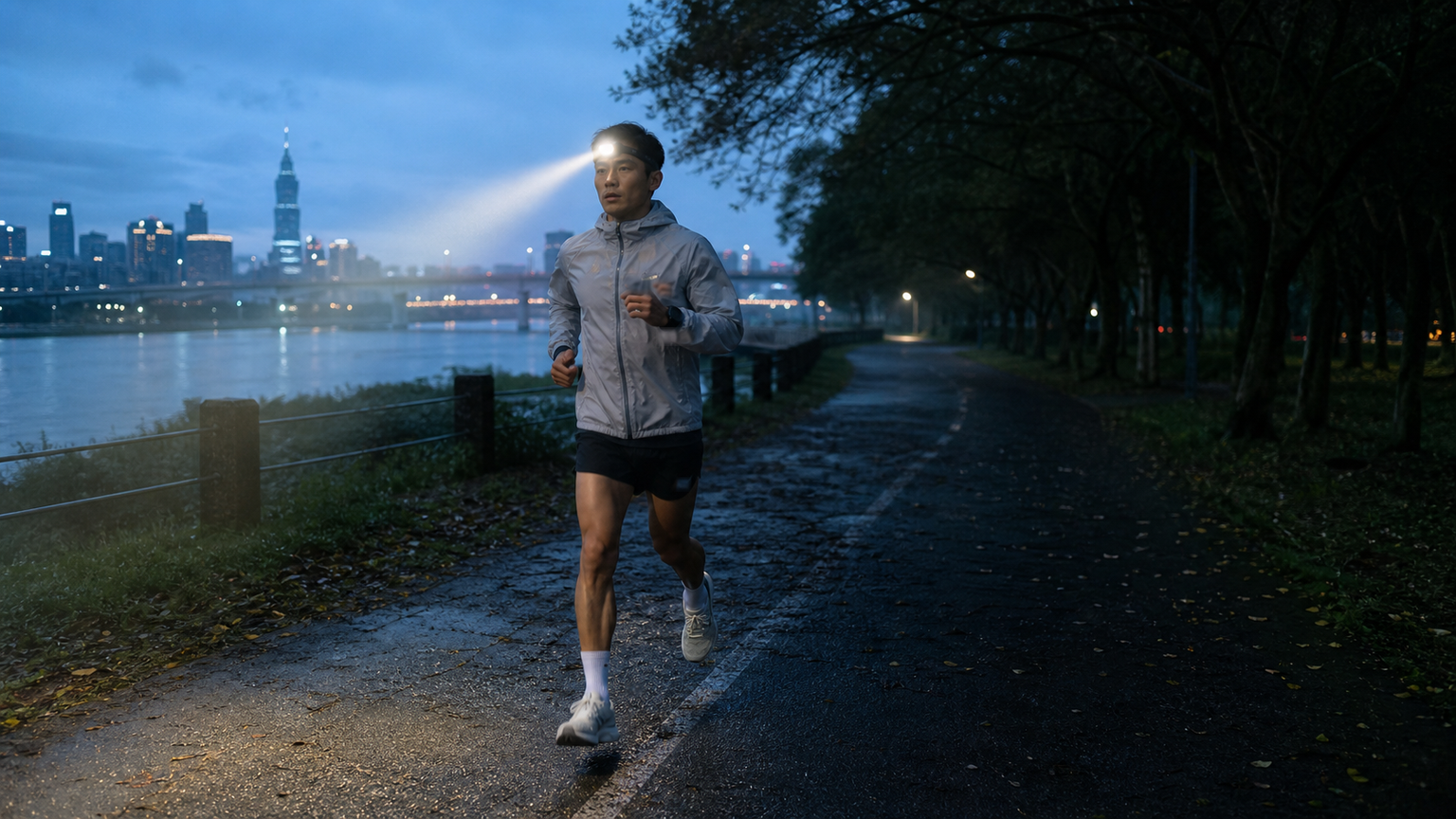
Taiwanese runners love running in the early morning and evening hours—partly to avoid the scorching daytime heat, and partly to enjoy the city’s tranquil atmosphere. However, the lighting conditions before sunrise and after sunset in Taiwan, combined with some runners choosing trail runs at night, make headlamps an indispensable piece of safety gear.
Headlamp specifications vary widely, from budget models under NT$100 to high-end trail versions costing over NT$3,000. Where exactly do the differences lie? Is a higher lumen (lm) rating always better? Are battery-powered or rechargeable models more convenient? This article will answer these questions one by one for Taiwanese runners.
Decoding the Core Specifications
Lumens
Lumens represent the total luminous flux of a light source. A higher number generally means brighter, but the actual experience is also affected by the beam angle:
- Spot beam: Concentrated beam with long throw distance, ideal for mountain trail running and spotting obstacles in the distance at night
- Flood beam: Wide beam with excellent close-range visibility, ideal for urban night runs and navigating the area around a treadmill
- Hybrid: Most headlamps offer both modes and can be switched as needed
| Lumen Range | Suitable Scenarios | Notes |
|---|---|---|
| 100–200 lm | Urban street night runs, areas with streetlights | Entry-level, lightweight and portable |
| 200–400 lm | Suburban trails, morning runs without streetlights | The practical choice for most runners |
| 400–800 lm | Taiwan mountain trails, low-visibility rainy nights | Mainstream trail models, drains batteries quickly |
| 800 lm and above | Ultramarathon races, steep mountain night runs | High brightness but heavier weight |
Battery Life and Power Management
Pros and cons of disposable batteries (AAA):
- Pros: Can carry spare batteries in the mountains without relying on charging facilities; performance degrades more slowly than rechargeable batteries in cold conditions (Taiwan’s high mountain winters)
- Cons: Higher long-term cost and greater environmental burden
Pros and cons of rechargeable lithium batteries:
- Pros: Lower long-term cost, no need to carry spare batteries; convenient USB-C charging
- Cons: Must stop running to recharge when the battery runs out; some older models have charging designs incompatible with USB-C
Practical advice: Urban runners should prioritize rechargeable models; mountain trail runners are advised to choose models with dual battery/rechargeable modes or carry spare battery packs.
Comparison of Popular Models for Taiwanese Runners
Petzl Bindi (approx. NT$1,800)
- Max brightness: 200 lm, weighs only 35g
- Rechargeable, USB-C
- Ultra-lightweight, ideal for urban night runs and runners who don’t want to feel the headlamp on their head
- Not suitable for: high-intensity mountain trail running (insufficient brightness and stability)
Black Diamond Sprinter 500 (approx. NT$2,200)
- Max brightness: 500 lm, weighs approx. 107g
- Rechargeable, includes a rear LED warning light (so vehicles behind you can see you)
- Best choice for urban night runs; the rear warning light is a major plus for road safety in Taiwan
Petzl Swift RL (approx. NT$3,000)
- Max brightness: 900 lm, with automatic brightness adjustment (switches automatically based on ambient light)
- Rechargeable, weighs approx. 100g
- Top choice for trail racing; automatic dimming reduces operational burden
Nitecore NU25 (approx. NT$800)
- Max brightness: 360 lm, weighs approx. 36g
- Rechargeable, excellent value for money
- Suitable for trail beginners on a budget
Key Factors for Wearing Comfort
Headlamp bouncing during a run is the most common complaint. Ways to improve it:
- Elastic headband tightness: The headlamp should sit snugly against the forehead, with the headband secured in a cross pattern (some models feature rear headband stabilization designs)
- Center of gravity design: For models with heavier front lamp housings, confirm the rear headband has sufficient tension to balance the weight
- Adjustments when wearing a cap: When running with a baseball cap, the headband is usually worn over the cap, so the tightness needs to be readjusted
Taiwan-Specific Climate Considerations
- Plum rain season and around typhoons: Check the headlamp’s waterproof rating (IPX4 or above resists rain; IPX7 can withstand brief submersion)
- Low temperatures in Taiwan’s high mountains: Rechargeable lithium batteries lose capacity significantly below 0°C; for winter runs above 3,000 meters in elevation, it’s recommended to carry a backup power source
Practical Recommendations
- Urban night/morning runs (streetlit environments): A lightweight 200 lm model is sufficient; pair it with a rear warning light for added safety
- Suburban mountain trails (partially lit): A mid-range 300–500 lm model balances weight and brightness
- Trail night runs/ultramarathon races: 600 lm or above; choose a model with a spare battery option
Conclusion
A headlamp is the safety gatekeeper for runners’ nighttime activities. Night running culture is thriving in Taiwan, and a headlamp suited to your specific use case not only lets you “see the road clearly” but also lets vehicles and pedestrians “see you.” When purchasing, don’t just chase the highest lumen count—consider the overall balance of weight, battery life, and waterproofing.
Related Reading
- Trail Running Headlamp Buying Guide: Lumens, Wide-Angle Beam Distribution, and Practical Testing Advice for Taiwan Night Runs
- Running Light Buying Guide: Lumen Requirements and Battery Life for Night Running Headlamps
- Running Light Buying Guide: Headlamp Lumens, Battery Life, and Night Running Safety in Taiwan
- Night Running Safety Lighting Systems: A Complete Buying Guide from Headlamp Lumens to Reflective Gear
雷達尾燈 雷不雷? 邁金L508 智慧雷達尾燈 情境考驗實測 | 同場加映 2千元等級的專業車錶 C406 Pro | 公路車 | CT Yeh
3 年前
趣味單車配件:多功能智慧尾燈 / 有方向燈 可app編輯圖案!? / GRC x Lumii 聯名款 / 公路車 CT Yeh
9 個月前
2024公路車車錶排行榜!2萬車友調查統計!今年黑馬是.../街頭車友民調/CT Yeh
2 年前
沉浸室內單車練功房開箱! 100吋大畫面,最便宜的花費? 居然還能K歌!? | 公路車 | CT Yeh
3 年前
一日北高前的高裝檢 | 北高 360 | 挑戰11小時的裝備 | 一日雙塔 | 補給
6 年前
大家都在開箱的...單車用藍芽對講耳機真的有幫助嗎? SENA BiKom 20 長距離旅遊 & 海鷗繞圈賽 實際體驗心得 / 公路車 / CT Yeh
9 個月前
2026 車錶排行榜!誰是最多車友正在使用?練家子最愛哪款?🏆 (2萬名車友數據) / 公路車 / CT Yeh
5 個月前
單車 一日北高 ( 雙城 ) 肥宅雙人瘋狂行 紀錄片 REACTO
10 年前