Running Knee Braces and Ankle Supports Buying Guide: When to Use Preventive vs. Therapeutic Supports
Introduction
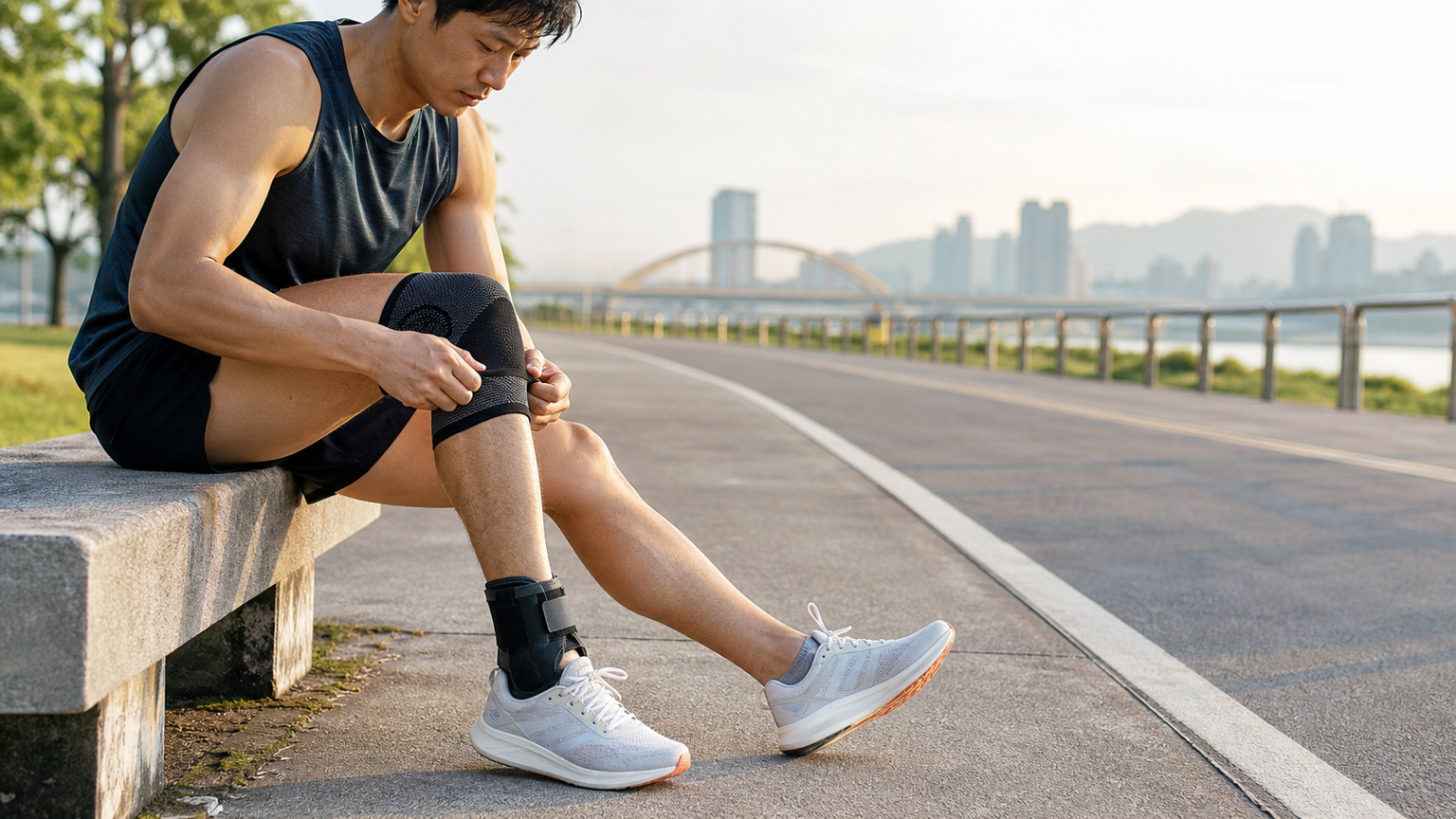
“Running ruins your knees” is a common stereotype among non-runners, but research shows that proper running technique combined with appropriate gear can actually strengthen the muscles around the knee joint. The role of supports is often misunderstood in Taiwan’s running community: some believe supports can “prevent all injuries,” while others feel that “wearing a support is a sign of weakness.” The correct perspective is: supports have their appropriate timing—used correctly, they multiply effectiveness; used incorrectly, they may backfire.
The Fundamental Differences Between Preventive and Therapeutic Supports
| Type | Purpose | Design Principle | When to Use |
|---|---|---|---|
| Preventive Supports | Reduce injury risk, enhance proprioception | Lightweight, elastic materials that provide proprioceptive feedback without restricting joint movement | Healthy runners during high-intensity training or races |
| Therapeutic Supports | Immobilize injured areas, reduce secondary injury | Stiffer support structures that limit joint movement in specific directions | During recovery after injury, must follow physician instructions |
| Compression Supports | Promote blood circulation, reduce swelling | Gradient-pressure elastic fabric | Chronic pain management, later stages of long-distance events |
Common Runner Knee Problems and Corresponding Supports
Iliotibial Band Syndrome (IT Band Syndrome)
- Symptoms: Pain on the outside of the knee, worsening on downhill runs
- Suitable supports: IT Band compression strap (applies pressure at the IT band friction point to shift the friction location)
- Note: Supports are only a palliative tool; the root treatment requires gluteal strengthening exercises
Runner’s Knee (Patellofemoral Pain Syndrome)
- Symptoms: Pain below or around the kneecap, noticeable when descending stairs
- Suitable supports: Patellar tracking strap or knee compression sleeve with an opening designed to stabilize patellar position
- Representative products: McDavid knee braces, Bauerfeind Sports Knee Support
Shin Splints
- Symptoms: Pain along the tibia on the front of the lower leg, noticeable in the early stages of a run
- Suitable supports: Calf compression sleeves (reduce vibration of the tibial fascia), Kinesio Tape
- Note: Tibial stress fractures and general shin pain require differential diagnosis; if symptoms persist or worsen, seek medical imaging
Protection After Ankle Sprains
- Symptoms: Feelings of ankle instability after lateral ankle ligament injury
- Suitable supports: Semi-rigid ankle braces (provide lateral ligament stability while allowing forward and backward movement)
- Representative products: Aircast Air-Stirrup, McDavid Ankle Brace
The Role of Kinesio Tape / KT Tape
Kinesio taping has become a common sight at races across Taiwan in recent years. Runners need to understand its actual functions:
What Kinesio Tape Does:
- Enhances local proprioception (telling the brain “pay attention here”)
- Provides mild muscle support and directional guidance
- Psychological comfort effect (the placebo effect should not be underestimated)
Limitations of Kinesio Tape:
- Cannot replace the ligament support function of rigid braces
- Those with sensitive skin may experience allergic reactions
- Heavy sweating in Taiwan’s summer shortens the tape’s effective duration
Things to Consider When Buying Supports
- Avoid long-term dependence: Healthy runners who rely on supports long-term may actually experience atrophy of surrounding muscles and degradation of proprioception
- Choose the right size: Supports that are too loose provide no support; those that are too tight may impair blood circulation
- Material considerations: In Taiwan’s summer, prioritize breathable mesh or moisture-wicking fabrics to reduce stuffiness
- Follow medical advice first: Runners with a confirmed injury should consult an orthopedist or physical therapist when choosing supports, rather than buying on their own
Common Brands and Prices in Taiwan
- Entry-level compression knee sleeves (McDavid, LP): approximately NT$300–800, suitable for short-term use when discomfort arises
- Mid-range sports supports (Bauerfeind Sports, Zamst): approximately NT$1,500–3,500, consistent quality, officially imported to Taiwan
- High-end supports (Donjoy, Breg): NT$5,000 and above, medical grade, usually prescribed by physicians
Practical Recommendations
- Healthy runners: No need to wear supports during daily training, but preventive knee compression sleeves may be considered in the later stages of a marathon
- Runners with previous injuries: During the early phase of returning to running (within 3 months after injury), use therapeutic supports as recommended by a physical therapist
- Those wanting to prevent injury: Investing in “strengthening training (hips, glutes, core)” is more effective than buying supports
Conclusion
Supports are assistive tools, not solutions. Before considering purchasing supports, runners in Taiwan should first clarify the root cause of their pain—whether it’s excessive training volume, technical issues, or insufficient muscle strength—so they can address the problem at its source, rather than masking warning signs with supports and continuing to run.
摔車後補裝備: 好市多新款單車安全帽& Specialized Romin 北高整路屁股都不痛的坐墊 | 一千元居然有MIPS | CT Yeh | 公路車
4 年前
一日北高/長距離團騎 常見問題補充篇 / 組團或跟團的眉角 / 壯車友容易被瘦車友慢性拉爆 / 原來屁股痛可能是這個原因...? / 風場配速法 / 公路車 / CT Yeh
2 年前
單車 一日北高 ( 雙城 ) 肥宅雙人瘋狂行 紀錄片 REACTO
10 年前
一日北高常見問題大集合 | 攻略 | 路線 | 訓練 | 補給 | 自行車 單車 | 一日雙城 | 雙塔 | TWB北高360 | 屁股痛
6 年前
一日北高前的高裝檢 | 北高 360 | 挑戰11小時的裝備 | 一日雙塔 | 補給
6 年前
大家都在開箱的...單車用藍芽對講耳機真的有幫助嗎? SENA BiKom 20 長距離旅遊 & 海鷗繞圈賽 實際體驗心得 / 公路車 / CT Yeh
9 個月前
碟煞公路車 銑面器 !? 原來銑完差這麼多! 降低蹭碟機率! | TIME 公路車 保養小記錄 | CT Yeh
3 年前
公路車 BB培林大升級! / 備戰海鷗繞圈賽 Canyon Aerod & TIME 一起改 / MIT大廠 CEMA對鎖式陶瓷培林BB & 導輪 / 公路車 / CT Yeh
2 年前